


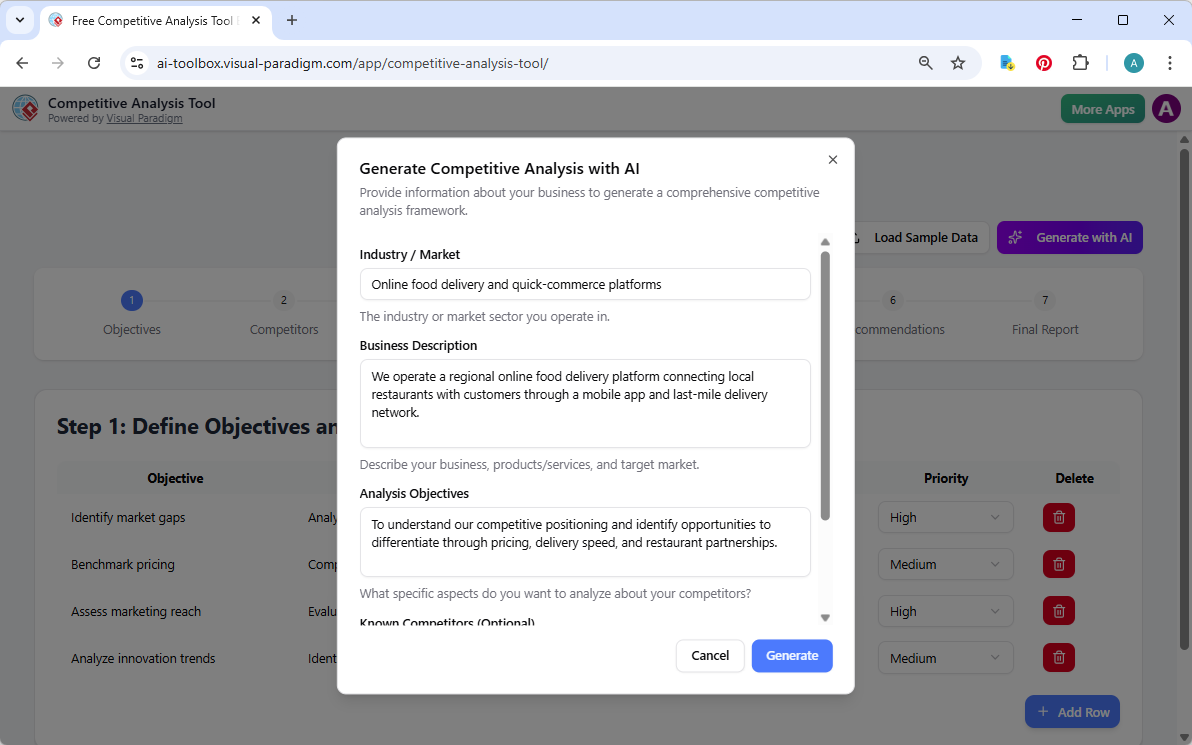
Discover how to rapidly generate a professional competitive analysis report for an online food delivery platform using Visual Paradigm’s AI-Powered Competitive Analysis Tool. This online competitive analysis tool guides you through a structured 6-step process, from defining objectives to generating a final, printable report. The tool leverages AI to create a comprehensive analysis draft based on your business context, significantly accelerating your market research. You can then refine the AI-generated insights with your own data, ensuring your strategic intelligence is both accurate and actionable. This powerful AI-powered analysis software is designed to help business strategists, product managers, and entrepreneurs make informed decisions to gain a competitive edge. The entire process is private, with your data saved locally to a .json file, ensuring your sensitive market insights remain secure. This feature deep dive demonstrates the tool’s capabilities by walking through a complete analysis for a regional food delivery service.
-
Quick Summary
-
Visual Paradigm’s AI-Powered Competitive Analysis Tool enables users to create a professional strategic report in minutes.
-
The tool uses AI to generate a comprehensive analysis based on a user’s business context, including objectives, competitors, and data sources.
-
Users can then refine the AI-generated data with their own research, ensuring accuracy.
-
The tool guides users through a structured 6-step process, culminating in a final report.
-
Analysis data is saved locally to a .json file, ensuring privacy and security.
How the AI-Powered Competitive Analysis Tool Works
The AI-Powered Competitive Analysis Tool from Visual Paradigm is designed to streamline the complex process of market research. It functions as a guided, step-by-step application that helps users define their objectives, identify key rivals, gather data, and synthesize findings into a professional report. The core of its functionality is the integration of artificial intelligence, which can generate a complete analysis framework based on a brief description of the user’s business. This AI-driven approach dramatically reduces the time and effort required to initiate a competitive study. The tool’s structure is based on a proven 6-step methodology, ensuring a thorough and logical analysis. The entire workflow is contained within a web browser, making it accessible and easy to use. The tool is not just a data entry form; it’s a strategic planning assistant that provides a clear roadmap for understanding your market position.
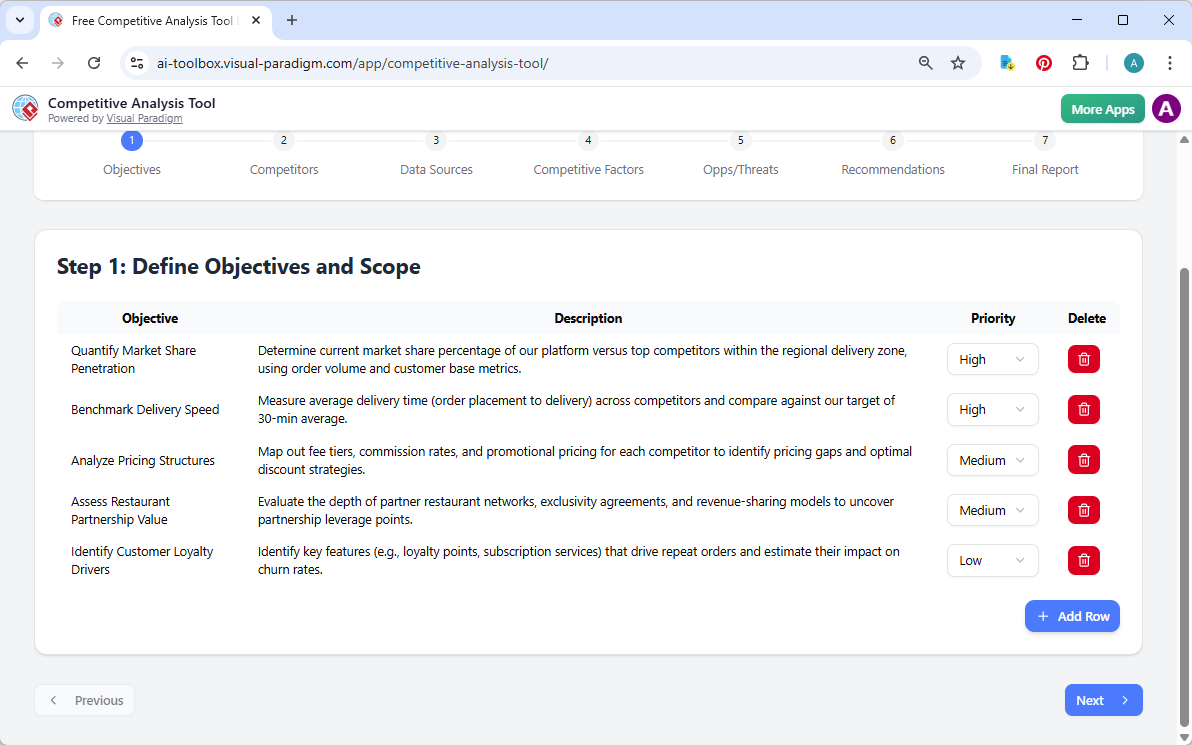
Step 1: Define Objectives and Scope – The process begins by establishing the goals of the analysis. The tool prompts the user to define specific objectives, such as quantifying market share or benchmarking delivery speed. The AI can generate a list of relevant objectives based on the user’s business description. The user can then review, edit, and prioritize these objectives, ensuring the analysis is focused on the most critical areas.
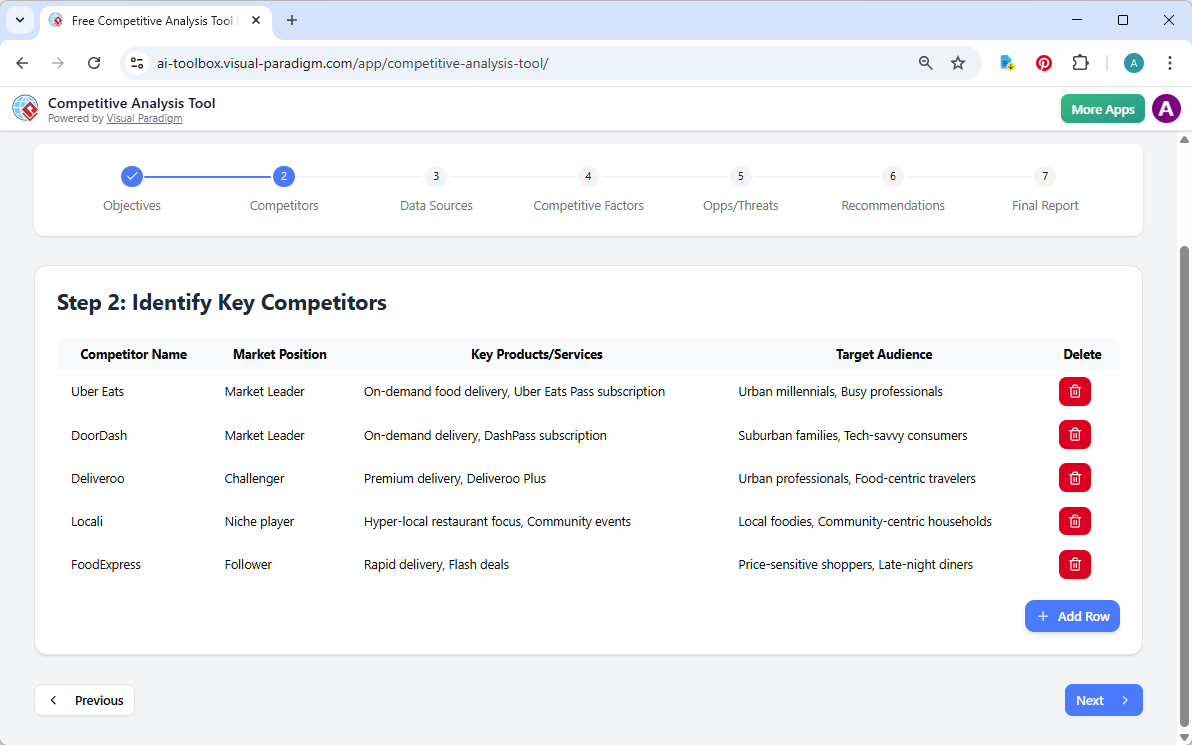
Step 2: Identify Key Competitors – The next step is to identify and list the primary competitors in the market. The tool provides a table where users can input competitor names, their market position (e.g., Market Leader, Challenger), key products, and target audience. The AI can suggest competitors based on the industry and business context provided. This step is crucial for setting the stage for a comparative analysis.
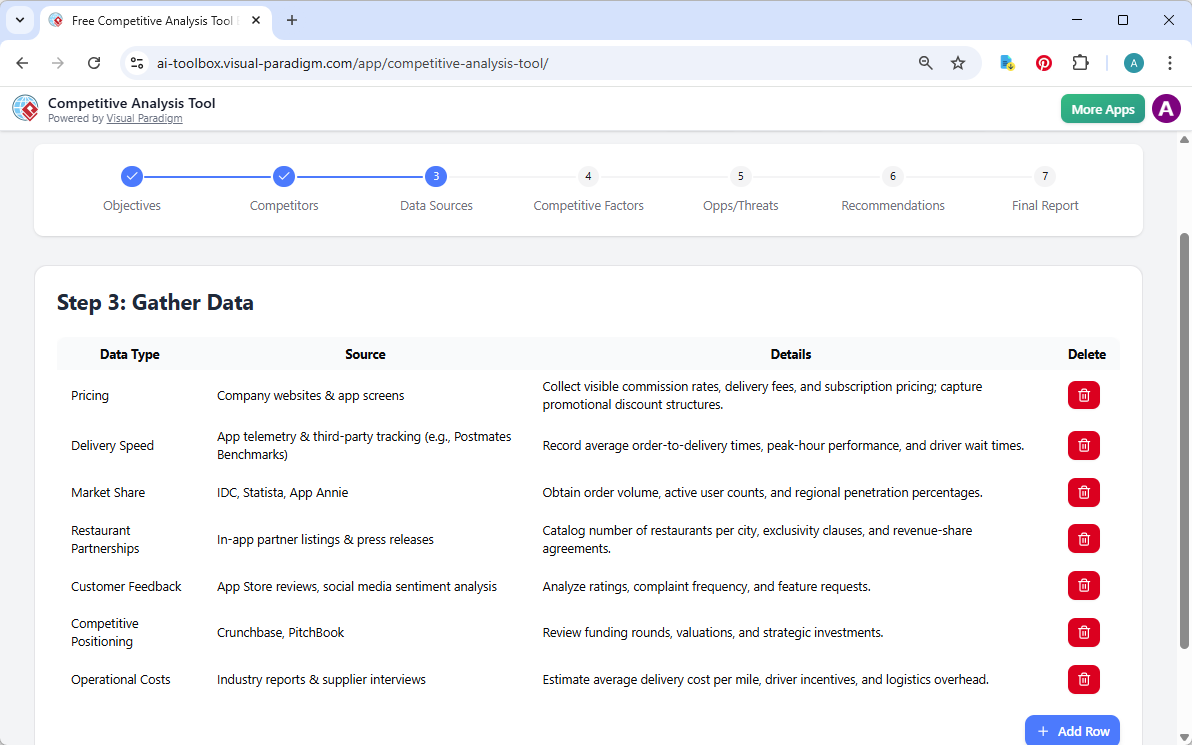
Step 3: Gather Data – With the objectives and competitors defined, the tool helps users identify the data sources needed for the analysis. This step involves specifying the types of data to collect, such as pricing, delivery speed, market share, and restaurant partnerships. The tool suggests reliable data sources for each data type, such as company websites, app telemetry, or industry reports. This ensures the analysis is grounded in verifiable information.
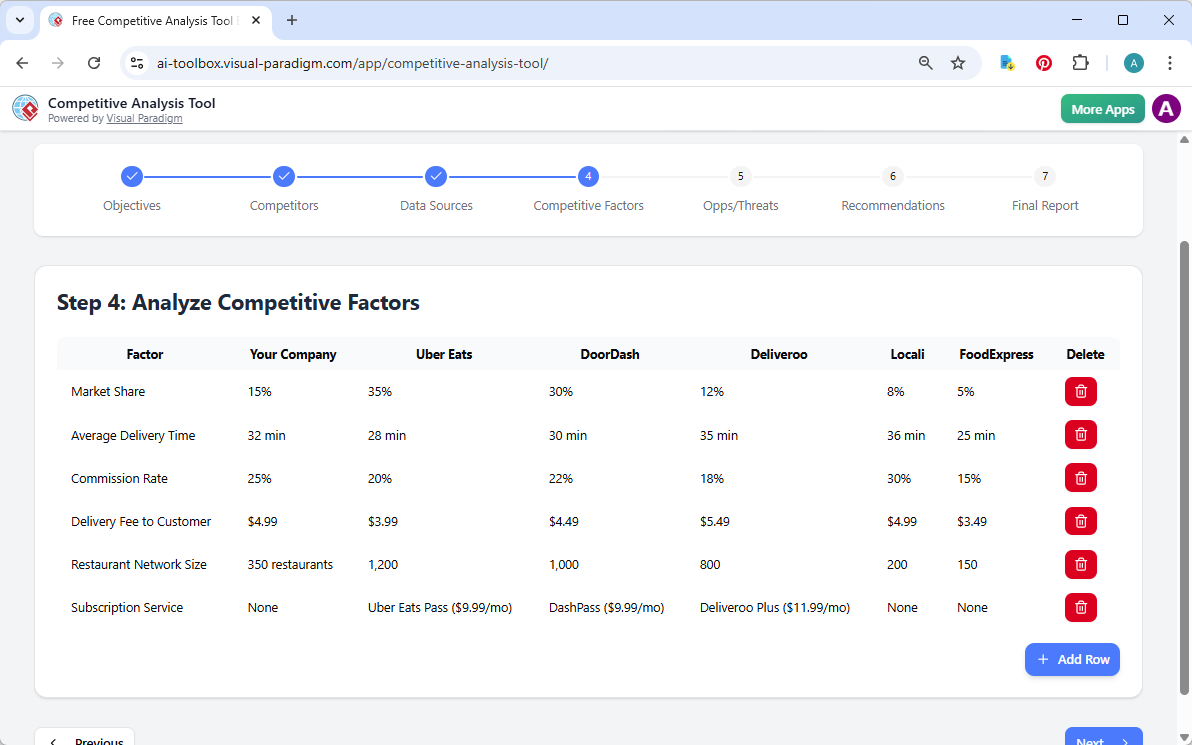
Step 4: Analyze Competitive Factors – This is the core analytical phase. The tool presents a comparative table where users can input data for their own company and each competitor across key factors. The example shown in the image includes metrics like market share, average delivery time, commission rate, and restaurant network size. This side-by-side comparison provides a clear picture of strengths and weaknesses.
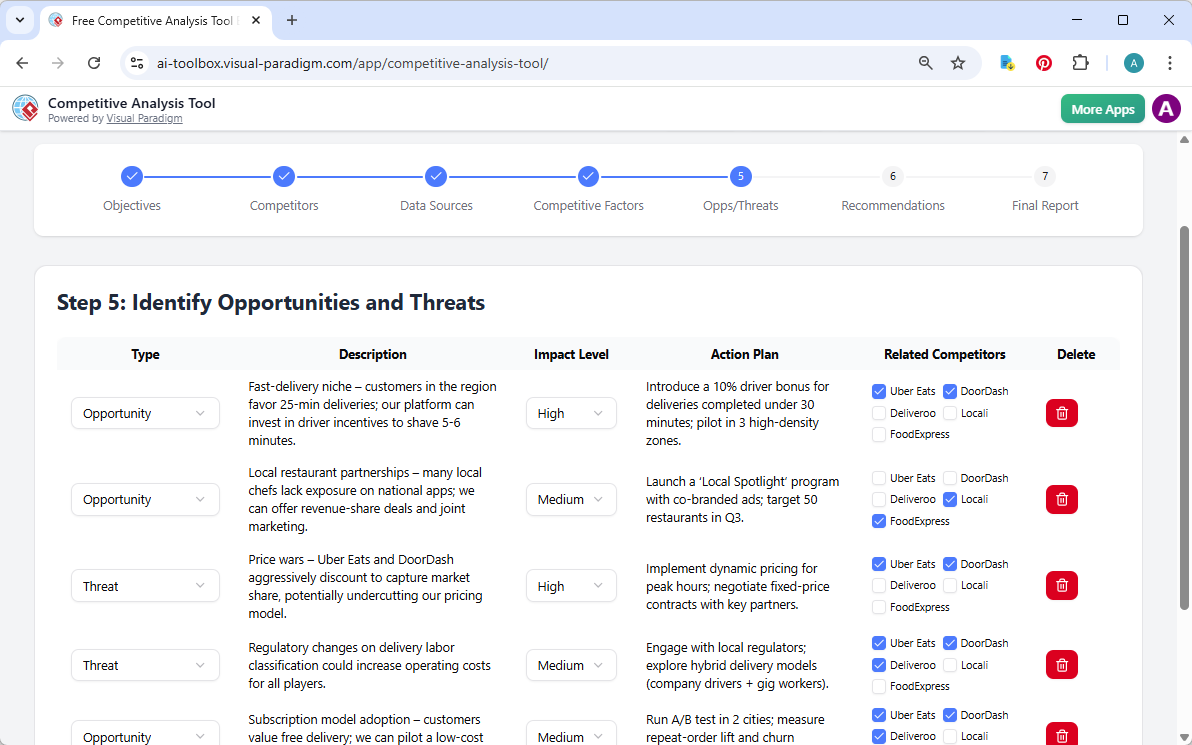
Step 5: Identify Opportunities and Threats – Based on the analysis, the tool helps users identify strategic opportunities and threats. The AI can generate a list of potential opportunities (e.g., fast-delivery niche) and threats (e.g., price wars) based on the competitive landscape. Users can then assign an impact level and develop an action plan for each, creating a strategic roadmap.
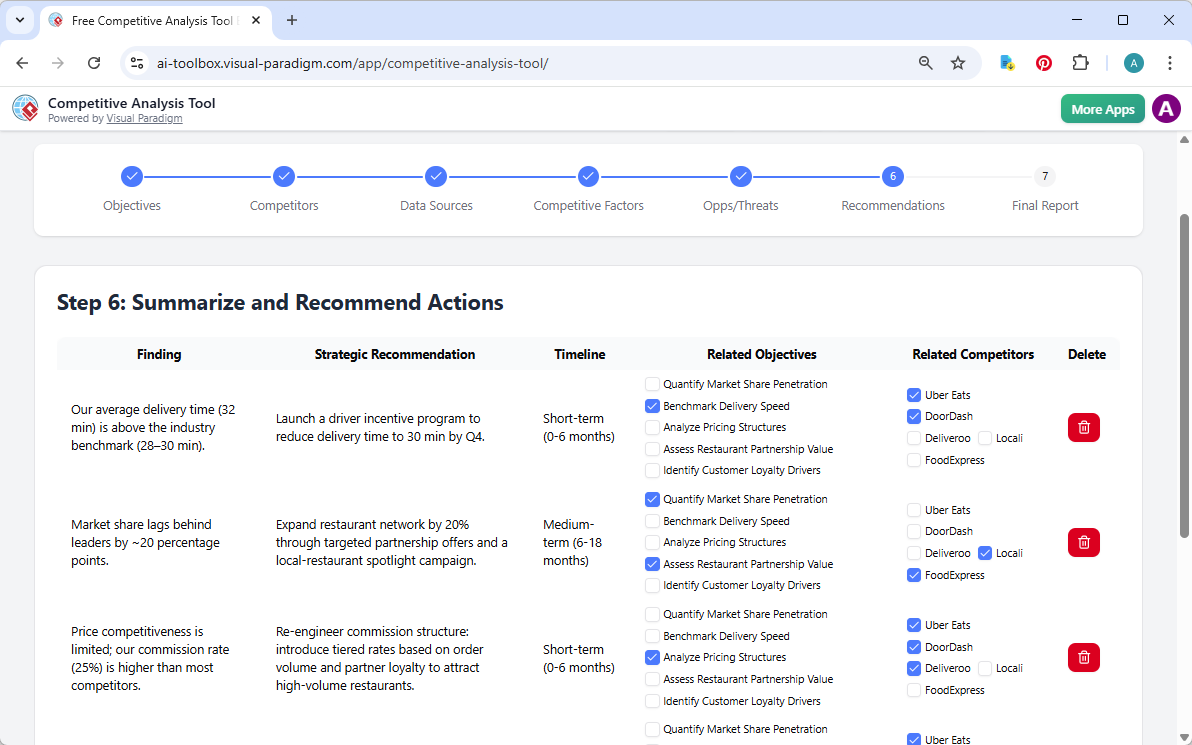
Step 6: Summarize and Recommend Actions – The tool synthesizes the findings into a structured summary. It links each strategic recommendation back to the original objectives and related competitors, ensuring the strategy is well-aligned. This step provides a clear, actionable plan for the user to implement.
Generating a Professional Final Report
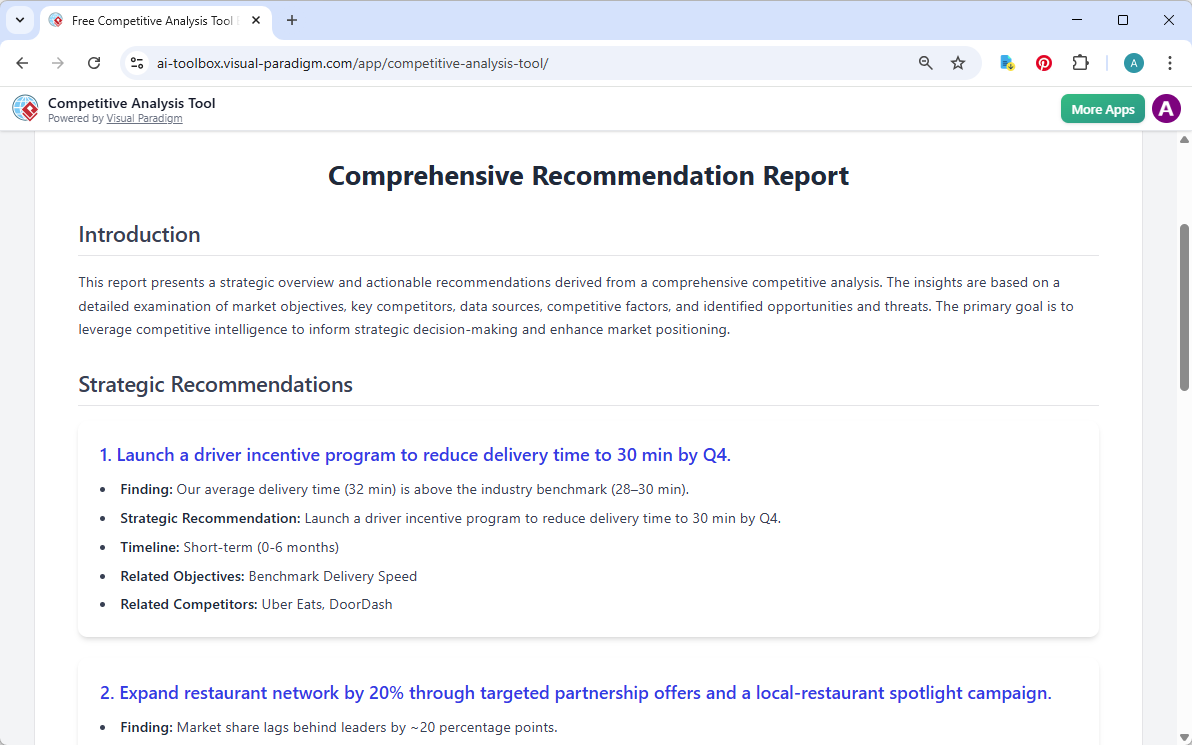
The culmination of the entire analysis process is the creation of a comprehensive, professional report. The tool consolidates all the data, findings, and recommendations from the previous steps into a single, well-organized document. The final report is designed to be easily shared with stakeholders, providing a clear and compelling narrative of the competitive landscape. It includes an introduction that outlines the purpose of the analysis, a detailed section on strategic recommendations, and a summary of key findings. The report is formatted for clarity and professionalism, making it suitable for presentations and strategic discussions. Users can print the report directly from the tool or save it as a PDF, ensuring the strategic insights are easily accessible. This final output is the result of a thorough, data-driven analysis that empowers businesses to make informed decisions.
Key Benefits of Using the Competitive Analysis Tool
The AI-Powered Competitive Analysis Tool offers several significant benefits for businesses seeking to gain a strategic advantage. The most prominent benefit is the ability to accelerate the analysis process. By using AI to generate a complete draft of the analysis, users can save hours of research and data organization. This allows them to focus on refining the insights and developing actionable strategies. The tool’s structured 6-step process ensures a thorough and systematic analysis, preventing critical aspects from being overlooked. This systematic approach is invaluable for business strategists and product managers who need to make data-driven decisions. Furthermore, the tool promotes improved strategic decision-making by providing a clear, data-driven view of the market. Instead of relying on assumptions, users can base their strategies on concrete competitive intelligence. The ability to save and print a professional report ensures that the insights are easily shareable and can be used to guide team discussions and leadership decisions. Finally, the tool’s commitment to data privacy by saving all analysis locally ensures that sensitive competitive information remains secure.
Try the AI-Powered Competitive Analysis Tool Today
Ready to transform your competitive intelligence? The AI-Powered Competitive Analysis Tool from Visual Paradigm is a powerful, easy-to-use solution for businesses of all sizes. It provides a fast, structured, and secure way to conduct a comprehensive competitive analysis. Whether you are an entrepreneur launching a new venture or a product manager refining your strategy, this tool can help you gain a deep understanding of your market and develop differentiated strategies. To get started, visit the official tool page and begin your analysis. Try the Competitive Analysis Tool Now.
Visual Reference:
Related Links
Visual Paradigm provides a comprehensive suite of strategic analysis tools, including Porter’s Five Forces, SWOT, and PESTLE, to facilitate data-driven business decisions. These tools allow teams to examine the external business environment, identify capability gaps, and compare competitor performance across multi-dimensional metrics. Additionally, specialized tools such as perceptual mapping and radar charts help visualize brand positioning relative to rivals to support strategic planning and market analysis.
-
How to Use Radar Charts for Competitive Analysis: A practical tutorial on comparing competitor performance across key metrics to inform strategic decision-making.
-
Radar Chart for Competitor Analysis: A Data Visualization Guide: Explains using radar charts to compare competitors across multiple dimensions for market analysis and positioning.
-
Comprehensive Suite of Strategic Analysis Tools: Details an integrated suite for Porter’s Five Forces, SWOT, and PEST analysis to support data-driven decisions.
-
Strategic Analysis Tool for Business Planning: An online platform designed to improve informed decision-making through various strategic modeling frameworks.
-
Perceptual Map Tool for Brand Positioning: A reliable tool for creating perceptual maps to visualize brand positioning and customer perceptions relative to rivals.
-
Strategic Analysis with PESTLE & Porter’s Five Forces Analysis: An in-depth guide to using these critical techniques to examine the external competitive environment.
-
Multi-Attribute Brand Perceptual Map: A specialized template for visualizing brand positioning across multiple consumer perception attributes.
-
SWOT Analysis Tutorial (Including Five Forces): A step-by-step guide for creating professional SWOT, PEST, and Five Forces diagrams online to support strategic evaluation.
Related posts:
 Architecting SaaS Success: Blueprinting via AI-Powered Model Canvas
 Case Study: Enhancing Customer Experience through Digital Transformation in a Technology Service Company
 Harnessing Visual Paradigm’s AI for Diagram Generation: The Ultimate 2026 Guide
 OpenDocs Review: The AI-Powered Knowledge Platform That Transforms Team Collaboration

 English
 Arabic
 Chinese (Simplified)
 Dutch
Dutch French
 German
 Italian
 Japanese
 Korean
 Portuguese
 Russian
 Spanish