Scrum uses an empirical approach (or sometimes called empiricism) to adapt to changing customer needs. Empiricism is the practice of making decisions based on actual experience. The empirical approach means working in a fact-based, experience-based, and evidence-based manner—especially, progress is based on observations of reality, not on a fictional plan derived from extensive upfront requirements.
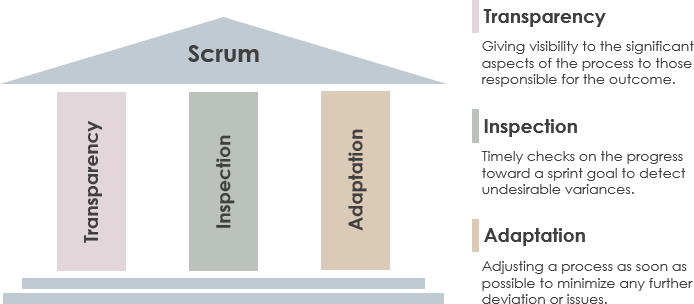
In short, we learn and improve from past mistakes and experiences. The three pillars that support every implementation of an empirical process control in Scrum are: transparency, inspection, and adaptation, as shown in the figure below:
Transparency
Transparency in Scrum can be achieved through Scrum tools such as the Product Backlog, task board, and Burndown Chart, daily stand-ups, retrospectives, Definition of Done, and Sprint Reviews. These help transfer workflow visibility across cross-functional teams. This is one of Scrum’s key advantages—allowing visibility into work and team progress. It means that when a team achieves its goal, those responsible for that goal can be recognized and appreciated.
Inspection
Scrum artifacts and progress toward goals must be inspected regularly to detect undesirable deviations. Inspection in Scrum can be achieved through Scrum events, such as:
- Using a shared Scrum board and other information radiators to make each person’s current project status visible
- Gathering feedback from customers and other stakeholders during epic development
- Creating a prioritized Product Backlog and executing a release planning process
- Product Owner inspecting and approving deliverables
- Demonstrating and validating with customers during the Sprint process
Adaptation
In the Agile world, we embrace and adapt to change so we can continuously improve. Adaptation means changing what isn’t working—or improving what is. It means constantly running small experiments, keeping what works, and changing when something fails. We use inspection results to decide what experiment to run next, for example:
- The development team inspects and adjusts daily during the daily stand-up
- The Sprint Review is another ceremony where the Scrum team requests feedback from all stakeholders and adjusts accordingly
- During the Sprint Retrospective, the Scrum team discusses internal issues and improvement opportunities. As a team, they prepare and adjust a new plan to deliver greater value
Summary
In Scrum, decisions are based on observation and experimentation rather than detailed upfront planning. Empirical process control relies on three core principles: transparency, inspection, and adaptation. This means project outcomes should:
- Be visible to those responsible for the outcome
- Be inspected in a timely manner to detect undesirable deviations in Sprint goals
- Be adjusted as quickly as possible to minimize further deviations or issues
In conclusion, empiricism and the three pillars are not only important for the Scrum process—they are its foundation. This is how your team achieves continuous improvement in the product you build and the process you use. The roles, events, and artifacts are not just followed for their own sake—they enable value-driven incremental improvements by embracing frequent feedback and change.

 English
 Arabic
 Chinese (Simplified)
 Dutch
Dutch French
 German
 Italian
 Japanese
 Korean
 Portuguese
 Russian
 Spanish