This article briefly introduces the Scrum framework. Scrum is an iterative and incremental approach to software development. Scrum has three main roles: the Product Owner, the Scrum Master, and the Scrum Team. Scrum projects typically consist of multiple Sprints, with each Sprint lasting typically between 2 to 4 weeks. Key elements of Scrum include: Scrum Roles, Artifacts, Ceremonies, and some guidelines and rules.
To kick off a Scrum project, the Product Owner creates a prioritized list of desired items called the Product Backlog. Through a Sprint Planning meeting, the Scrum Team decides how many backlog items they can develop during the Sprint. Each day of the Sprint, the team holds a standing meeting called the Daily Scrum Meeting. During the Sprint, the Scrum Master works to remove any impediments that block progress so the Scrum Team can continue working. At the end of the Sprint, the team demonstrates the developed features to the team and other stakeholders—these may be candidates for release. At the end of the Sprint, a Sprint Review is followed by a Sprint Retrospective.
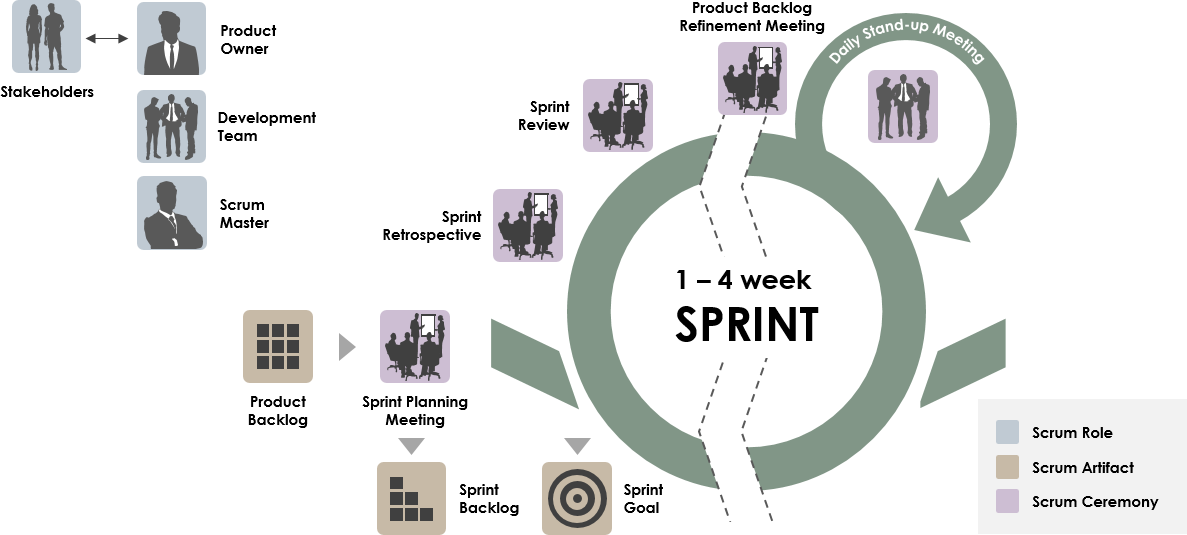
8 Steps of Scrum Sprint Cycle
Scrum Roles:
- Product Owner
- Scrum Master
- Development Team
- Stakeholders
Scrum Artifacts
- Product Backlog
- Sprint Goal
- Sprint Backlog
Scrum Ceremonies
- Product Backlog Refinement
- Sprint Planning
- Daily Scrum
- Sprint Review
- Sprint Retrospective
Scrum Process Explained
- We first need to define the Product Backlog—a prioritized list of product requirements—this is the responsibility of the Product Owner.
- Through the Product Backlog Refinement session, the Scrum Team estimates and organizes the work based on the Product Backlog items.
- Using the Product Backlog, we hold a Sprint Planning meeting to define the Sprint Goal (the Sprint duration typically ranges from 1 to 4 weeks), and then select a list of user stories to form the Sprint Backlog for the upcoming Sprint, which helps achieve the Sprint Goal.
- The Sprint Backlog is completed by the Scrum Team, with each item broken down into smaller tasks (each taking a few days to complete).
- Daily Scrum meetings are required during the Sprint. Each meeting should last about 15 minutes. Everyone must stand and report what they did yesterday, what they will do today, and any blockers or issues they’re facing. The Sprint Burndown Chart is then updated.
- To ensure daily integration, a working and demonstrable version must be successfully compiled and built every day. Many teams do not use automated daily integration. If so, unit tests are run immediately. If all tests pass, the version is released.
- When all user stories are completed (i.e., the Sprint Backlog is complete), the Sprint is finished. At this point, a Sprint Review (also known as a demo) must be held. The Product Owner and customers must participate. Each member of the Scrum Team demonstrates the completed software. This meeting is critical and should not be skipped.
- Finally, the Sprint Retrospective is held after each Sprint. During this meeting, the team reflects on what worked and what didn’t during the Sprint, and identifies potential improvements. The Retrospective typically lasts 90 minutes and helps embed continuous improvement into the team’s culture and Sprint rhythm.
Summary
Scrum is an iterative and incremental framework for managing product development. It defines a flexible, holistic product development approach where development teams collaborate closely to achieve shared goals. By encouraging physical co-location or close online collaboration among all team members and daily face-to-face communication across all team members and disciplines, Scrum enables teams to self-organize.

 English
 Arabic
 Chinese (Simplified)
 Dutch
Dutch French
 German
 Italian
 Japanese
 Korean
 Portuguese
 Russian
 Spanish