


This guide provides a detailed, step-by-step approach to creating a PEST (Political, Economic, Social, and Technological) Analysis for a streaming entertainment platform. Based on the principles outlined in the provided information, it emphasizes the use of AI-powered modeling software to streamline the process. PEST Analysis is a strategic tool used to evaluate external macro-environmental factors that could impact a business. For streaming platforms, which operate in a dynamic, global market, understanding these factors is crucial for informed decision-making, market entry strategies, and investor communications.
The guide is designed for product managers, startup founders, analysts, and teams without extensive market research expertise. It draws on real-world examples and highlights how AI transforms natural language prompts into structured, actionable insights. While AI accelerates the process, remember that outputs should be reviewed and validated by humans for accuracy in high-stakes scenarios.
1. Understanding PEST Analysis in the Context of Streaming Platforms
What is PEST Analysis?
PEST Analysis is a framework that examines four key external factors:
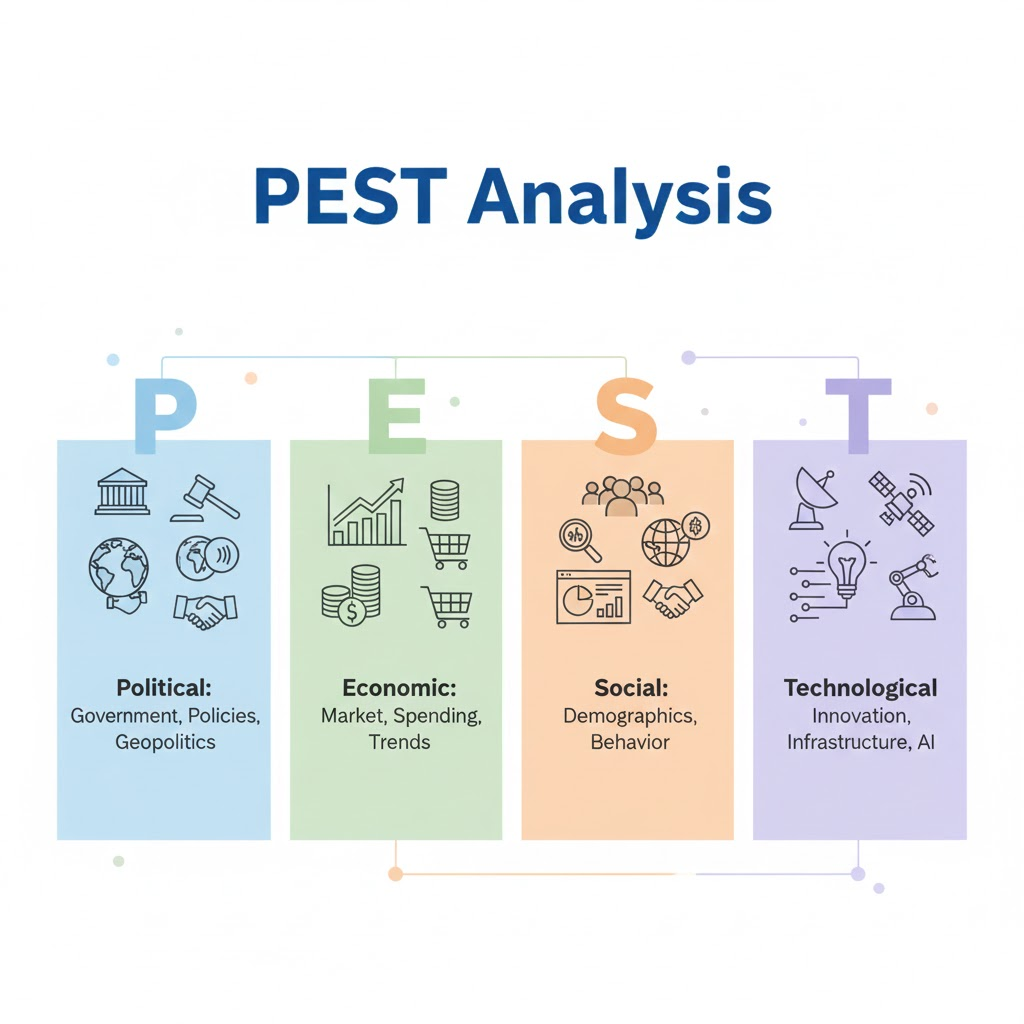
- Political: Government policies, regulations, and geopolitical influences.
- Economic: Market conditions, consumer spending, and financial trends.
- Social: Cultural shifts, demographics, and societal behaviors.
- Technological: Innovations, infrastructure developments, and tech advancements.
For a streaming platform, these factors help identify opportunities (e.g., growing demand for diverse content) and risks (e.g., content licensing restrictions). Without this analysis, businesses may overlook critical trends, leading to misguided strategies.
Why Focus on Streaming Platforms?
Streaming services like Netflix or emerging startups deal with content distribution, user engagement, and global scalability. External forces such as regulatory changes (e.g., content censorship) or technological shifts (e.g., AI recommendations) directly affect success. In emerging markets, factors like local language requirements or economic inflation add complexity.
The Role of AI-Powered Modeling Software
Traditional PEST Analysis involves manual data collection, which is time-consuming and prone to bias. AI-powered tools (e.g., chatbots like Visual Paradigm’s AI) use natural language processing to generate diagrams, reports, and insights from simple prompts. This democratizes analysis, making it accessible to non-experts. Key advantages include:
- Speed: Generate outputs in minutes.
- Relevance: Tailored to industry-specific trends.
- Visualization: Diagrams for easy sharing.
- Actionability: Converts insights into business plans or presentations.
2. Preparing for Your PEST Analysis
Before diving in, define your scenario:
- Business Context: Specify your platform’s focus (e.g., global content, emerging markets, high-quality diverse programming).
- Goals: What do you need? A diagram for quick review, a report for investors, or recommendations for strategy?
- User Profile: If you’re a product manager or founder, note any constraints like limited access to data sources.
- Tool Selection: Use AI-powered modeling software that supports diagramming and report generation. The example here references Visual Paradigm’s AI Chatbot, but similar tools exist.
Ensure your prompts are clear and descriptive to get accurate, contextualized results.
3. Step-by-Step Guide to Generating a PEST Analysis with AI
Follow this process to create a PEST Analysis from scratch. We’ll use the example of a startup product manager launching a global streaming service.
Step 1: Initiate the Analysis with a Prompt
- Action: Start by describing your request in natural language.
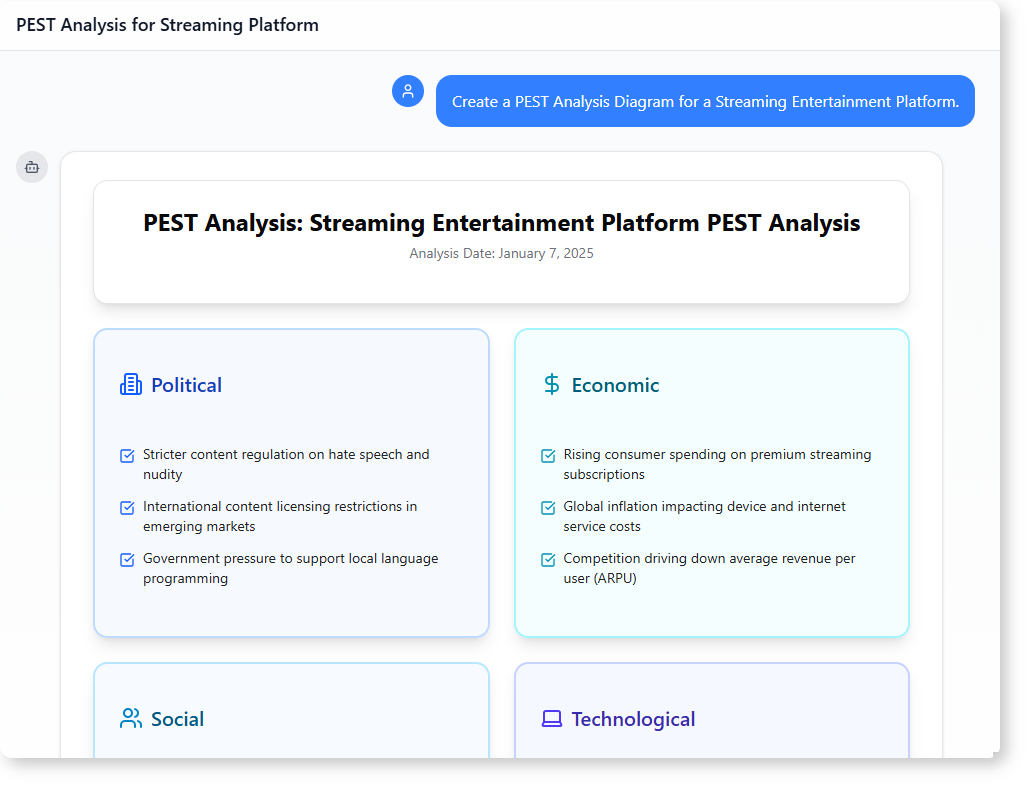
- Example Prompt: “Create a PEST Analysis Diagram for a Streaming Entertainment Platform.”
- What Happens: The AI interprets the prompt and generates a structured diagram with the four PEST pillars. It populates sections based on current industry trends, drawing from trained data on market dynamics.
- Tips:
- Be specific: Mention “global focus” or “emerging markets” to tailor the output.
- Review Initial Output: Ensure it aligns with your business; refine prompts if needed (e.g., “Focus on Asia-Pacific regions”).
Step 2: Review and Populate the PEST Sections
- Action: The AI auto-fills each category with relevant trends. Analyze and iterate as needed.
- Example Outputs for a Streaming Platform:
- Political:
- Stricter regulations on content (e.g., hate speech, nudity).
- International licensing restrictions in emerging markets.
- Government mandates for local language or cultural programming support.
- Economic:
- Increasing consumer spending on premium subscriptions.
- Inflation raising costs for devices and internet services.
- Intense competition lowering average revenue per user (ARPU).
- Social:
- Demand for diverse, inclusive content representation.
- Shift to on-demand, ad-free viewing among younger audiences.
- Rise in global and international content consumption.
- Technological:
- AI advancements for personalized recommendations.
- Growth in 8K/HDR for high-quality streaming.
- AI tools for content moderation and metadata tagging.
- Political:
- Tips:
- Ask for expansions: “Elaborate on political factors in emerging markets.”
- Visualize: The tool creates a diagram for easy interpretation and sharing.
Step 3: Transform the Diagram into a Detailed Report
- Action: Request a long-form version for deeper use.
- Example Prompt: “Create a long-form report suitable for a business plan appendix based on the diagram.”
- What Happens: The AI converts the visual structure into a professional document, including:
- Executive Summary: High-level overview of key factors.
- Detailed Sections: Explanations, impacts, and risks (e.g., how inflation affects profitability).
- Recommendations: Strategic advice, like prioritizing local content or investing in AI moderation.
- Tips:
- Customize: Specify format (e.g., “Include bullet points for risks” or “Add data visualizations”).
- Integrate: Use this as an appendix in business plans, investor decks, or strategy sessions.
Step 4: Refine and Validate
- Action: Review the output for accuracy and relevance.
- Best Practices:
- Cross-Check: Compare AI insights with current news or reports.
- Iterate: Prompt refinements like “Update with 2025 trends” or “Add quantitative examples.”
- Human Oversight: For critical decisions, consult experts to validate trends.
Step 5: Apply Insights to Your Business
- Action: Use the analysis to inform decisions.
- Examples:
- Content Strategy: Focus on inclusive programming to align with social trends.
- Market Positioning: Navigate political hurdles by partnering locally.
- Risk Mitigation: Budget for economic fluctuations in subscription pricing.
4. Real-World Example: User’s Journey
Consider a product manager at a startup launching a diverse content streaming service:
- Background: No access to premium reports; needs quick insights for emerging markets.
- Process:
- Prompted for a diagram → Received structured PEST with trends.
- Requested a report → Got a detailed appendix with summaries and recommendations.
- Outcome: Shared with executives and investors, highlighting risks like licensing and opportunities like AI personalization. This example illustrates how AI bridges the gap for non-analysts, turning ideas into professional outputs.
5. Benefits of Using AI-Powered Modeling Software
- Speed and Efficiency: From prompt to report in minutes, bypassing hours of research.
- Clarity and Accessibility: Structured visuals and narratives for all team members.
- Relevance to Industry: Tailored to streaming-specific trends, like content regulation or tech innovations.
- Actionability: Outputs ready for business plans, presentations, or strategic planning.
- Cost-Effectiveness: Ideal for startups without dedicated analysts.
- Intuitive Workflow: Natural language prompts make it user-friendly.
6. When is This Approach Right for You?
This method suits teams in fast-paced sectors like entertainment, tech, or media. If your platform faces complex external factors (e.g., global regulations, tech disruptions), AI helps without requiring deep expertise. It’s especially valuable for:
- Early-stage founders mapping market forces.
- Product teams building investor materials.
- Non-experts needing quick, insightful overviews.
However, it’s a starting point—combine with human judgment for nuanced decisions.
7. Frequently Asked Questions (FAQs)
Q: How does AI-powered modeling software help in creating a PEST Analysis? A: It converts natural language prompts into a structured framework with industry-relevant factors, saving time and ensuring up-to-date insights.
Q: Can I use this for a streaming platform in emerging markets? A: Absolutely. The AI incorporates local elements like regulations, cultural preferences, and licensing challenges.
Q: Is the analysis specific to content or tech platforms? A: Yes, prompts for streaming platforms yield factors tied to content distribution, user trends, and tech adoption.
Q: How accurate is the AI-generated PEST Analysis? A: It’s based on current trends and market data but serves as an initial tool. Always validate with human review for critical applications.
Q: What if I need more customization? A: Refine prompts (e.g., “Add focus on sustainability”) or iterate on outputs to tailor further.
Q: Are there limitations? A: AI relies on trained data, so emerging events may require manual updates. It’s not a substitute for professional consulting.
Conclusion
Generating a PEST Analysis with AI-powered modeling software empowers streaming platforms to navigate external challenges efficiently. By following this guide, you can produce insightful diagrams and reports that drive strategic success. Start with a clear prompt, review outputs, and apply insights to your business. For hands-on experience, explore tools like Visual Paradigm’s AI Chatbot. Remember, AI enhances thinking—it doesn’t replace it. If your needs evolve, adapt prompts to generate deeper analyses.

 English
 Arabic
 Chinese (Simplified)
 Dutch
Dutch French
 German
 Italian
 Japanese
 Korean
 Portuguese
 Russian
 Spanish