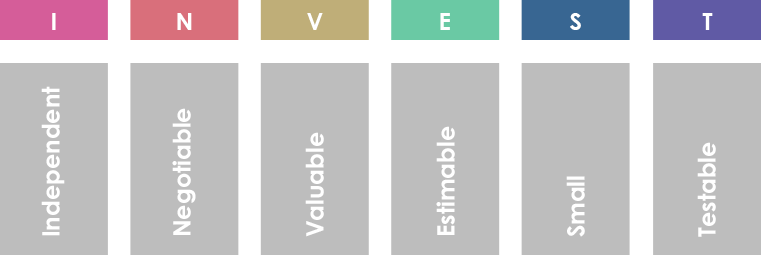
Agile uses user stories to express the problems that a product or system should solve. The Agile INVEST guideline is a set of recommendations compiled by Bill Wake to help test and create high-quality user stories (or more generally, Product Backlog Items) that support effective agile project management.
According to the Agile INVEST guideline, high-quality user stories are easy to:
- Understand
- Implement
- Test
- Demonstrate to the customer
- Be independent
But let’s break down what the acronym INVEST actually stands for.
Agile INVEST – Independent
This means the story can exist as a Product Backlog Item (PBI) with its own priority, be estimated independently, and does not depend on any other stories.
The assigned priority of a user story should be the only factor determining when the team implements it. If its priority is lower, the story sits lower in the backlog and is implemented later; if higher, the team moves it up in the backlog for faster delivery. When user stories are interdependent, the dependency—not priority—dictates when the team implements them.
Agile INVEST – Negotiable
A good user story captures the essence of the customer’s need. If there are questions, the team discusses them with the customer to determine the correct value of the story. The development team can negotiate with the Product Owner and stakeholders. This way, collaboration between the project team (supplier and customer) creates an outstanding product or service.
Does an agile team have nothing to ask because everything is documented in the agile user story? Then a business analyst wrote the requirements.
There will be some non-negotiable items (often non-functional), such as:
- Security policies related to user accounts
- Performance requirements, such as the number of concurrent users the system must handle
That’s fine—as long as the details of the functionality itself remain open and invite conversation.
Agile INVEST – Valuable
Referring to agile principles, “valuable” means we can demonstrate the requested feature or functionality to the customer during the Sprint Review meeting.
When splitting user stories, teams must split vertically (also representing the “V”) rather than horizontally. This delivers complete functionality at the end of the Sprint and increases the potentially shippable product increment.
Teams may find it more interesting to implement technical PBIs, but they do not always deliver direct value to the customer—which contradicts one of the Agile principles: satisfy the customer through early and continuous delivery of valuable software.
Agile INVEST – Estimable
A good user story must be estimable. In agile, estimation is relative—compared to the other user stories in the backlog. Popular methods include the Fibonacci sequence, T-shirt sizing (S, M, L, etc.), and more.
The discussion around estimation helps the entire team reach consensus on the conditions needed to complete the story. Sometimes a story is not estimable, which is normal if the story is too large or contains multiple features within the same item. In such cases, split the story into multiple smaller stories. In other situations, there are too many unknowns that require research.
Agile INVEST – Small
Stories should take from a few hours up to a maximum of one full Sprint length. Otherwise, different problems arise—such as velocity (how the team holds itself accountable for delivery points), difficulty in accurate estimation, and more.
Agile INVEST – Testable
In this context, “testable” refers to the acceptance criteria defined during analysis.
We cannot consider a user story “Done” unless it meets the acceptance criteria. The only way we know it is satisfied is through testing and verification.
Acceptance criteria are not test cases. They answer the question: “How do I know when I’ve finished this user story?”
Test cases outline the steps required to test the functionality.
The customer can tell you what the test environment looks like and the test conditions under which the team considers a user story to be DONE.

 English
 Arabic
 Chinese (Simplified)
 Dutch
Dutch French
 German
 Italian
 Japanese
 Korean
 Portuguese
 Russian
 Spanish