The wording of the manifesto is carefully crafted to capture the essence of agility in minimal language, emphasizing:
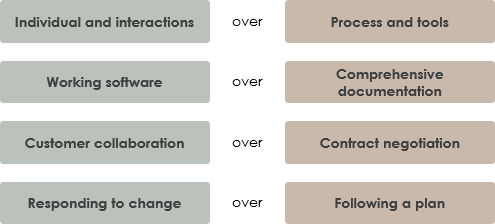
- Individuals and interactions over processes and tools
- Working software over comprehensive documentation
- Customer collaboration over contract negotiation
- Responding to change over following a plan
Note:
- The key word in each of these statements is “over”. The manifesto is not suggesting to replace the right-hand side items with the left-hand side, but rather to prioritize the left-hand side items.
- The Agile Manifesto was created as an alternative to documentation-driven, heavyweight software development processes (such as the waterfall model).
Principles Behind the Agile Manifesto
The “Twelve Principles” further elaborate on the core Agile Manifesto, providing deeper insight into what agility truly means. The Scrum framework promotes these principles through various events such as the Product Backlog, Daily Stand-ups, Iterative Development, and Retrospectives:
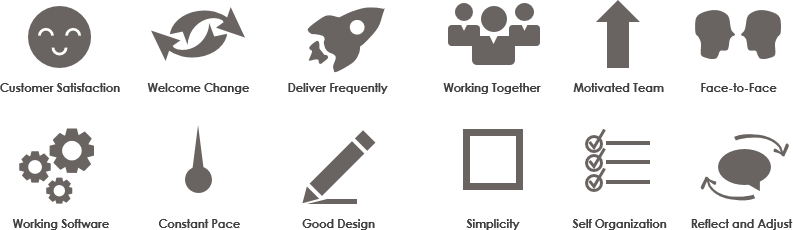
- Our highest priority is to satisfy the customer through early and continuous delivery of valuable software.
- Welcome changing requirements, even late in development. Agile processes harness change for a competitive advantage.
- Deliver working software frequently, from a couple of weeks to a couple of months, with a preference to the shorter timescale.
- Business people and developers must work together daily throughout the project.
- Build projects around motivated individuals. Give them the environment and support they need, and trust them to get the job done.
- The most effective method of conveying information to and within a team is face-to-face conversation.
- Working software is the primary measure of progress.
- Agile processes promote sustainable development. The sponsors, developers, and users should be able to maintain a constant pace indefinitely.
- Sustainably focus on technical excellence and good design to enhance agility.
- Simplicity—the art of maximizing the amount of work not done—is essential.
- The best architectures, requirements, and designs emerge from self-organizing teams.
- At regular intervals, the team reflects on how to become more effective, then tunes and adjusts its behavior accordingly.

 English
 Arabic
 Chinese (Simplified)
 Dutch
Dutch French
 German
 Italian
 Japanese
 Korean
 Portuguese
 Russian
 Spanish