


Introduction
Software design begins with understanding the problem domain—identifying core concepts, their attributes, behaviors, and relationships. Traditionally, this process relies on manual analysis of requirements documents, which can be time-consuming and prone to human error.
AI-Powered Textual Analysis revolutionizes this process by automating the extraction of design elements from unstructured problem descriptions. Tools like Visual Paradigm’s AI-Powered Textual Analysis leverage to transform textual requirements into structured , accelerating the design phase and improving accuracy.
This tutorial will guide you through the key concepts, workflow, and benefits of AI-Powered Textual Analysis, with a focus on how Visual Paradigm can empower your team.
Key Concepts in Textual Analysis
1. Problem Description
A problem description is a textual summary of the software system’s requirements. It typically includes:
- (e.g., “users can place orders”)
- Key entities (e.g., “products,” “customers,” “payments”)
- Relationships (e.g., “a customer can have multiple orders”)
2. Candidate Classes
Candidate classes are extracted from the problem description. They represent potential domain objects in your system.
- Example: In an “Online Shopping Cart,” candidate classes might include
Customer,Product,Order, andPayment.
3. Attributes and Operations
- Attributes: Properties of a class (e.g.,
Customerhasname,email,address). - Operations: Actions a class can perform (e.g.,
OrderhascalculateTotal(),addItem()).
4. Class Relationships
Relationships define how classes interact:
- Association: A general connection (e.g.,
Customerplaces anOrder). - Composition: A “whole-part” relationship (e.g.,
OrdercontainsOrderItem). - : Specifies how many instances of one class relate to another (e.g., “1 to many”).
5. Class Diagram
A visual representation of classes, their attributes, operations, and relationships. It serves as a blueprint for software design.
Why Use AI-Powered Textual Analysis?
1. Automation and Efficiency
- Reduces manual effort: Automatically identifies classes, attributes, and relationships from text.
- Faster iteration: Generates a Class Diagram in minutes, not hours.
2. Consistency and Accuracy
- Minimizes human error: AI ensures logical consistency in relationships and multiplicities.
- Standardized output: Follows .
3. Collaboration and Clarity
- : Class Diagrams make complex systems easier to understand.
- : Teams can align on domain concepts early in the design phase.
4. Flexibility and Refinement
- : AI-generated diagrams can be refined in tools like Visual Paradigm Online.
- : Update the problem description and regenerate the diagram as requirements evolve.
Step-by-Step Tutorial: Using Visual Paradigm’s AI-Powered Textual Analysis
Step 1: Provide a Problem Description
- Open Visual Paradigm and navigate to Tools > Apps.
- Select Textual Analysis and click Start Now.
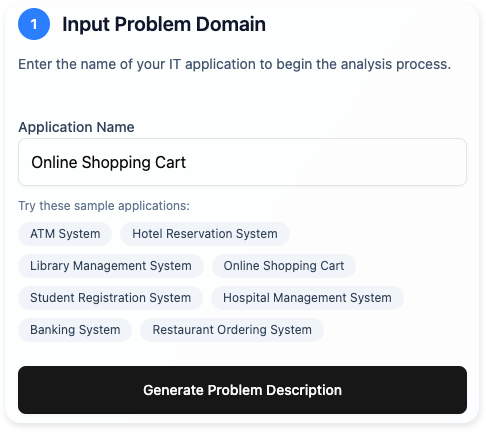
- Enter a brief description of your system (e.g., “ATM System” or “Online Shopping Cart”).
- Click [Generate Problem Description]. The AI will create a detailed paragraph. Edit it if needed.
Step 2: Identify Candidate Classes
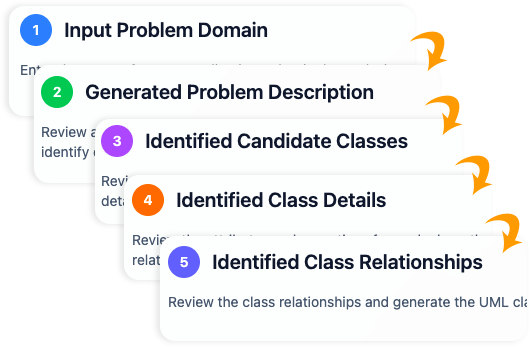
- Click [Identify Candidate Classes].
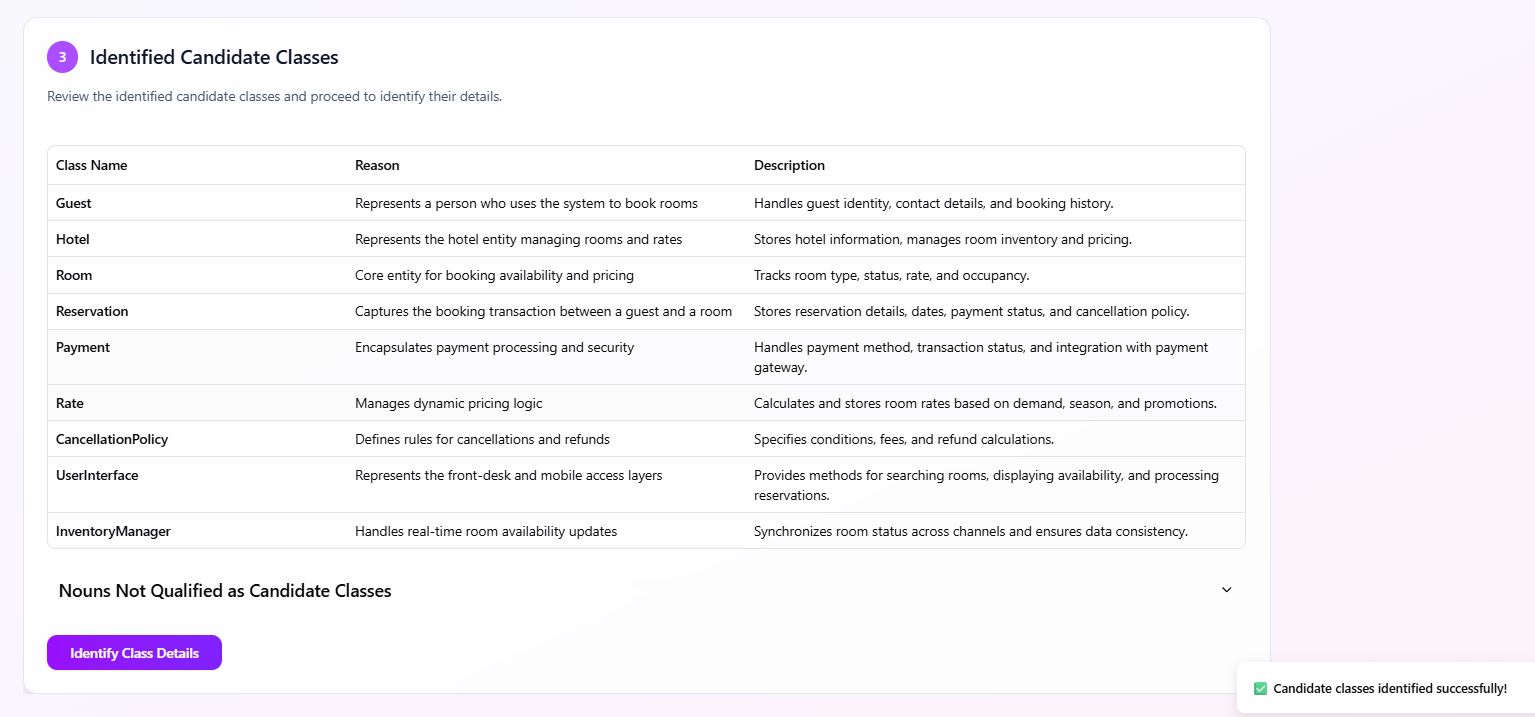
- The AI will list potential classes in a table with:
- Class Name (e.g.,
Account,Transaction) - Reason (why it was selected)
- Description (contextual explanation)
- Class Name (e.g.,
- Review the list and exclude irrelevant classes if necessary.
Step 3: Identify Class Details
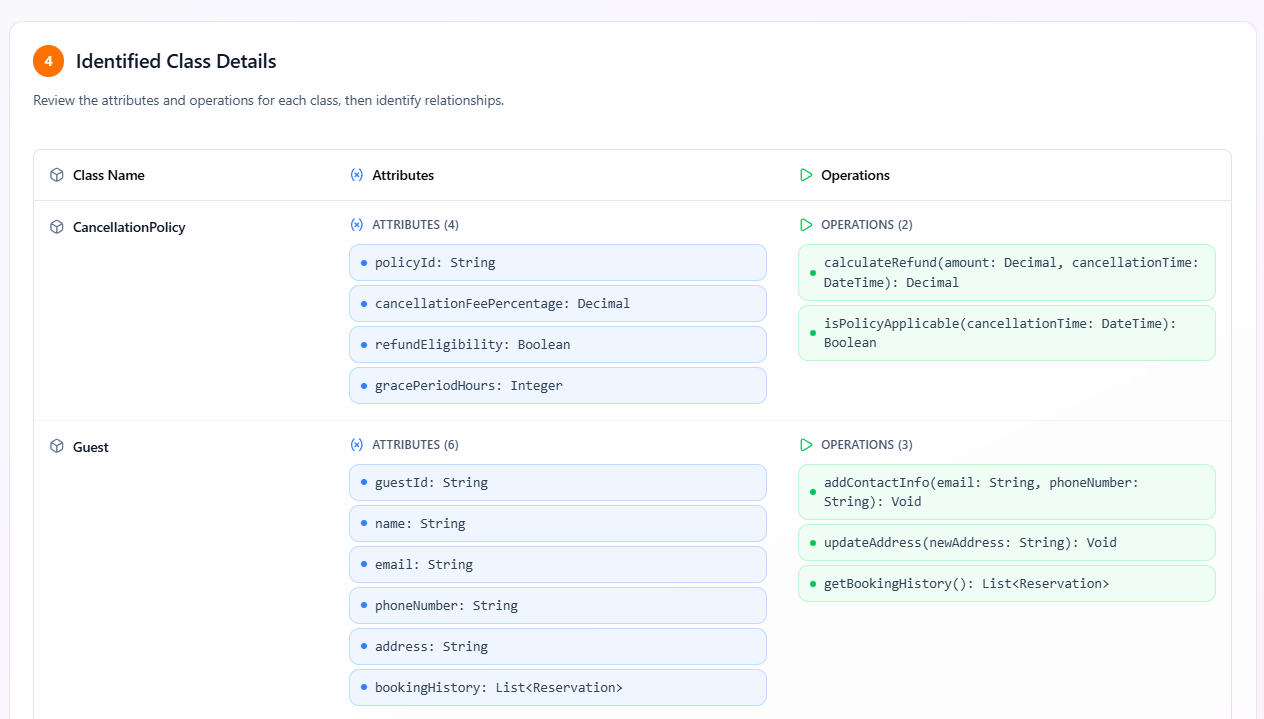
- Click [Identify Class Details].
- The AI will suggest attributes and operations for each class.
- Example for
Customer:- Attributes:
name,email,address - Operations:
updateProfile(),viewOrderHistory()
- Attributes:
- Example for
Step 4: Identify Class Relationships
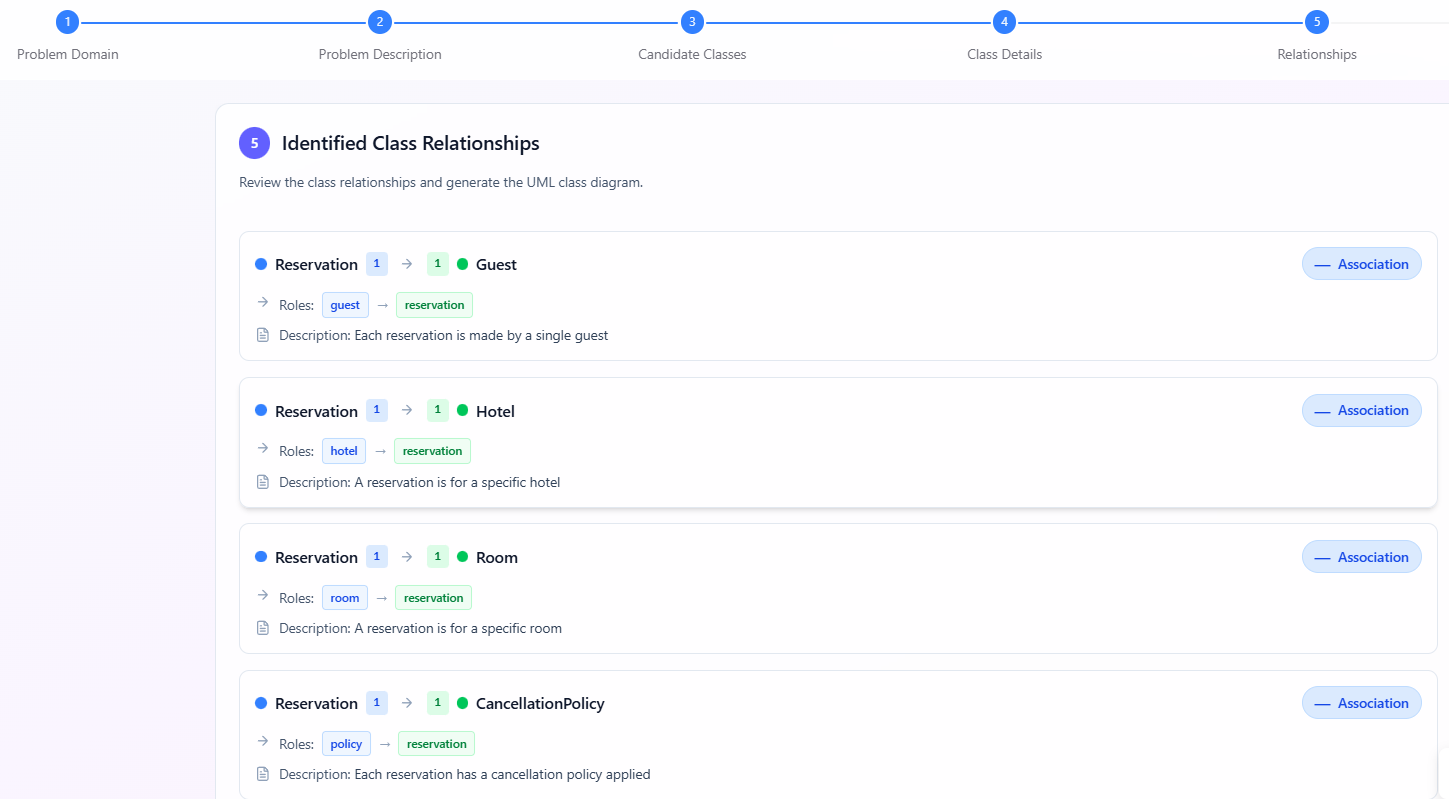
- Click [Identify Class Relationships].
- The AI will propose relationships (e.g.,
CustomerplacesOrder) and multiplicities (e.g., “1 to many”). - Review and adjust relationships as needed.
Step 5: Generate the Class Diagram
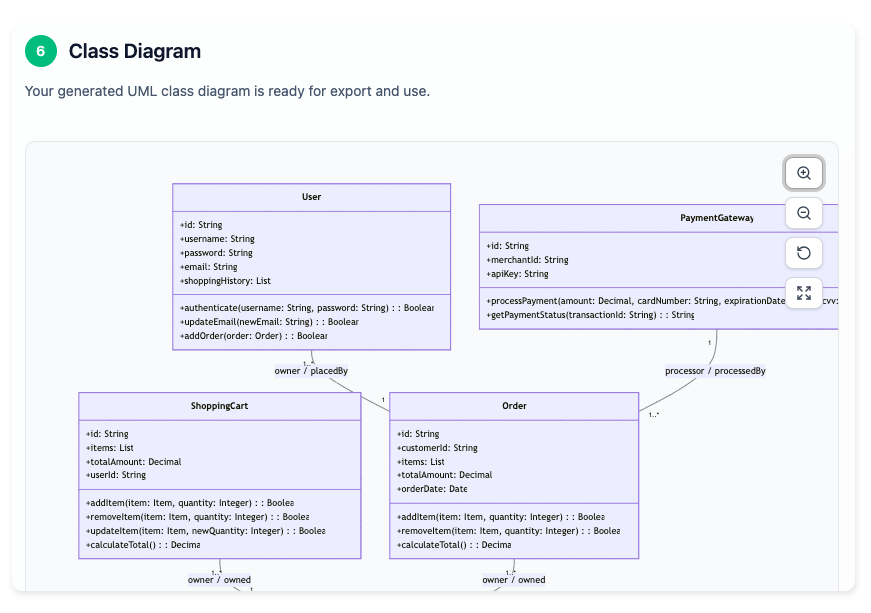
- Click [Generate Diagram].
- A Class Diagram will appear, visualizing all identified elements.
- Use [Open in Visual Paradigm Online] to refine the diagram further.
Example: Online Shopping Cart System
Problem Description
“An online shopping cart system allows customers to browse products, add items to their cart, and checkout. Customers can register, log in, and view their order history. The system tracks inventory and processes payments.”
AI-Generated Output
- Candidate Classes:
Customer,Product,Cart,Order,Payment,Inventory - Attributes for
Product:productID,name,price,stockQuantity - Operations for
Order:calculateTotal(),confirmOrder(),cancelOrder() - Relationships:
CustomerplacesOrder(1 to many)OrdercontainsProduct(many to many)Cartbelongs toCustomer(1 to 1)
Class Diagram
The AI generates a visual diagram showing all classes, attributes, operations, and relationships.
How Visual Paradigm AI-Powered Textual Analysis Helps Your Team
1. Accelerates the Design Process
- Reduces time spent on manual analysis and diagram creation.
- Enables rapid prototyping of domain models.
2. Improves Collaboration
- Standardized visual output ensures all team members understand the domain model.
- Centralized platform for editing and refining diagrams.
3. Enhances Accuracy
- AI-driven suggestions reduce oversight and inconsistencies.
- Automated checks for logical relationships and multiplicities.
4. Supports Agile Development
- Adapts to changing requirements: Regenerate diagrams as the problem description evolves.
- Integrates with Visual Paradigm Online for seamless updates.
5. Empowers Non-Technical Stakeholders
- Bridges the gap between business requirements and technical design.
- Facilitates discussions with clear, visual representations.
Conclusion
AI-Powered Textual Analysis is a game-changer for software design, transforming unstructured problem descriptions into structured, visual domain models. Visual Paradigm’s tool automates the heavy lifting—identifying classes, attributes, operations, and relationships—while providing the flexibility to refine and adapt the output.
By adopting this approach, your team can:
- Save time and reduce manual errors.
- Improve collaboration with clear, standardized diagrams.
- Accelerate the transition from requirements to implementation.
Ready to streamline your design process? Try Visual Paradigm’s AI-Powered Textual Analysis today and experience the future of software modeling.
Have questions or want to explore a specific use case? Let’s discuss how AI-Powered Textual Analysis can !

 English
 Arabic
 Chinese (Simplified)
 Dutch
Dutch French
 German
 Italian
 Japanese
 Korean
 Portuguese
 Russian
 Spanish