Commonly used terms—“Continuous Integration,” “Continuous Delivery,” and “Continuous Deployment”—are considered components of Agile Software Development. These practices share the prefix “continuous,” indicating and enabling incremental integration (deliverable software) and simultaneous deployment of results, without the delays typically involved in traditional sequential development. In the modern Agile environment, these terms represent the delivery of completed increments through a pipeline, allowing for automatic deployment as upgrades.
The core principle of Continuous Delivery is to incrementally deliver working software in short iterations. In other words, Continuous Delivery is a short-cycle implementation where code is frequently developed, built, checked in, automatically tested, and deployed.
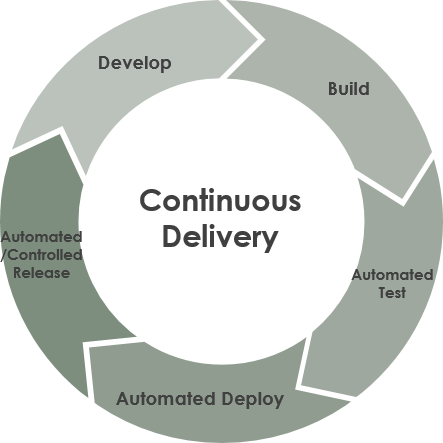
Continuous Delivery
Note:
It doesn’t require short release cycles—only the ability to allow new code commits whenever they’re ready. This way, developers can update the product multiple times a day, continuously delivering value to users. This is achieved through high levels of testing and deployment automation.
Continuous Delivery in Scrum
In Scrum, fixed-length Sprints of 1–4 weeks are promoted, ending with testing, demonstration, Sprint Review, final sign-off, and release. Now, we want to release even more frequently—continuous delivery.
Continuous Integration refers to a software development practice requiring developers to integrate code into a central repository several times a day. In addition to concurrent and automated updates, issues can be detected easily by verifying different check-in times.
Continuous Delivery enables safe, rapid delivery of all types of changes (including new features, configuration changes, bug fixes, and experiments) to production or end users in a sustainable way.
Continuous Deployment further extends the Continuous Integration approach by minimizing the time interval between coding and deployment.
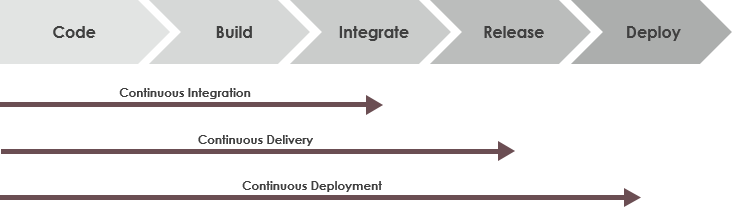
Continuous Delivery in Scrum
Benefits of Continuous Delivery
People often assume that releasing software more frequently means accepting lower levels of stability and reliability in the system. However, many studies show this is not the case. In fact, shipping one feature at a time significantly reduces the risk of each deployment. Your team can deliver features to customers faster, enabling quicker feedback. A Continuous Delivery pipeline brings numerous benefits to teams, business, and users:
- Reduced time-to-market
- Lower costs
- Faster feedback
- Happier customers
- Lowers-risk releases
According to the 2014 Xebia Labs Survey Report, Continuous Delivery led the way, with Agile following closely. 36.4% of respondents listed DevOps as a key initiative in 2014, as shown in the chart below:
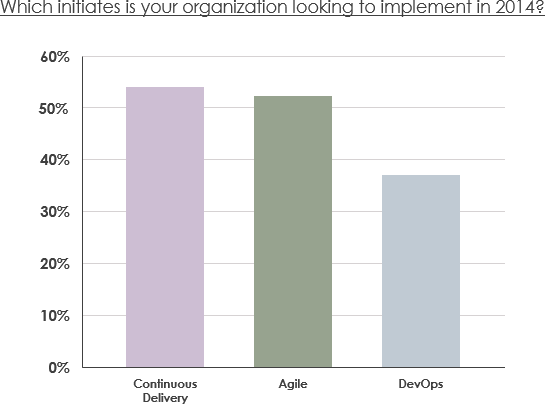
Software Project Initiative Application (2014)
Summary
If this sounds too good to be true, remember: Continuous Delivery is not magic. Software releases require a lot of discipline. Continuous Delivery in Scrum achieves continuous daily improvement by releasing smaller changes more frequently, helping everyone get used to a regular, predictable pace and leaving room to respond to change. Most importantly, successful releases become shared successes—something everyone can celebrate together.

 English
 Arabic
 Chinese (Simplified)
 Dutch
Dutch French
 German
 Italian
 Japanese
 Korean
 Portuguese
 Russian
 Spanish