Definition of Done (DoD) is a checklist of requirements that a user story must meet in order for the team to consider it complete. While the acceptance criteria of a user story include a set of test cases that must be met to confirm that the software works as intended.
The key difference lies in the fact that DoD is common to all user stories, whereas acceptance criteria are specific to individual user stories. The acceptance criteria for each user story will vary depending on the specific requirements of that story.
In other words, both the Definition of Done and the acceptance criteria must be met for a user story to be considered complete. The product increment is not considered complete unless both checklists are fully satisfied. Therefore, we need to define two aspects of the Definition of Done: the DoD and the acceptance criteria:
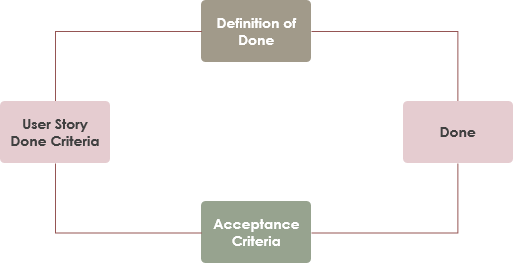
Definition of Done vs Acceptance Criteria
Definition of Done:
The Definition of Done is structured as a checklist, with each item serving as a verification point for a story or PBI. Its purpose is to ensure the development team agrees on the quality of the work they are delivering. It acts as a checklist to verify the completeness of every Product Backlog item (also known as a PBI or user story). The items in the Definition of Done are intended to apply to all items in the Product Backlog, not just individual user stories. It can be summarized as follows:
- Applies to the entire product increment
- Implies that the product increment is potentially shippable in most cases
- Defined in the Scrum Guide
- Serves as a communication tool among team members:
- Overall software quality
- Whether the increment is shippable
Goals of the Definition of Done
- Establish a shared understanding of quality and completeness across the team
- Act as a checklist for verifying user stories (or PBIs)
- Ensure that the increment produced at the end of a Sprint is of high quality and that all participants clearly understand the quality standards
Example – Definition of Done
For example, in the software industry, teams may ask the following questions to define their DoD:
- Code peer-reviewed?
- Code completed?
- Code reviewed?
- Code checked in?
- Unit tests passed?
- Functional tests passed?
- Acceptance tests completed?
- Product Owner has reviewed and accepted
Acceptance Criteria
A user story is one of the key artifacts in Agile development, but Scrum does not explicitly require the use of user stories or acceptance criteria. If a product backlog item is too large to fit into a Sprint, it is typically broken down into user stories and then further into a set of tasks, as shown below:
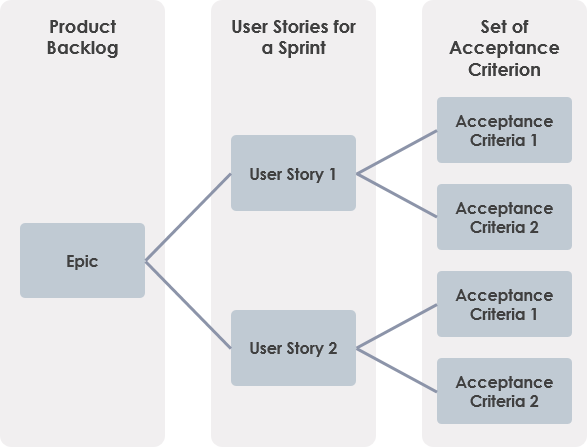
Acceptance Criteria
User stories encapsulate acceptance criteria, so we often see the Definition of Done and acceptance criteria coexisting in our Scrum processes. The user story provides context for the functionality the team should deliver. Acceptance criteria provide detailed guidance on what the feature should do and how the customer will accept it. Together, they define the complete deliverable.
Some acceptance criteria are discovered during the ongoing Backlog Refinement session before the Sprint begins, while others are identified immediately after Sprint Planning, so that the team can have a conversation with the user story. Therefore, acceptance criteria are a unique attribute of a user story or product backlog item.
- Applies to individual PBI/story
- Acceptance criteria vary per PBI/story
- Not defined in the Scrum Guide
- Serves as a communication tool to meet specific requirements of a PBI/story
- Also known as acceptance tests, satisfaction conditions, or in some cases “test cases”
Goals of Acceptance Criteria
- Clarify what the team should establish before starting work
- Ensure everyone shares a common understanding of the requirements
- Help team members understand when a story is complete
- Help verify the story through automated testing
Example – Acceptance Criteria
- The user cannot submit the form without filling in all required fields
- Information from the form is stored in the registration database
- Guests can pay via credit card
- An email confirmation is sent to the user after the form is submitted
Example of a User Story with Acceptance Criteria
The image below shows an example of acceptance criteria for a user story.
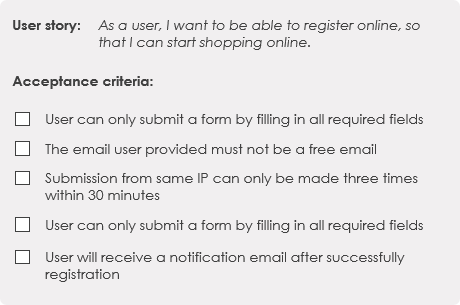
Example of Definition of Done

 English
 Arabic
 Chinese (Simplified)
 Dutch
Dutch French
 German
 Italian
 Japanese
 Korean
 Portuguese
 Russian
 Spanish