Extreme Programming (XP) is an Agile software development framework designed to generate higher-quality software and improve team quality of life. XP is the most specific Agile framework when it comes to proper engineering practices.
Scrum is a framework where people can solve complex adaptive problems while delivering high-value products efficiently and creatively. Scrum itself is a simple framework that enables effective team collaboration on complex products.
Both Scrum and XP are Agile methodologies, sharing common concepts such as iterative development, working software, releases and iteration planning, daily stand-ups, retrospectives, and all other Agile process elements. These two approaches are so consistent that it can be difficult to distinguish between a team practicing XP and another practicing Scrum.
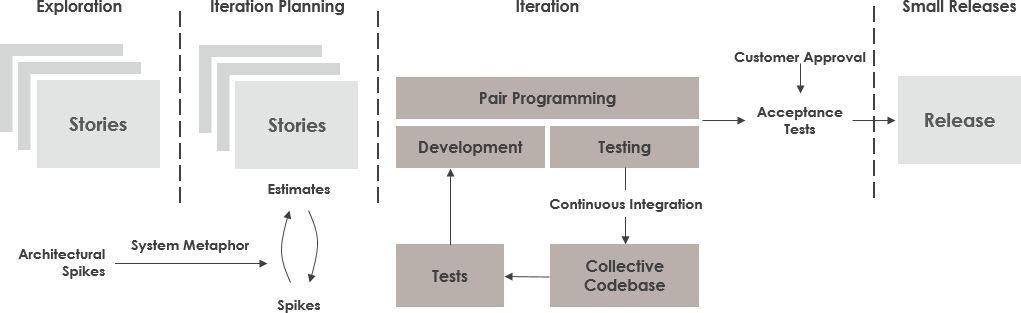
Extreme Programming
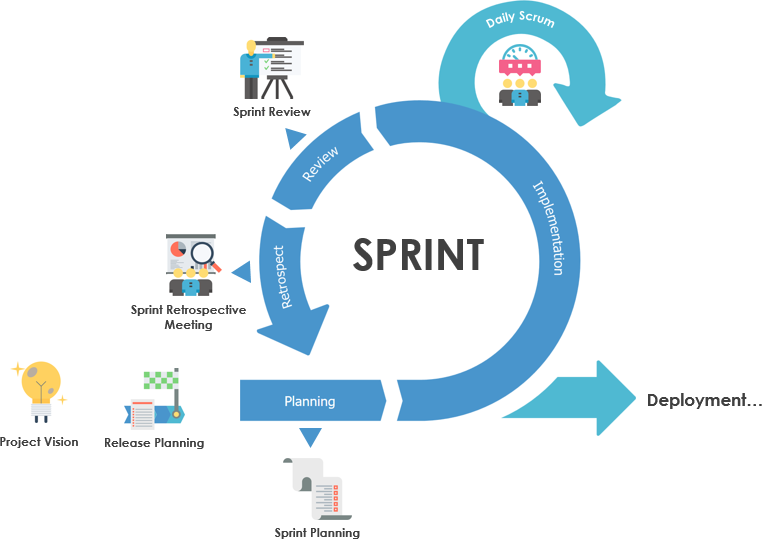
Sprint Cycle
However, there are some differences, some of which are quite subtle, particularly in the following four aspects:
- Typically two to four weeks.
- Typically one to two weeks.
- Does not allow changes to their sprint.
- Once the sprint planning is complete and a set of product backlog items is committed, those items remain unchanged until the end of the sprint.
- Easier to change during the iteration.
- As long as a specific feature hasn’t been started, a new feature of similar size can be swapped into the XP team’s iteration in place of an unstarted one.
- Work in strict priority order.
- The features to be developed are prioritized by the customer (Scrum’s Product Owner), and the team must handle them in sequence.
- The Scrum Product Owner prioritizes the product backlog, but the team determines the order in which they develop backlog items.
- A Scrum team might well choose to work on the second-most important item.
- Does not prescribe any specific engineering practices.
- Yes, XP does.
- For example: TDD, pair programming, simple design, refactoring, etc.
We can summarize the differences between XP and Scrum as follows:
| Aspect | Practice | XP | Scrum |
| Iteration Length | Whether Requirements Can Be Changed During the Iteration | 1–2 weeks | 2–4 weeks |
| Change Handling During Iteration | Whether Requirements Are Strictly Ordered by Priority | Can be replaced with another requirement of equal size if not yet implemented. | Scrum does not allow this. No changes are permitted after the sprint starts, and the Scrum Master enforces this strictly. |
| Feature Prioritization | Whether Requirements Are Strictly Ordered by Priority | Yes | Not required |
| Engineering Practices | Whether Strict Engineering Methods Are Used to Ensure Progress or Quality | Very strict | Requires developers to be conscious |
Therefore, we believe XP’s approach is acceptable, but it introduces a paradox into Agile: combining XP’s philosophy with Agile principles sends a confusing message to teams: “You are a fully self-managed organization, but you must implement TDD, Pair Programming, etc.”
It’s clear that these four differences are quite distinct:
- In Scrum, the emphasis is on self-organization.
- In XP, the emphasis is on strong engineering practice constraints.
Conclusion
Scrum is a product development framework—a container into which other practices can be added. XP is one of the practices you can apply within the Scrum framework. There is no reason for a team to choose between Scrum and XP. XP rules and practices are not easy, and most of them are non-negotiable. Incorporating XP into Scrum may be a natural progression for a team that starts with Scrum and strives to become a professional Scrum team.

 English
 Arabic
 Chinese (Simplified)
 Dutch
Dutch French
 German
 Italian
 Japanese
 Korean
 Portuguese
 Russian
 Spanish