A Scrum team is a group of individuals who collaborate to deliver a product increment, consisting of three key roles:
- Product Owner
- Scrum Master
- Development Team
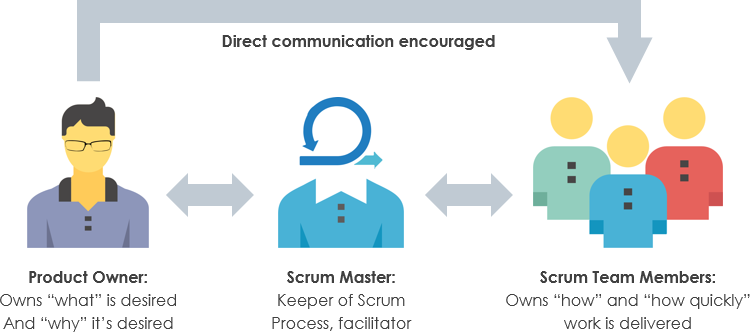
Self-Organizing and Cross-Functional
In Scrum, the team is self-organizing and cross-functional:
- Self-organizing team chooses how to best accomplish their work—rather than being directed by someone outside the team.
- Cross-functional team possesses all the skills needed to complete the work, without depending on individuals outside the team. The Scrum team model is designed to optimize flexibility, creativity, and productivity.
How Do Scrum Teams Collaborate Effectively?
Scrum teams deliver the product incrementally and iteratively, maximizing feedback opportunities. Delivering a “done” product increment ensures a potentially shippable version is always available.
Scrum is defined by a set of principles (or the 5 Scrum Values), which should be understood as simple guidelines for working effectively within the team. They are:
- Courage – especially when solving tough problems
- Focus
- Commitment to shared team goals
- Respect for team members
- Openness to work and any challenges that may arise
Scrum Key Concepts
Scrum consists of a series of Sprints or development iterations. Each Scrum Sprint involves the same process: Roles (people), Events (meetings), and Artifacts (tangible deliverables).
- A Sprint is a repeating development cycle until the project is complete.
- During each Sprint, requirements are developed, tested, integrated, and approved (often in the form of user stories). This process continues from Sprint to Sprint.
As previously mentioned, the Scrum framework consists of three distinct categories: Roles, Events, and Artifacts:
Scrum Roles
The Scrum framework is defined by three core roles: the Development Team, the Scrum Master, and the Product Owner.
Product Owner
The Product Owner is responsible for maximizing the value of the product and the work of the Development Team. How this is achieved may vary by organization, Scrum team, and individual.
Product Owner’s Role
The Product Owner is the sole person responsible for managing the Product Backlog. Product Backlog management includes:
- Clearly expressing Product Backlog items;
- Ordering items in the Product Backlog to best achieve goals and objectives;
- Optimizing the value of the work the Development Team performs;
- Ensuring the Product Backlog is visible, transparent, and clear to all, showing what the Scrum Team will work on next; and
- Ensuring the Development Team understands the items in the Product Backlog to the required level.
Scrum Master
The Scrum Master is responsible for ensuring Scrum is understood and enacted. Scrum Masters achieve this by ensuring the Scrum Team adheres to Scrum theory, practices, and rules.
The Scrum Master is a servant-leader for the Scrum Team. The Scrum Master helps people outside the Scrum Team understand which interactions with the team are useful and which are not. The Scrum Master helps everyone change these interactions to maximize the value created by the Scrum Team.
Scrum Master’s Role
The Scrum Master serves the Product Owner in various ways, including:
- Identifying effective Product Backlog management techniques;
- Helping the Scrum Team understand the need for clear and concise Product Backlog items;
- Understanding product planning in an empirical environment;
- Ensuring the Product Owner knows how to order the Product Backlog to maximize value;
- Understanding and practicing agility; and
- Facilitating Scrum Events as needed.
Scrum Master Serves the Development Team
The Scrum Master serves the Development Team in various ways, including:
- Guiding the Development Team in self-organization and cross-functionality;
- Helping the Development Team deliver high-value products;
- Removing impediments that hinder the team’s progress;
- Facilitating Scrum Events as required; and
- Guiding the Development Team in organizations where Scrum is not yet fully adopted or understood.
Scrum Master Serves the Organization
- The Scrum Master serves the organization in multiple ways, including:
- Leading and guiding the organization’s adoption of Scrum;
- Planning the implementation of Scrum within the organization;
- Helping employees and stakeholders understand and adopt Scrum and empirical product development;
- Driving change to improve Scrum Team productivity; and
- Collaborating with other Scrum Masters to enhance Scrum’s effectiveness across the organization.
Development Team
The Development Team consists of professionals who deliver a potentially shippable “Done” product increment at the end of each Sprint. Only members of the Development Team can create the increment.
The Development Team is self-organized and empowered by the organization to organize and manage their own work. This synergy optimizes the team’s overall efficiency and effectiveness.
Development Team’s Role
The Development Team has the following characteristics:
- They are self-organizing. No one (not even the Scrum Master) tells the Development Team how to turn Product Backlog items into a potentially shippable increment.
- The Development Team is cross-functional, possessing all the skills needed to create the product increment.
- Scrum does not recognize any titles other than “Developer” for members of the Development Team, regardless of the work being performed. This rule has no exceptions.
- Scrum does not recognize any sub-teams within the Development Team, regardless of the specific domain being addressed (e.g., testing or business analysis). This rule has no exceptions.
- Individual team members may have specialized skills and expertise, but accountability rests with the entire Development Team.
Scrum Events
The Scrum framework is marked by five events. These are: Sprint, Sprint Planning, Daily Scrum, Sprint Review, and Sprint Retrospective.
- A Sprint (also called an iteration) is the fundamental unit of development in Scrum. A Sprint is a time-boxed effort—meaning it is limited to a specific duration. The duration of each Sprint is predetermined, typically ranging from one to four weeks, most commonly two weeks.
- Sprint Planning is an event in the Scrum framework where the team determines which Product Backlog items they will work on during the Sprint and discusses their initial plan for completing them.
- A Daily Stand-up (also called Daily Scrum) is a short, time-boxed meeting held each day. This meeting is typically limited to 5–15 minutes and is sometimes referred to as a stand-up, morning huddle, or daily sync.
- The Sprint Review occurs after the Sprint ends. During the review, the Product Owner explains what was completed and what was not completed during the Sprint. The team then presents the completed work and discusses progress, challenges, and how to improve.
- The Sprint Retrospective is held after each Sprint, following the Sprint Review. It provides the team with an opportunity to inspect themselves and create a plan for improvement for the next Sprint.
Scrum Artifacts
Artifacts are physical records that provide detailed information about the project. Scrum artifacts include the Product Backlog, Sprint Backlog, and Product Increments.
- The Product Backlog is a prioritized list of features, bugs, or technical work that is currently not in progress. From the Product Owner’s perspective, it should include all valuable work.
- As product requirements evolve, the Product Owner and other team members jointly review and adjust the Product Backlog as needed.
- The Sprint Backlog is a list of all Product Backlog items selected for the Sprint. This list is compiled by prioritizing items from the Product Backlog until the team believes they have reached their Sprint capacity. Team members register tasks in the Sprint Backlog based on skills and priorities, following the self-organizing Scrum framework.
- The Product Increment is the sum of all completed product work during the Sprint, plus all work completed in previous Sprints. The goal of the Sprint is to produce a Done product increment. The Scrum Team decides what defines the “Done” state of the Increment, but all members must agree and understand the definition.
Scrum Life Cycle
The Scrum life cycle begins with the Product Backlog, but provides no guidance on how to develop or prioritize it. Instead, it includes a series of Sprints that eventually result in a potentially shippable product increment, as shown in the diagram below.
During these Sprints, all activities required for product development occur on a small portion of the overall product. Below is an explanation of key steps in the Scrum life cycle:
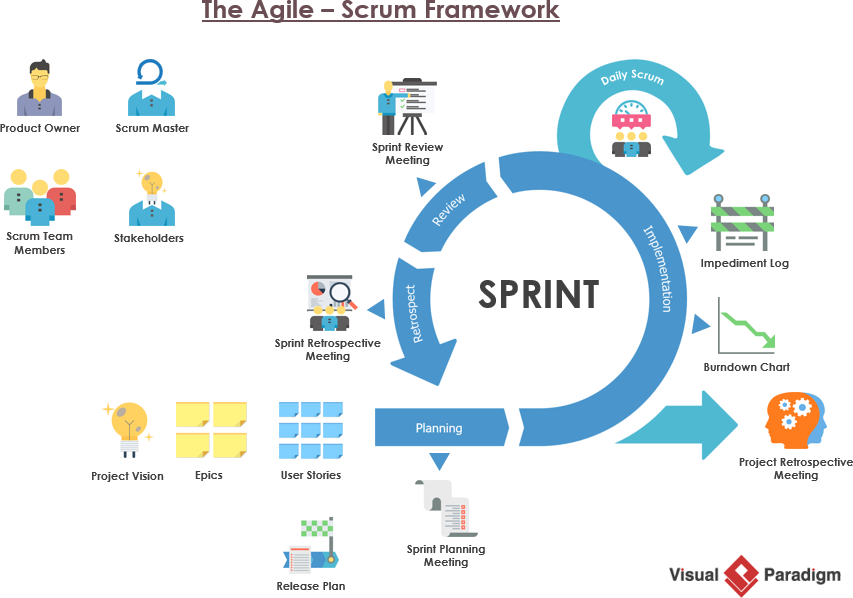
Agile Scrum Framework
- Businesses prioritize, and the team self-organizes to determine the best way to deliver the highest-priority features.
- The Product Owner represents the business, responsible for maintaining the product backlog (feature list) and setting development priorities.
- During Sprint Planning, the team pulls a small portion from the top of the backlog, adds it to the Sprint Backlog, and decides how to deliver it.
- Scrum is based on iterative cycles called Sprints, typically lasting 2–4 weeks, during which the product is designed, coded, and tested while daily stand-ups track progress (Daily Scrum).
- During this process, the Scrum Master keeps the team focused on their goals.
- At the end of the Sprint, the work should be ready to deliver to stakeholders.
- The Sprint concludes with a Sprint Review and a Retrospective.
- With the next Sprint, the team selects another chunk of the Product Backlog and begins again.
- The process continues until the entire backlog is completed—or until work stops due to time or budget constraints.
- This continues until the project is considered complete, either when work stops (deadline, budget, etc.) or when the entire backlog is completed.

 English
 Arabic
 Chinese (Simplified)
 Dutch
Dutch French
 German
 Italian
 Japanese
 Korean
 Portuguese
 Russian
 Spanish