The foundation of the Scrum framework was introduced in 1986 by Hirotaka Takeuchi and Ikujiro Nonaka in a Harvard Business Review article titled “The New New Product Development Game.” The authors described two approaches to managing product development. Some teams work like relay racers in a straight line, passing the baton as they go. Other teams operate like rugby players in a single match, passing the ball back and forth as needed.
Takeuchi and Nonaka concluded that the relay-race method used in NASA’s phased planning system was outdated. They argued that the rugby model would provide businesses with the tools needed to compete in a global commercial world.
In 1993, Jeff Sutherland, John Scumniotales, and Jeff McKenna experimented with developing Scrum software at the software company Easel Corp. In 1995, Ken Schwaber and Sutherland, along with others including McKenna and Scumniotales, published a paper titled “SCRUM Development Process.” This resulted in a major shift that caused developers to question the effectiveness of the classic waterfall software development model.
In November 2020, Sutherland and Schwaber released an updated version of “The Scrum Guide,” which contains the official definition of Scrum.
Relationship Between Scrum and Agile
Agile is a development and project planning approach. As explained in the Agile Manifesto, it has an overarching philosophy or framework that guides the methods beneath it. Scrum is one of several agile methods.
Scrum can be seen as a practical way to implement Agile. Like Agile, Scrum includes a set of values and principles. Development teams integrate Scrum into their agile strategy to add a layer of specificity.
One principle of agile development is for team members to regularly discuss how to improve efficiency and then adjust their behavior accordingly. Scrum incorporates a formal process to help teams do this. Daily meetings allow the team to reflect on what needs to be done in the next 24 hours and adapt their approach based on expectations or obstacles encountered.
Another agile principle recognizes that the best work comes from self-directed teams. The Scrum Master plays a key role here. They provide the team with what is needed to get the job done and the freedom to set their own path. They then act as a servant leader, guiding the team in solving problems, achieving goals, and resolving conflicts.
Scrum Pillars and Values
The three pillars of Scrum are Adaptation, Inspection, and Transparency.
- Adaptation. Teams continually adjust their approach to solving problems and adopt new methods when new issues arise.
- Inspection. Teams consistently reflect on and evaluate their own performance.
- Transparency. The team works in an open environment where all members understand each other’s processes and are aware of the challenges others face.
The Five Core Values of Scrum
These values support the three pillars:
- Commitment. The team is self-directed, and everyone is dedicated to completing the agreed-upon work.
- Courage. The team operates as a whole—succeeding or failing together. Members do the right thing and tackle difficult issues.
- Focus. Distractions are limited, and the team concentrates on the work that must be done today.
- Openness. The team takes time to share what is going well and what needs improvement.
- Respect. Team members have different strengths, and each person’s strengths are respected. No one is blamed when figuring out how to solve problems.
Scrum is a project management framework that emphasizes teamwork, accountability, and iterative progress toward well-defined goals. The framework starts with a simple premise: begin with what can be seen or known. Then track progress and adjust as needed.
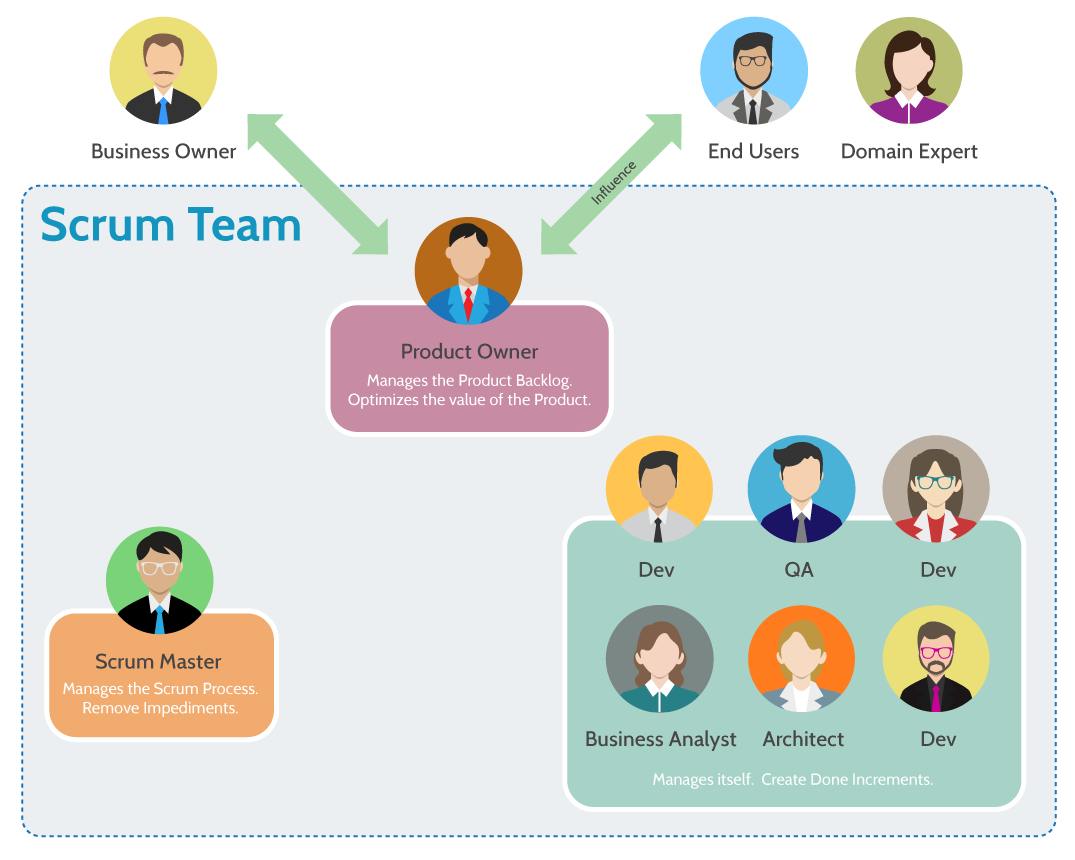
Scrum is commonly part of agile software development. It is named after a rugby formation in which everyone plays a role. The Scrum roles in software development include:
- Product Owner — This person acts as the liaison between the development team and the customer. The Product Owner ensures that the expectations for the completed product are communicated and aligned.
- Scrum Master — Known as the project facilitator. They ensure Scrum best practices are followed. They must be excellent leaders and project managers, skilled in collaboration, conflict resolution, and process improvement.
- Development Team — Members of the Scrum Development Team work together to create and test incremental versions of the final product. Developers must understand Scrum and agile development practices.
What is the Scrum Process?
The Scrum process encourages practitioners to use what they have and continuously evaluate what works and what doesn’t. Good communication is essential and takes place through meetings (called “events”).
Scrum events include the following:
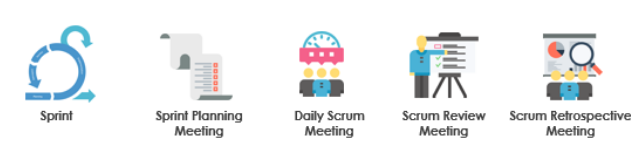
- Daily Standup (Daily Scrum) — This is a short, stand-up daily meeting held at the same time and place every day. In these meetings, the team reviews what was accomplished the previous day and plans what to do in the next 24 hours. This is the time for team members to discuss any issues that might impede project completion.
- Sprint — A Sprint is a fixed time-box (usually 30 days) during which work must be completed. A new Sprint begins immediately after the previous one ends.
- Sprint Planning Meeting — In these meetings, everyone participates in setting goals. At a minimum, the outcome is at least one increment—a usable piece of software.
- Sprint Review — This is the time to demonstrate the increment.
- Sprint Retrospective — The Sprint Retrospective is a meeting held after the Sprint ends. During this meeting, everyone reflects on the process. Team-building exercises can also be included. One key goal of this event is continuous improvement.
What are Scrum Artifacts?
It is useful to review Scrum artifacts during Sprint Planning meetings. Scrum artifacts include the following:
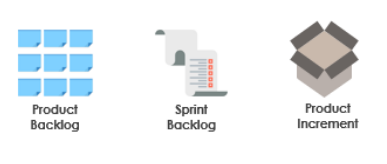
- Product Backlog — This is the list of work yet to be done. During Product Backlog refinement sessions, the development team works with the business owner to prioritize the backlog. The Product Backlog can be fine-tuned in a process called backlog refinement.
- Sprint Backlog — This is the list of tasks that must be completed before delivering the selected Product Backlog items. These are broken down into time-boxed user stories.
- Product Increment — This represents what was completed during a Sprint—all Product Backlog items completed in that Sprint—plus everything created in previous Sprints. The Product Increment reflects the progress made.
- Burn Down Chart — A Burn Down Chart is a visual representation of the amount of work remaining. It has a Y-axis showing work and an X-axis showing time. Ideally, the chart shows a downward trend as remaining work decreases to zero over time.
Benefits of the Scrum Method
The core benefits of Scrum include:
- High-Quality Products — The Sprint Retrospective part of the Scrum process builds on feedback and continuous improvement. As a result, development teams using this method can deliver high-quality products.
- Teamwork — Scrum creates cohesive software development teams that communicate effectively, meet deadlines, and solve problems together. Members trust and respect each other and understand that time is valuable. This may mean limiting Daily Scrums to strict time windows. Some software teams include a “hack sprint” in their process, allowing developers to explore new concepts, test ideas, and take ownership of the product.
- Flexibility — With Scrum, teams must adapt their tools and processes to new circumstances. Product definitions may evolve as development progresses, and effective teams deliver these changes over several iterations. Regular Product Backlog meetings allow the team to reprioritize before items enter a Sprint.
- Reduced Risk — Scrum focuses on predictable, sustainable delivery velocity and consistent feedback, giving teams the opportunity to reduce risk early and often. If an idea doesn’t work, short Sprints allow the team to fail fast, making failure manageable.
- Shorter Time-to-Market — Scrum is designed to release products and features in predictable increments using well-defined Sprints. Releasing features does not require completing the entire product. Sprints are designed to add shippable functionality with each increment. The complete product composed of these features is called a complex product.
- Higher Return on Investment (ROI) — The combined advantages of Scrum lead to higher ROI. Continuous feedback reduces costly errors late in the process and results in better product quality with fewer defects. Shorter time-to-market and incremental releases bring revenue faster.

 English
 Arabic
 Chinese (Simplified)
 Dutch
Dutch French
 German
 Italian
 Japanese
 Korean
 Portuguese
 Russian
 Spanish