Important product backlog items need to be prioritized to ensure it doesn’t become an open list of random ideas from anyone about your product. Your backlog needs to be structured, organized, and prioritized to identify what’s most important for your team. In this article, I’ll introduce the 100-Point Method for product backlog refinement activities.
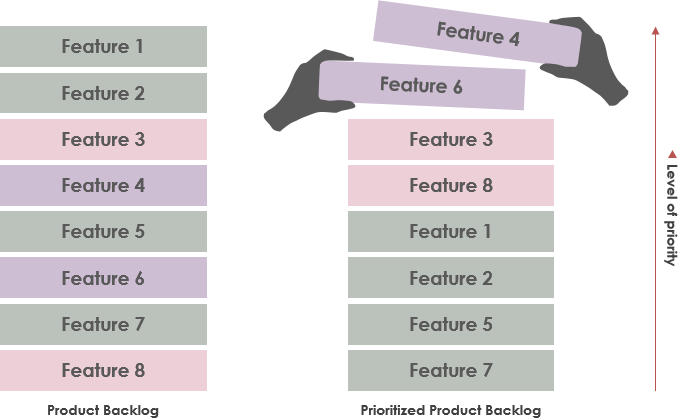
Agile Prioritized Product Backlog
What is the 100-Point Method?
The 100-Point Method (also known as 100 Dollars, Fixed Sum, or Fixed Allocation) was introduced by Dean Leffingwell and Don Widrig in 2003. Its purpose is to prioritize backlog items with higher weighting compared to other available user stories. It involves giving participants 100 points they can allocate to items in the product backlog—such as Epics or user stories that add the most business value. The points do not need to be evenly distributed; instead, they can be assigned in a weighted distribution to reflect that certain items are deemed more important. After the voting process is complete, priorities are determined by calculating the total number of points assigned to each user story.
How Does the 100-Point Method Work?
As mentioned above, the 100-Point Method allows participants to distribute 100 points to prioritize different items. The scoring is displayed in percentages, with the most popular choices ranked from the top.
Imagine a group trying to prioritize 5 items. One person might decide all items are equally important and assign 20 points to each. Alternatively, they might decide Item 1 is more important than Item 2, which is more important than Item 3, and so on, thus distributing votes in a weighted manner—where Item 1 gets 40 votes, Item 2 gets 30, Item 3 gets 15, etc.—until all 100 votes are used. Each person allocates their 100 points. Then, all votes are added together to determine the final vote count for each item, leading to the prioritized list.
Here’s an example of the 100-Dollar / 100-Point Method for a new e-commerce website development:
| Feature | Marketing Rep | IT Manager | Business Owner |
| Customer Registration | 30 | 25 | 35 |
| Social Media Sharing | 20 | 15 | 25 |
| Customer Profile | 25 | 25 | 20 |
| Order Tracking | 25 | 35 | 20 |
| Total | 100 | 100 | 100 |
Summary
Sometimes this method is also referred to as the Fixed Sum or Fixed Allocation Method, because when we give participants the same set of items and ask them to allocate 100 points based on the relative importance of product backlog items.
When making prioritization decisions, they must make trade-offs. The more points assigned to one item means fewer points for others. The depth of decision-making required means this method carries a high cognitive load on participants, but it also brings real value to the decision-making process.
Since the 100-Point Method provides a fixed sum, the correctness of the prioritization is considered valid. Otherwise, some validation procedure would be needed, but this may be worthwhile and can be done through certain software tools.

 English
 Arabic
 Chinese (Simplified)
 Dutch
Dutch French
 German
 Italian
 Japanese
 Korean
 Portuguese
 Russian
 Spanish