ArchiMate is owned and maintained by The Open Group, closely aligned with the Open Group Architecture Framework (TOGAF), but applicable to any EA methodology.
Symbol references clarify functions, roles, processes, participants, products, and services. References define relationships, explaining how they interact and influence each other. Conceptually, ArchiMate evolved from UML, making it easy to understand and integrate into architecture framework development tools.
The most effective use of ArchiMate is generating viewpoints. A single function/process/service in architecture can be represented in multiple ways, depending on the stakeholder reviewing the development status. Senior management needs to know how their requirements, objectives, and principles are being met.
Business unit managers want to confirm that services and products will deliver appropriate offerings to customers. Application, data, and IT systems managers must ensure they can support the delivery framework for services and products.
Concepts
Using TOGAF as a reference, ArchiMate defines different framework development areas after the four iterative phases: Architecture Capability, Architecture Development, Migration Planning, and Architecture Governance. In this model, ArchiMate is divided into 5 concepts, 3 core, and 2 extensions:
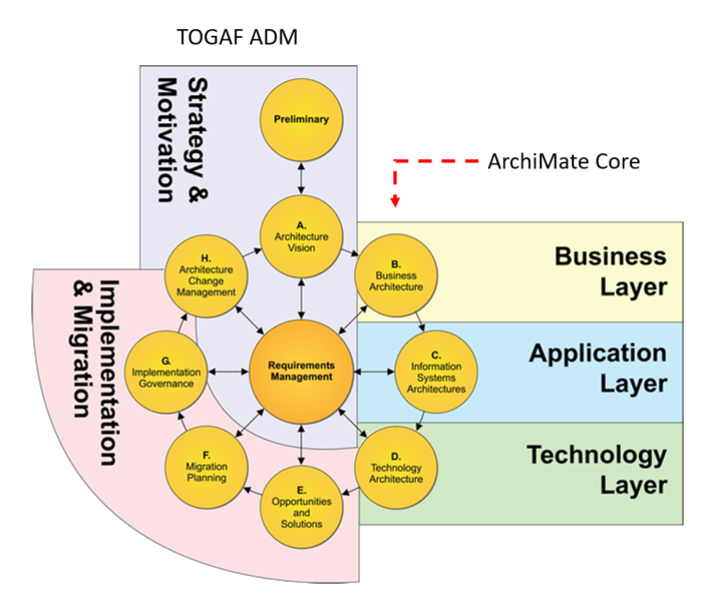
The Core Layers
- Phase B (Phase B) – Business Architecture
- Phase C (Phase C) – Information Systems Architecture
- Phase D (Phase D) – Technology Architecture
Extension (Extension) – Strategy and Motivation
- Preliminary Phase (Preliminary phase)
- Vision Phase (Phase A – Vision)
- Requirement Management (Phase H – Requirement Management)
Extension (Extension) – Implementation and Migration
- Phase E (Opportunities and Solutions)
- Phase F (Migration Planning)
- Phase G (Implementation Governance)
Business Layer Concepts – Phase B (Business Layer)
The business layer defines the highest-level concepts and relationships in architecture: final products; customer delivery systems. This part of the architecture realizes the goals and needs of senior management, which drive the implementation of the enterprise architecture framework.
- Business Actor – Human or computer element that drives the system.
- Business Role – Defines the responsibility authorized to a participant to perform an action.
- Business Collaboration – When different roles execute sequential tasks.
- Business Interface – The place where collaboration operates.
- Location – The physical space where participants reside.
- Business Object – System elements on which the system operates.
- Business Process – Identifier of system processes.
- Business Function – Groups a set of related behaviors.
- Business Interaction – Activities related to business collaboration.
- Business Event – Causal activity that triggers change.
- Business Service – Product delivery oriented toward customers.
- Product – A set of services marketed and sold to customers.
- Contract – Institution that legally establishes an agreement between enterprise and customer.
- Representation – Logical view of a business object.
- Meaning – Knowledge context of a business object or its representation.
- Value – Perceived value, importance, or utility of a product.
Application Layer Concepts – Phase C (Application Layer)
ArchiMate combines application and data architecture into a single layer, representing its concepts. This layer displays the system elements that implement business layer concepts. It explains how business layer concepts are deployed. The application layer works horizontally across the architecture.
- Application Component – A discrete software module that can be replaced or updated without interfering with other application components; accessed via Application Programming Interfaces (API).
- Application Collaboration – A set of two or more application components working together to support an application.
- Data Object – Entity on which an application component acts.
- Application Function – Description of behaviors of an application component.
- Application Service – Provides access to business layer functions, processes, and services.
Technology Layer Concepts – Phase D (Technology Layer)
Technology layer concepts describe the device-level elements of architecture. The descriptive elements in this layer expose IT systems that support the application layer, and in some cases, specific elements of the business layer (such as personal computers). While the application layer shows application components, the technology layer shows which hardware systems contain these components and their relationships.
- Node – General computing resource on a network used for deployment or execution of artifacts.
- Device – General device used to store artifacts to be utilized.
- Network – Physical communication method between hardware devices.
- Communication Path – Logical representation of data flow between two or more nodes.
- Infrastructure Interface – Physical access point for nodes or devices on a network.
- System Software – Physical representation of software and applications.
- Infrastructure Function – Behaviors performed by nodes in collaboration.
- Infrastructure Service – External-facing functional representation.
Concept Extensions
Motivation Concepts
The purpose and goals of the enterprise architecture framework provide meaning for development, governance, and implementation elements. Motivation concepts are defined within the Architecture Capability iteration of TOGAF ADM. Stakeholders, managers, and architects identify principles, drivers, goals, requirements, and constraints for architecture development and implementation.
- Stakeholder – Representative of business function teams.
- Driver – Something that needs to be changed.
- Assessment – Evaluation of the current state, used to check enterprise readiness and change capability.
- Goal – Clear description of the outcome to be achieved through implementing changes.
- Requirement – Specific, well-documented statement of needs.
- Constraint – Limitation imposed by requirements, goals, or principles.
- Parameter – Parameters for achieving goals.
- Restriction – Limitations imposed by competing requirements, goals, and principles.
- Principle – Fundamental, unchanging attributes guiding and directing architecture development.
Implementation and Migration Concepts
This concept represents how business, application, and technology layers are implemented. Implementation and migration begin after the business, architecture, and technology layers are established. It is based on defined baseline, transition, and target architectures; results of gap analysis; high-level architecture roadmap from architecture development iterations; and other documented requirements.
- Work Package – Discrete set of tasks executed during transition from baseline architecture to transition and target architectures.
- Deliverable – Precisely defined outcome of a work package, used to verify completion of work package tasks.
- Plateau – Transition architecture between baseline and target architectures; used by project teams to verify if transition is on track and identify changes needed in the development plan.
- Gap – Determines what is already in place, what is missing, and what needs to be rationalized.
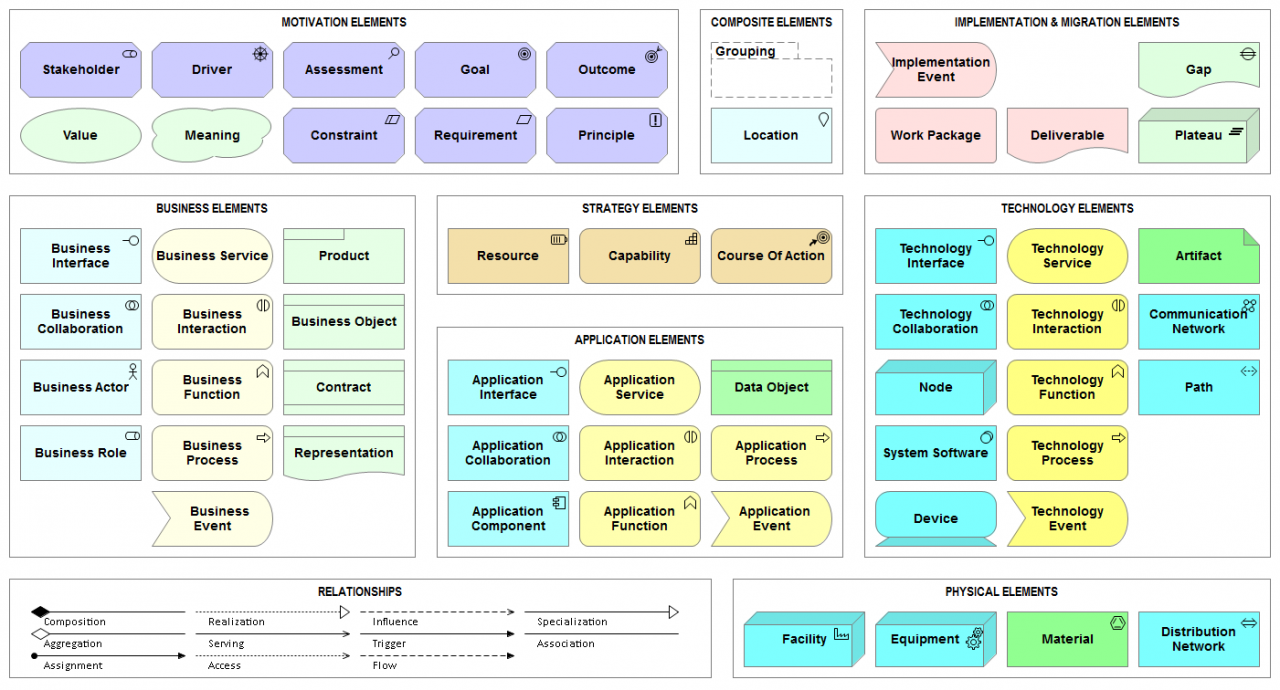
Summary
This article explains only the core concepts of ArchiMate and its relationship with TOGAF.
This modular language further defines the relationships between concepts within and across business, application, and technology layers. It explains how to use ArchiMate notation to build viewpoints tailored to specific audiences. While complex, it is also highly flexible and customizable to any enterprise architecture framework implementation.
Further Reading
- What is ArchiMate?
- Full ArchiMate Viewpoints Guide
- ArchiMate 3 Update
- What’s New in ArchiMate 3?
- Using ArchiMate Tool with TOGAF ADM
- How to Use Value Stream in ArchiMate 3.1?
- What’s New in ArchiMate 3.1?

 English
 Arabic
 Chinese (Simplified)
 Dutch
Dutch French
 German
 Italian
 Japanese
 Korean
 Portuguese
 Russian
 Spanish