In Chapter 1 of this series, we outlined the ArchiMate concepts that symbolize the artifacts that make up the TOGAF architecture framework. There are specific relationships between each concept, representing flow, dependency, realization, etc. Relationships usually have specific pairings, but not always.
The ArchiMate language also defines a set of core generic relationships, each of which can connect a predefined set of source and target concepts (mostly elements, but in a few cases also other relationships). Many of these relationships are “overloaded”; that is, their exact meaning varies depending on the source and target concepts they connect.
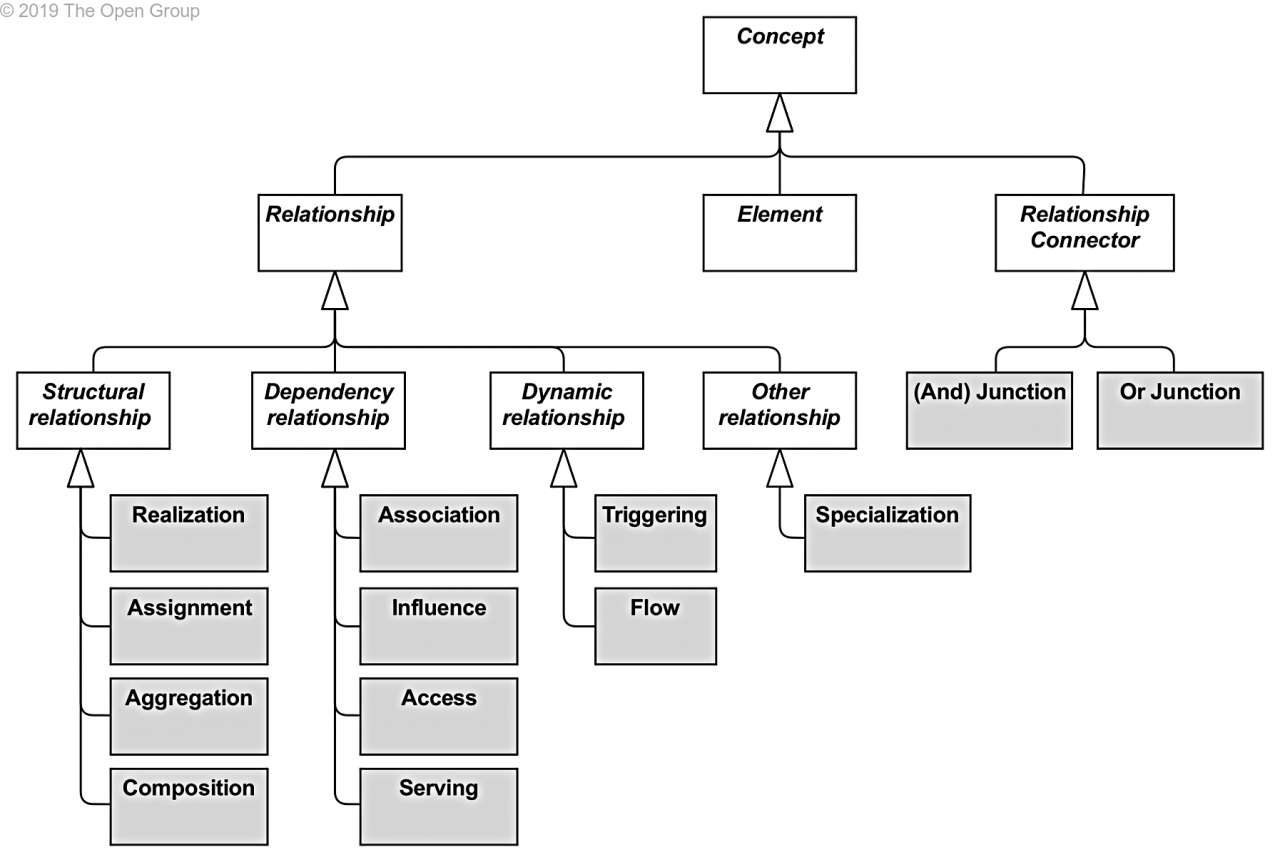
Relationships are classified as follows (see figure):
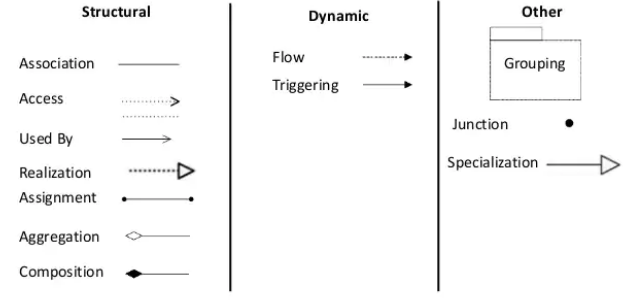
- Structural relationships: model static composition or aggregation of concepts of the same or different types
- Dependency relationships: model how elements are used to support other elements
- Dynamic relationships: used to model behavioral dependencies between elements
- Other relationships: relationships that do not belong to any of the above categories
Consider the following diagram:
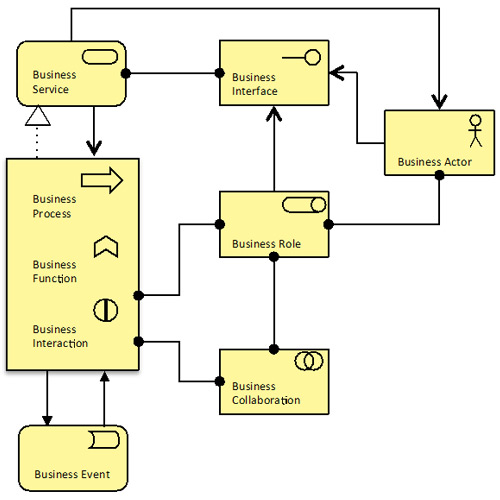

The box symbols represent concepts, and the connectors represent relationships. The diagram shows the relationships between these concepts: Assignment, Trigger, Realization, and Used by.
Relationship Definitions
Structural Core Relationships
Association: Models a relationship between objects where the relationship is not covered by another more specific relationship. Usually used when the relationship is unknown or irrelevant to the viewpoint.


Access: Models the access of behavioral concepts to business or data objects.


Used by: Models the use of services by processes, functions, or interactions, and the access to interfaces by roles, components, or collaborations.


Realization: Links a logical entity to a more concrete entity that realizes it; i.e., the logical representation of a real object (a data object is real; a report is a logical entity realized by a data object).


Assignment: Links a unit of behavior to an active element that performs it (e.g., role, component) or a role to the actor that performs it.


Aggregation: Indicates that one object combines many other objects. An object can be part of multiple aggregation objects.
Composition: Indicates that one object consists of one or more other objects. The latter objects can only be part of one composition.




Dynamic Core Relationships
Flow: Describes the exchange or transfer of information or value between processes, functions, interactions, and events.


Trigger: Describes a temporal or causal relationship between processes, functions, interactions, and events.


Other Core Relationships
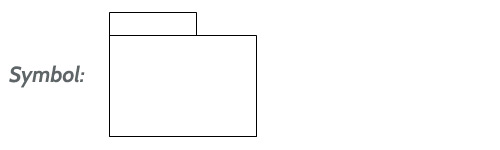
Grouping: Indicates that objects of the same or different types belong together based on some common characteristic.

Junction: Used to connect relationships of the same type.


Specialization: Indicates that one object is a specific kind of another object.


Motivation Extension Relationships
Motivation relationships handle interactions/dependencies between motivation concepts, such as drivers, goals, principles, etc. Two of these relationships are similar to core relationships but have different connotations: Aggregation and Realization. Influence is unique to Motivation.
Aggregation: Models the division of an intention into multiple intentions (arrow points to the more general, undivided intention).


Realization: Models that some purpose is realized by some means.


Influence: Models that some motivation element has a positive or negative influence on the realization or achievement of another motivation element.

Relationship Summary
Table: Overview of ArchiMate relationships and their definitions.
| Structural Relationships | Symbol | Role Names | |
| Composition | Indicates that one element consists of one or more other concepts. | 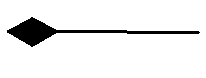  |
← composes → composed of |
| Aggregation | Indicates that one element combines one or more other concepts. | 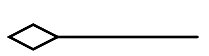  |
← aggregates → aggregated in |
| Assignment | Represents the allocation of responsibility, performance of behavior, storage, or execution. |   |
← assigned to → assigned |
| Realization | Indicates that one entity plays a critical role in the creation, achievement, fulfillment, or operation of another entity. | 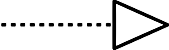  |
← realizes → realized by |
| Dependency Relationships | Symbol | Role Names | |
| Serving | Indicates that one element provides its functionality to another element. | 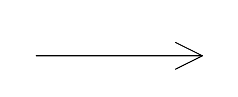  |
← serves → served by |
| Access | Indicates the ability of behavioral and active structure elements to observe or act upon passive structure elements. | 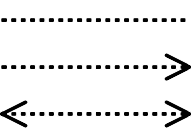  |
← accesses → accessed by |
| Influence | Indicates that one element has a positive or negative influence on the realization or achievement of another motivation element. | 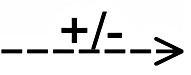  |
← influences → influenced by |
| Association | Indicates an unspecified relationship, or a relationship not expressed by another ArchiMate relationship. | 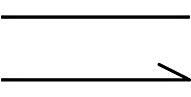  |
associated ← associated with → associated from |
| Dynamic Relationships | Symbol | Role Names | |
| Triggering | Indicates a temporal or causal relationship between elements. |   |
← triggers → triggered by |
| Flow | Indicates a transfer from one element to another. |   |
← flows to → flows from |
| Other Relationships | Symbol | Role Names | |
| Specialization | Indicates that one element is a specific kind of another element. | 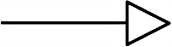  |
← specializes → specialized by |
| Relationship Connectors | Symbol | Role Names | |
| Junction | Used to connect relationships of the same type. | 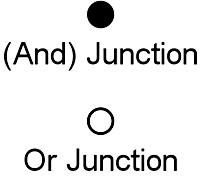  |
|
Next time…
In the next blog post, we will demonstrate how to combine concepts and relationships to create viewpoints and other visualizations.

 English
 Arabic
 Chinese (Simplified)
 Dutch
Dutch French
 German
 Italian
 Japanese
 Korean
 Portuguese
 Russian
 Spanish