Layers and Architecture
ArchiMate Language defines three primary layers based on the core concepts introduced in the previous article.
- Business Layer delivers products and services to external customers, which are implemented by business processes carried out by business actors within the organization.
- Application Layer supports the business layer services, which are implemented by (software) applications.
- Technology Layer provides infrastructure services required to run applications (e.g., processing, storage, and communication services), implemented through computer and communication hardware and system software.
The general structure of models within each layer is similar. The same types of concepts and relationships are used, although their exact nature and granularity differ.
The key relationship between layers is the “used by” relationship: higher layers use services provided by lower layers.
Another key relationship is the “implementation” relationship: elements in lower layers may implement comparable elements in higher layers:
- A “data object” (in the Application Layer) can implement a “business object” (in the Business Layer).
- An “artifact” (in the Technology Layer) can implement a “data object” or “application component” (in the Application Layer).
The aspects and layers identified earlier can be organized into a nine-cell framework:
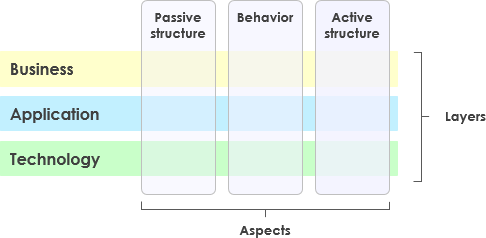
It is important to recognize that the classification based on aspects and layers is merely a high-level categorization. It is impossible to define strict boundaries between aspects and layers, as concepts connecting different aspects and layers play a central role in coherent architectural descriptions.
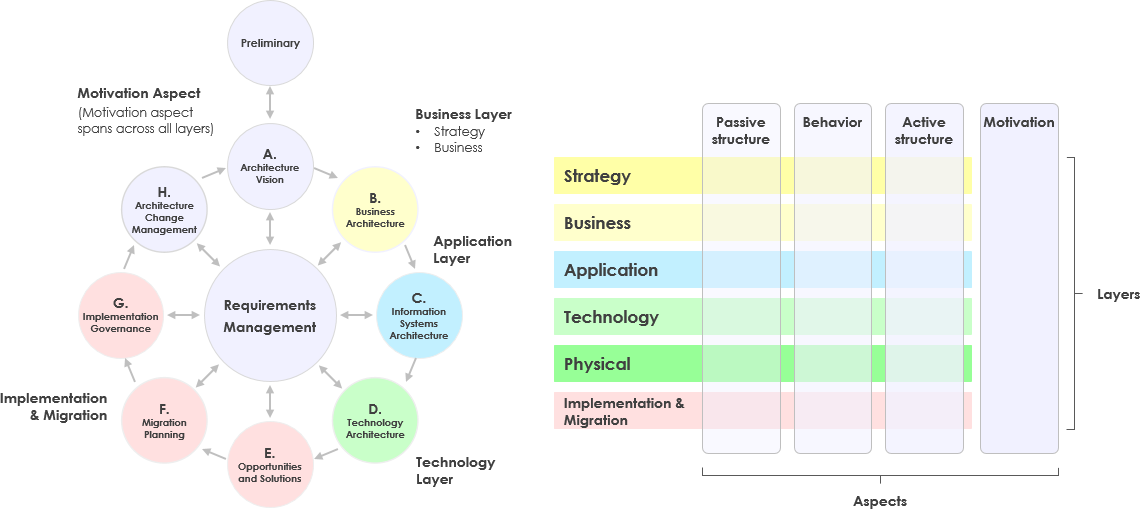
Learn more about the integration mapping in the latest version of TOGAF and ArchiMate 3.1:
- What is ArchiMate?
- Complete ArchiMate Viewpoints Guide
- What is TOGAF?
- TOGAF ADM Tutorial
- TOGAF 9.1 Framework – Comprehensive Guide
- TOGAF Software for Enterprise Architecture
- ArchiMate 3 Update
- Best TOGAF Software
- Practical TOGAF Tutorial
- Step-by-Step Enterprise Architecture Tutorial with TOGAF ADM
- Essential TOGAF ADM Knowledge for EA Development
- TOGAF 9.2: What’s New?
- What’s New in ArchiMate 3?
- Using ArchiMate Tool with TOGAF ADM
- How to Use Value Stream in ArchiMate 3.1?
- How to Perform Stakeholder Management in TOGAF?
- TOGAF Stakeholders – Views, Concerns, and Requirements
- TOGAF vs Zachman Framework
- Case Study: Using ArchiMate with TOGAF
- TOGAF ADM and Architecture Content Framework

 English
 Arabic
 Chinese (Simplified)
 Dutch
Dutch French
 German
 Italian
 Japanese
 Korean
 Portuguese
 Russian
 Spanish