Quick Learning ArchiMate Part 5 – Extended Layers
Some TOGAF development phases are not included in ArchiMate Core because TOGAF has a broader scope, especially addressing more advanced strategic issues and lower-level engineering aspects of system development, while ArchiMate Core is limited to enterprise architecture abstraction levels.
However, the new extended layers described in ArchiMate 3.0 address these additional concerns. They define concepts such as goals, principles, and requirements, as well as concepts oriented toward planning and migration.
ArchiMate‘s most effective use is in generating viewpoints. A single function/process/service within an architecture can be represented in multiple ways, depending on the stakeholders reviewing the development status.
Some TOGAF development phases are not included in ArchiMate Core because TOGAF has a broader scope, especially addressing more advanced strategic issues and lower-level engineering aspects of system development, while ArchiMate Core is limited to enterprise architecture abstraction levels.
However, the new extended layers described in ArchiMate 3.0 address these additional concerns. They define concepts such as goals, principles, and requirements, as well as concepts oriented toward planning and migration.
ArchiMate‘s most effective use is in generating viewpoints. A single function/process/service within an architecture can be represented in multiple ways, depending on the stakeholders reviewing the development status.
Senior management needs to know how their requirements, goals, and principles are being met. Business unit managers want to confirm that services and products will deliver appropriate value to customers. Application, data, and IT systems managers must ensure they can provide the supporting framework for services and products.
Relationship Between ArchiMate Layers and TOGAF
In this article, we will refer to Figure 1 to examine the relationship between ArchiMate and TOGAF.
The introduction to these articles explains that ArchiMate, developed by The Open Group, is closely related to the TOGAF model. Most of the relationship pertains to the Architecture Development phases BD, but more recently The Open Group has added concepts of motivation and implementation and migration. This makes modeling tools effective throughout the entire TOGAF ADM.
Core Concepts (Core Layers)
The standard concepts in ArchiMate provide graphical representations of various elements within the architecture framework. These elements include actors, roles, services, functions, collaborations, data and application objects, processes, and more. Each phase of TOGAF Architecture Development (Business, Information Systems Architecture, and Technology) has its own unique set of concepts.
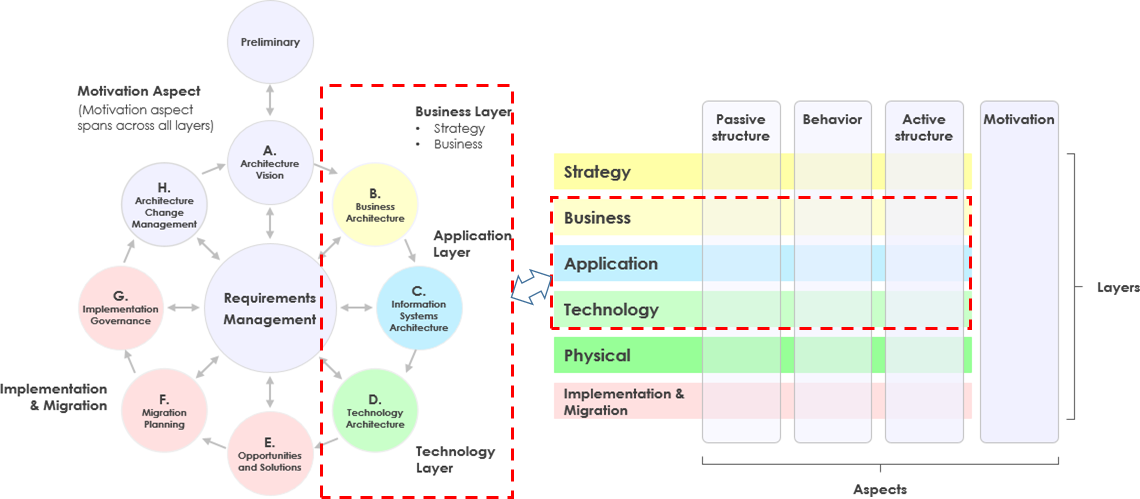
The diagram above illustrates the mapping between phases B, C, D and ArchiMate layers. Note that phase B maps to the ArchiMate Business Layer, phase C maps to the Application Layer, and phase D maps to the Technology Layer. The application layer in ArchiMate deals with data and application elements.
This is the core of ArchiMate. Each layer is broken down into three types of concepts: passive structure, behavior, and active structure. Passive structure elements are read and written by active structure elements. Behavior elements describe transactions between active and passive structure elements, as well as among active structure elements.
Examples of passive structure elements are contracts, data objects, and products. Actors, roles, collaborations, and other elements representing active structures. Functions, processes, and events are some elements representing behavioral structure.
Motivation (Strategy and Motivation Layers)
The motivation concepts apply to architectural capability development.
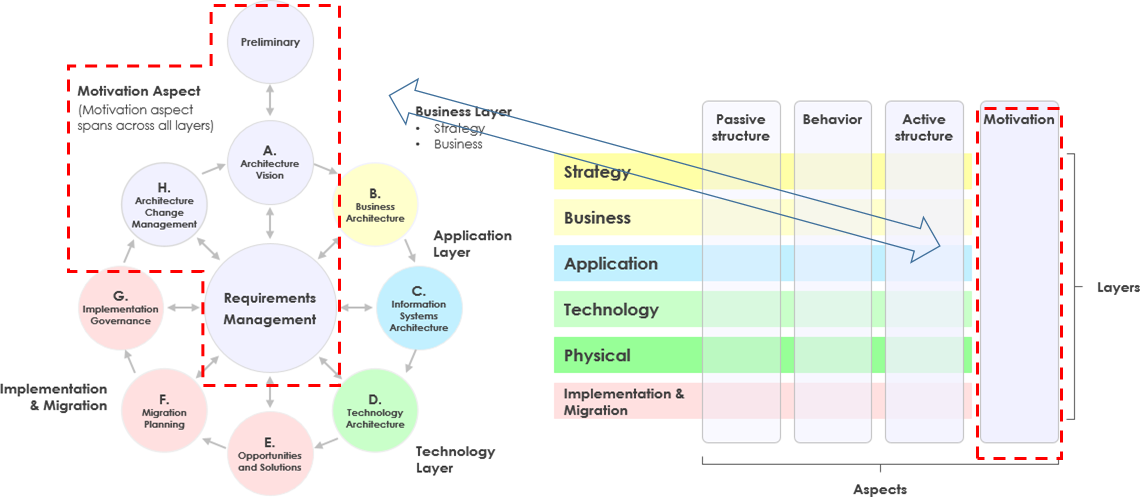
Its concepts include stakeholders, assessments, drivers, goals, principles, constraints, and requirements. These concepts help understand how enterprise architecture remains aligned with its environment, the people or organizations influencing, guiding, or constraining it, and the internal or external factors affecting plans and goals.
Implementation and Migration (Implementation and Migration Layers)
The implementation and migration concepts in ArchiMate apply to transition planning and architecture governance. Its concepts include work packages, deliverables, gaps, and plateaus.
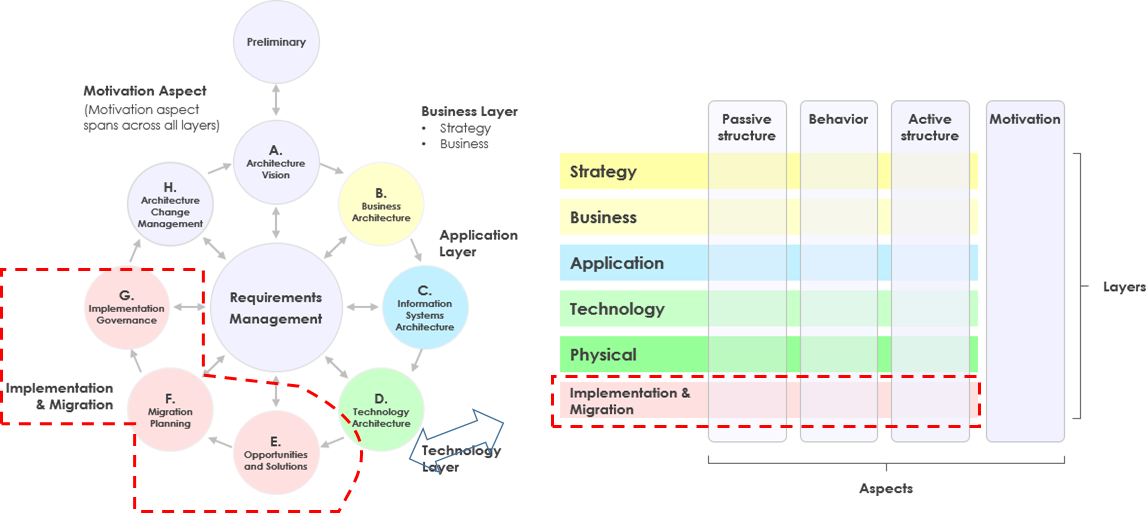
These concepts help understand the plans/projects for implementing, the results and outcomes generated as part of the implementation, and the baseline, transition, and target architectures. The differences between architectural states are addressed within migration plans.
Summary
This article provides a thumbnail overview of how ArchiMate maps to the TOGAF model, particularly in relation to ADM.
The next article will provide a detailed introduction to the standard concepts.
- What is ArchiMate?
- Full ArchiMate Viewpoints Guide
- ArchiMate 3 Update
- What’s New in ArchiMate 3?
- Using ArchiMate Tool with TOGAF ADM
- How to Use Value Stream in ArchiMate 3.1?
- What is New in ArchiMate 3.1

 English
 Arabic
 Chinese (Simplified)
 Dutch
Dutch French
 German
 Italian
 Japanese
 Korean
 Portuguese
 Russian
 Spanish