The Chicken and the Pig’s business fable explains the roles of the Pig and the Chicken in the Scrum process. It’s a way to distinguish between roles in the Scrum / Agile world. Roles are key to agility. They are immutable, serve as the foundation for every decision, and define the most fundamental interpersonal relationships in Scrum.
The Pig and the Chicken Fable
The fable of the Pig and the Chicken illustrates the different levels of involvement of stakeholders in a project. The basic fable goes like this:
The Pig and the Chicken are walking down the road.
The Chicken says: “Hey Pig, I think we should open a restaurant!”
The Pig replies: “Hmm, maybe. How should we call it?”
The Chicken responds: “How about ‘Ham and Eggs’?”
The Pig thinks for a moment and says: “No, thanks. I’ll be committed, but you’ll just be involved.”
Sometimes, the story is a riddle;
Question: What’s the difference between the chicken and the pig in a bacon and egg breakfast?
Answer: The chicken is involved, but the pig is committed!
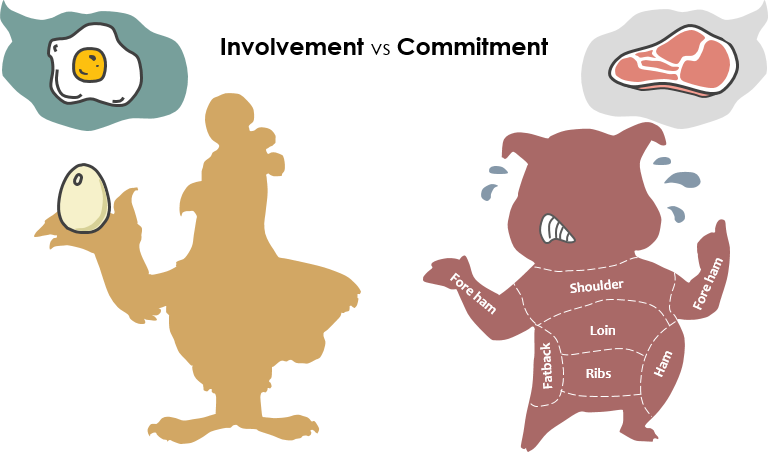
Scrum Pig and Chicken
The Pig and the Chicken in the Scrum Context
The business fable of the Pig and the Chicken is about commitment to a project or venture. When producing a plate of ham and eggs, the pig provides the ham, which requires sacrifice, while the chicken provides the eggs, which are less demanding to produce. Therefore, the pig is committed to the dish, while the chicken is only involved, yet both are essential to creating the meal.
In the context of Scrum, the chicken contributes to the product to be developed, but the pig determines how it will be completed and at what pace it can be delivered. Thus, the pig includes the development team members, while the Product Owner and Scrum Master—representing the chicken—responsible for organizing some Scrum events, especially during Scrum stand-ups. Customers, vendors, managers, and other key stakeholders with a vision are, in fact, the chickens in Scrum.

 English
 Arabic
 Chinese (Simplified)
 Dutch
Dutch French
 German
 Italian
 Japanese
 Korean
 Portuguese
 Russian
 Spanish