The Eight Lean Wastes
Lean organizations understand customer value and focus on their key processes to continuously improve it. The ultimate goal is to deliver perfect value to the customer through a perfect value creation process with zero waste.
What is Waste?
Waste is any step or activity in a process that does not contribute to successfully completing the process (referred to as “non-value-added”). When waste is eliminated, only the necessary steps (referred to as “value-added”) remain, which deliver a satisfactory product or service to the customer.
These are the eight wastes:
- Defects – Products or services that require resources to correct beyond specification requirements.
- Overproduction – Producing more products than needed before they are ready for sale.
- Waiting – Time spent waiting for the previous step in the process to complete.
- Underutilized Talent – Employees not effectively engaged in the process.
- Transportation – Moving items or information from one place to another that do not need to be processed.
- Inventory (or Information) in Process – Unnecessary stockpiling of inventory or information that is not being actively used.
- Overprocessing – Unnecessary actions performed by people, information, or equipment due to poor workspace layout, ergonomic issues, or searching for misplaced items.
- Extra Processing – Any activity that is not required for a product or service to function normally during production.
Later, the Lean concept was adapted by Eric Ries in his famous book, “The Lean Startup.”
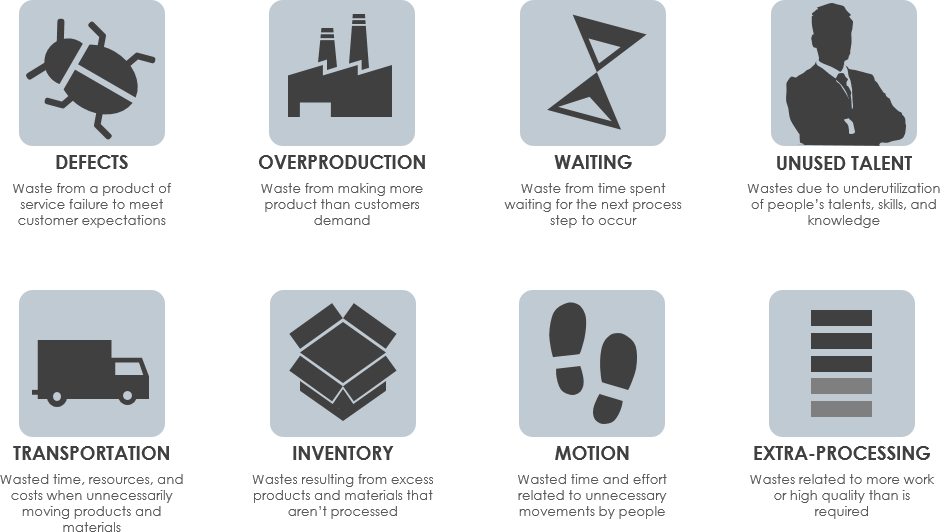
8 Scrum Wastes
Five Steps of the Lean Approach
The five-step thinking process guiding the implementation of Lean is easy to remember, but not always easy to execute:
- Define value from the end customer’s perspective, by product family.
- Identify all steps in the value stream for each product family, eliminating as many non-value-adding steps as possible.
- Make the value-creating steps flow in sequence so the product moves smoothly toward the customer.
- As flow is introduced, pull value from the next upstream activity.
- As value is defined, identify the value stream, eliminate waste, introduce flow and pull, restart the process, and continue until reaching the ideal state—where perfect value is created without any waste.
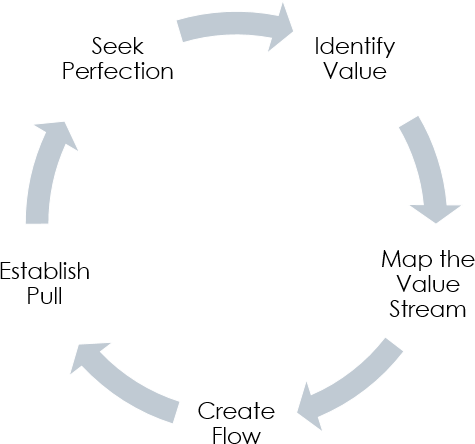
5 Steps Lean Approach
Agile, Lean, and Scrum
Lean predates the Agile manifesto by a significant margin. It originated in post-war Japanese factories aiming to improve productivity.
The diagram below is often misunderstood—Agile is a subset of Lean, and Scrum is a subset of Agile.
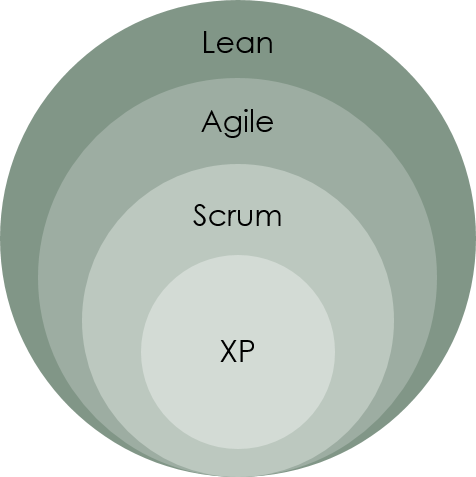
What It Means:
- Lean methodology covers a broader scope—principles like “limit work in progress” and “continuous process improvement” apply almost to any environment.
- Agile is higher-level—essentially a set of values and principles without specific practices.
- Scrum sits between the two—it is not limited to software development and requires the use of time-boxed events (e.g., sprints) and a product backlog.
- XP (Extreme Programming) is more specific, focused exclusively on engineering best practices within software development.
In short, a Lean project becomes highly effective when it incorporates Agile concepts into its execution. After all, Lean means “lean”—without excess or waste—meeting all the requirements proposed by Agile methodologies.

 English
 Arabic
 Chinese (Simplified)
 Dutch
Dutch French
 German
 Italian
 Japanese
 Korean
 Portuguese
 Russian
 Spanish