Whether you’re a Scrum Master, project manager, Product Owner, team member, or simply someone trying to answer “How do you run an Agile Scrum project in the real world?” — this article will definitely provide you with the answers you need.
Traditional Project Management
The traditional project management (waterfall) approach is linear, where all phases of the process occur sequentially. This method relies on predictable tools and predictable experience. Each project follows the same lifecycle, including feasibility, planning, design, build, testing, production, and support phases, as shown in the figure below.
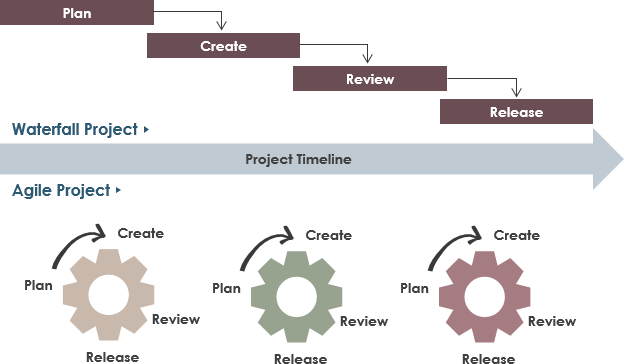
Waterfall vs Agile Software Development
The entire project is pre-planned with no room for change in requirements — like Waterfall, PMI’s PMBOK, and PRINCE2 are rigid and highly controlled. They outline distinct phases from start to finish and assume you already have all the requirements and information you need.
This approach assumes time and cost are variables, while requirements are fixed — which is why traditional project management often struggles with budget and schedule issues.
Agile Project Management
While traditional systems focus heavily on upfront planning, factors like cost, scope, and time are critical. Agile, on the other hand, emphasizes teamwork, customer collaboration, and flexibility.
Agile rejects traditional project management as tedious, restrictive, and unsuitable for the fast-paced modern world. Agile project management is iterative, aiming to continuously integrate user feedback and ongoing releases with each development iteration, as shown above. Each task output is a product you sell to stakeholders. Teams and workflows are structured around creating something directly useful to the customer.
Traditional or Agile – How to Choose?
According to the 2011 CHAOS Report by the Standish Group, Agile projects are three times more successful than Waterfall projects. The chart below shows the specific results from studies conducted between 2002 and 2012:
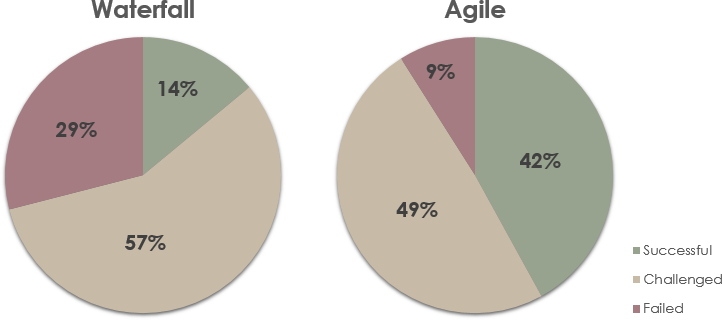
Success Rate of Waterfall vs Agile Projects
Differences Between Traditional and Agile
The table below summarizes many key differences between Scrum and traditional project management models.
| Category | Traditional | Agile |
| Development Model | Sequential (Waterfall) | Iterative |
| Focus | Process | People |
| Management Style | Control | Facilitation |
| Customer Involvement | Limited to requirements gathering and delivery phases | Continuous and on-site involvement |
| Developer Work Style | Works individually within the team | Collaborative or pair programming |
| Technology | Any | Primarily object-oriented |
| Product Features | All features included | Most important features first |
| Testing | At the end of the development cycle | Iterative and/or test-driven |
| Documentation | Extensive | Only when needed |
Cost of Change
Traditionally, changes to software projects are avoided because the cost increases significantly later in the project. Agile software development recognizes that change is inevitable and that investing heavily in upfront planning is impractical. This is clearly expressed in one of the four values of the Agile Manifesto:
“Responding to changing requirements over following a fixed plan.”
Agile challenges this notion and argues that the cost of change may be relatively flat, as shown in the figure below:
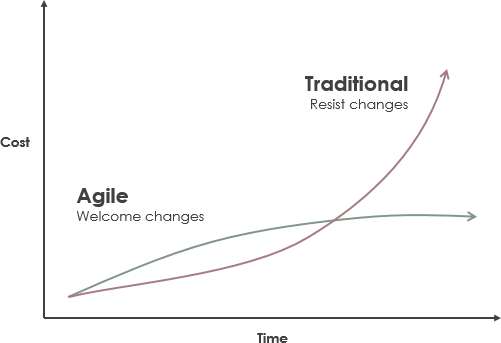
Cost of Change in Traditional vs Agile
Agile vs Traditional Iron Triangle in Project Management
Project management success has traditionally been associated with the ability to manage constraints in scope, time, cost, and quality, as shown in the figure below. This is a popular metaphor suggesting that project managers are expected to balance these constraints reasonably.
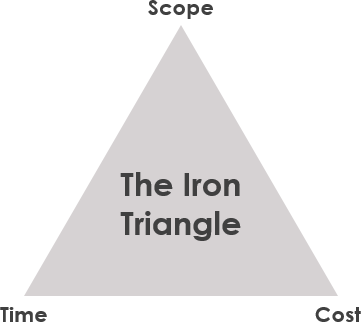
Iron Triangle in Agile vs Traditional Project Management
What Is the Problem with the Traditional Iron Triangle?
For example, a project can be completed faster by increasing the budget or reducing the scope. Similarly, expanding the scope typically requires a corresponding increase in budget and timeline. Cutting the budget without adjusting the timeline or scope leads to a decline in quality. However, in practice, trade-offs between constraints are not always feasible. For instance, investing more funds (and people) in a project with ample resources may actually slow down progress. Moreover, in poorly performing projects, improving budget, schedule, or scope without negatively impacting quality is often impossible.
As such, the traditional Iron Triangle is clearly insufficient as a model for project success, as it overlooks key dimensions of success, including stakeholder impact, learning, and user satisfaction.
Agile Iron Triangle – A Paradigm Shift
In the traditional approach, the triangle usually looks like the left one shown below. As you can see, product requirements have a fixed scope. Therefore, to ensure the product delivers all the required features, we need flexibility in our resources (and budget) and timeline (deadline). If we absolutely need the product to include the full list of features described in the initial requirements specification, we may need to delay the release date by months or more.
In the Agile sense, there is a fixed timeline (in Scrum, this is achieved through time-boxed Sprints and fixed resources). Therefore, when things don’t go as planned, scope must be reduced. But in Agile, we ensure that even if we must compromise on scope, we still deliver the highest-priority items from the Product Backlog to maximize the value generated by the project.
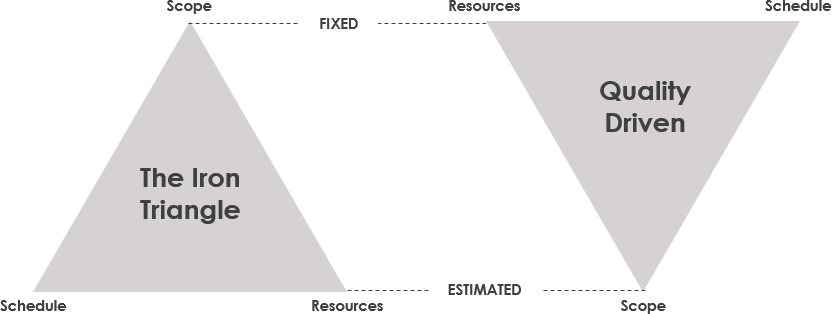
Iron Triangle in Agile Context

 English
 Arabic
 Chinese (Simplified)
 Dutch
Dutch French
 German
 Italian
 Japanese
 Korean
 Portuguese
 Russian
 Spanish