Before we start learning, understanding, or discussing Tuckman’s principles, let’s first go over some key agile terms.
Terminology
- Motto — One Team, One Goal
- Process — Inspect and Adapt
- Execution — Iterative and Incremental
- Team Qualities — Courage, Accountability, Respect, Cross-functional
- Rituals/Ceremonies — Backlog Grooming/Refinement, Sprint Planning, Daily Standup, Sprint Review, Retrospective
- Scrum Master — Servant Leader
Tuckman’s Principle
In 1965, a philosopher named Bruce Tuckman defined group dynamics. Based on his work, every team must go through five stages during the project lifecycle.
Forming, Storming, Norming, Performing, and Adjourning (added in 1977).
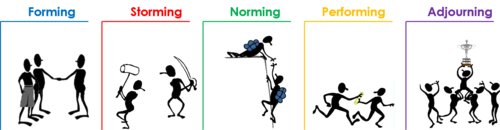
Forming — This is the initial stage when the group first comes together. As a leader, it’s important to give the team time to get to know each other. When the group begins to form, factions often emerge immediately. People introduce themselves to better understand one another. They talk about their strengths and weaknesses when working as a team.
Storming — This is the second stage of the theory and often the most dangerous in terms of team success. Team members have disagreements and try to reach consensus. This stage is necessary because it provides an opportunity for the team to improve. It occurs as they start working and planning. The team needs a clear goal to avoid being distracted by emotional issues or interpersonal conflicts. Tuckman considered this a critical stage that helps teams grow into better teams.
Norming — This is the turning point. Team members accept the process and begin working together effectively. They build trust with one another. When people find ways to collaborate despite differences, the team gains stronger cohesion. Relationships and communication within the group become more dynamic. Teammates cooperate better, and the team starts to develop its own identity.
Performing — The team begins to perform at a high level. By placing team needs above individual ones, they focus on shared goals and find ways to resolve any issues that arise. The team has a clear understanding of what’s happening, greater strategic awareness, and a shared vision. They can work together without major conflicts. Disagreements are resolved quickly, and the team becomes more positive. Members look after each other. They need leadership tasks to keep things running smoothly but require less guidance as the project nears completion. The team leader oversees the teammates.
Adjourning — To grow, face challenges, solve problems, find solutions, plan work, and deliver results, all of the above stages are necessary and inevitable. The best real-world example of this principle is the team in the movie The Avengers.
How to Apply Tuckman’s Principle in Scrum
The fastest and most accurate way to reach Performing is to minimize the duration of the Storming stage. There are many ways to achieve this in different product development processes, but in Scrum Agile, it is one of the inherent behaviors or characteristics of the process itself. Agile is designed to always try to reduce the Storming stage.
How Does Agile Minimize the Storming Stage?
- Scrum Master: Agile introduces the concept of a Servant Leader (the Scrum Master), who is not a team leader or project manager. Their primary goal is to remove obstacles for the Scrum Team and provide an environment where the team can easily complete defined tasks, user stories, and epics. By eliminating tangible and intangible barriers, the Scrum Master helps shorten the duration of the Storming stage.
- Scrum Team and Motto — A self-driven team with qualities such as transparency, courage, etc., helps avoid the Storming stage. In Scrum, success is measured by the team—not individuals—so the entire team represents one unit working toward one goal. The team should be cross-functional, so when someone has extra time in a defined Sprint, they can pick up any task or user story and try to complete it according to the Definition of Ready and Definition of Done.
- Inspect and Adapt — Scrum is a process of inspection and adaptation. At the first sign of problems, issues, or obstacles, people become aware of them and try to resolve or prevent them. This helps avoid unnecessary delays and blame games.
- Ceremonies — Sprint Planning meetings involve team-based estimation and rating of user stories, which avoids unreasonable assessments and task assignments. Tasks are accepted based on capacity and availability, reducing dependencies and helping everyone grow according to their skills. Daily Standups help identify dependencies or blockers faced by individuals or the team—resolving them prevents internal conflict. Sprint Review meetings, attended by all stakeholders, clarify expectations and increase transparency across the team. Neutral and unbiased Retrospective meetings help identify areas for improvement. There are many ways to conduct them, but the main focus is on solving issues rather than blaming individuals—this helps minimize the Storming stage of Tuckman’s principle.
In short, following a traditional agile process can help minimize the Storming stage and allow the team to easily reach the Norming stage. Even if we customize the agile process, it’s ideal to follow its core principles, team qualities, and celebrate all ceremonies to reduce the Storming phase as much as possible.
* Bruce Tuckman is famous for his research on human dynamics. He published a model called Tuckman’s Stages of Team Development in 1965. The theory originally had four stages, but a fifth stage was added in 1977.
- What is Scrum Team?
- What is a Self-Organizing Team in Scrum?
- How Scrum Team Works? – A Brief Guide
- Feature Team vs Component Team in Agile
- How to be a Good Product Owner in Scrum Project?
- What is Product Owner’s Role in Scrum?
- Agile Development: How to Become a Qualified Scrum Master?
- What is Pig and Chicken in Scrum?
- Project Manager vs Scrum Master vs Project Owner
- What Are The Three Scrum Roles?
- What is a Scrum Master? The Role and Responsibilities
- What is Cross-Functional Team in Agile?
- As a Scrum Master, How Can You help Your Project Owner?

 English
 Arabic
 Chinese (Simplified)
 Dutch
Dutch French
 German
 Italian
 Japanese
 Korean
 Portuguese
 Russian
 Spanish