Unified Modeling Language (UML)
Key Concepts
Unified Modeling Language (UML) is a general-purpose modeling language widely used for software system design and development. It provides a set of standardized diagrams to describe the structure and behavior of a system. The main UML diagrams include:
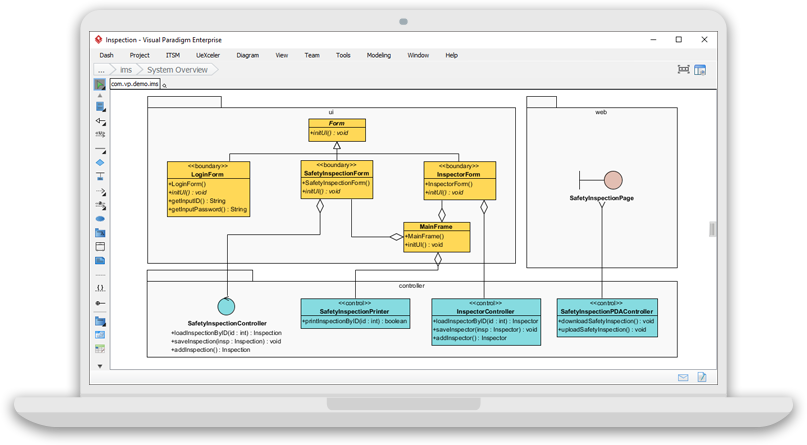
- Class Diagram: Shows classes in the system and their relationships.
- Sequence Diagram: Illustrates the order of interactions between objects.
- State Diagram: Depicts state changes of an object throughout its lifecycle.
- Activity Diagram: Represents workflows or business processes.
Business Process Model and Notation (BPMN)
Key Concepts
Business Process Model and Notation (BPMN) is a graphical notation specifically designed for business process modeling. It offers a set of visual elements to describe the steps and participants in a business process. The core elements of BPMN include:
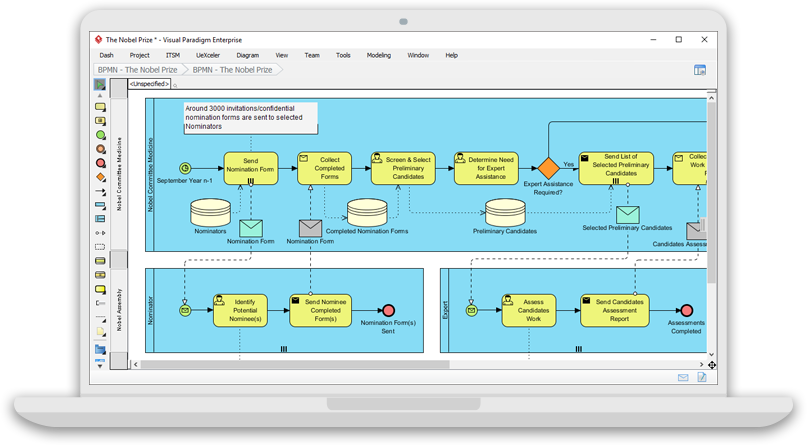
- Events: Represent occurrences in a process, such as start, end, or intermediate events.
- Activities: Represent tasks or work within a process.
- Gateways: Control the branching and merging of process flows.
- Flow Objects: Connect events, activities, and gateways to represent the sequence of a process.
Systems Modeling Language (SysML)
Key Concepts
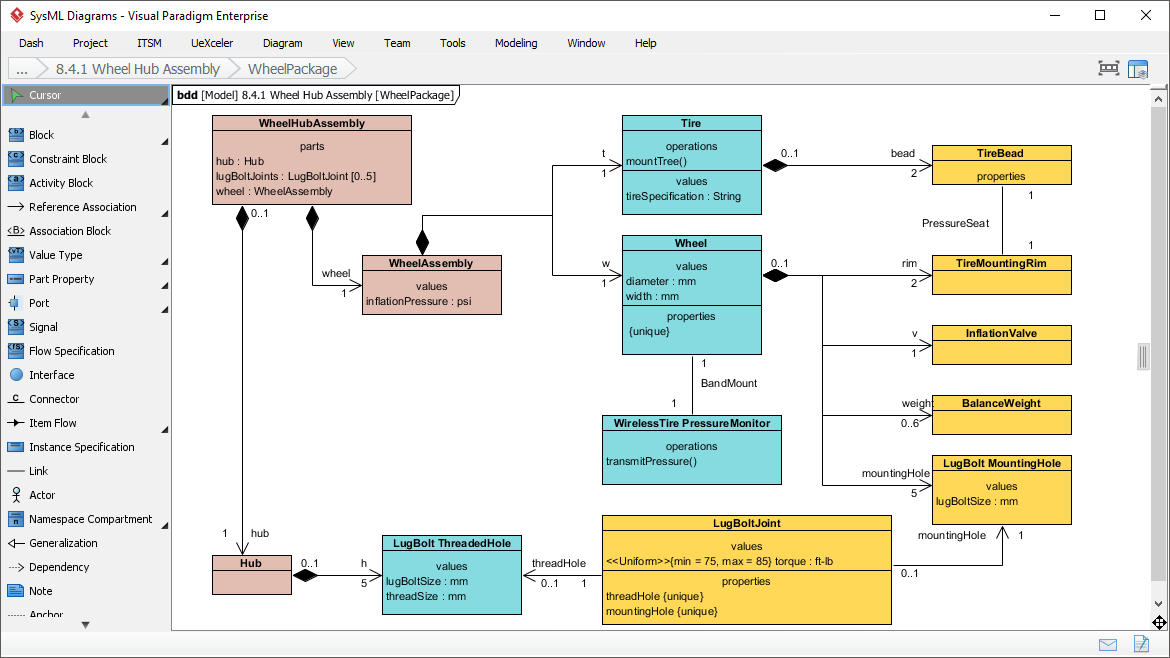
SysML is a specialized modeling language for systems engineering, extending from UML. It provides a set of diagrams to describe the structure, behavior, requirements, and parameters of complex systems. The primary SysML diagrams include:
- Requirements Diagram: Illustrates system requirements and their relationships.
- Structure Diagram: Depicts the physical and logical structure of a system.
- Behavior Diagram: Shows the behavior and interactions within a system.
- Parametric Diagram: Represents constraints and parameters within a system.
Comparison and Contrast
| Feature | UML (Unified Modeling Language) | BPMN (Business Process Model and Notation) | SysML (Systems Modeling Language) |
|---|---|---|---|
| Application Scenario | Software system design and development | Business process modeling | Systems engineering, complex system modeling |
| Primary Diagrams | Class diagrams, sequence diagrams, state diagrams, activity diagrams | Events, activities, gateways, flow objects | Requirements diagrams, structure diagrams, behavior diagrams, parametric diagrams |
| Advantages | Highly general-purpose, applicable to various software systems | Focused on business processes, intuitive and easy-to-understand graphical elements | Extends from UML, offers more diagram types, ideal for complex systems |
| Example | Describing relationships between classes and objects in a software system | Describing steps and decision points in a business process | Describing the physical and logical structure, behavior, and constraints of a system |
| Applicable Domains | Software development, system design | Business process management, enterprise architecture | Systems engineering, complex system design |
| Graphical Elements | Classes, objects, messages, states, activities | Events, activities, gateways, flow objects | Requirements, structure, behavior, parameters |
| Extensibility | Extensible via configuration files | Focused on business processes, lower extensibility | Extends from UML, offers more diagram types |
This table summarizes the main features and application scenarios of UML, BPMN, and SysML, helping readers better understand the differences and advantages of these three modeling languages.
Visual Paradigm: One of the Best UML, BPMN, and SysML Tools for Project Teams
In modern software development and systems engineering, selecting the right modeling tool is crucial. Visual Paradigm is widely regarded as one of the best choices for project teams conducting UML, BPMN, and SysML modeling, thanks to its powerful and flexible features. Below are the advantages and recommended reasons for using Visual Paradigm in these three domains.
UML Modeling
Advantages
- Comprehensive Diagram Support: Visual Paradigm offers full support for UML diagrams, including class, sequence, state, and activity diagrams, meeting diverse software design needs.
- Intuitive User Interface: A user-friendly interface makes creating and editing UML diagrams simple and intuitive.
- Real-Time Collaboration: Supports real-time collaboration among multiple users, allowing team members to work on the same project simultaneously, boosting efficiency.
Recommendation
For project teams working on complex software system design, Visual Paradigm provides comprehensive UML modeling tools that support every stage—from requirements analysis to system design. Its intuitive interface and real-time collaboration features enhance team productivity.
BPMN Modeling
Advantages
- Professional Business Process Modeling: Offers a complete set of BPMN modeling tools, supporting all BPMN elements such as events, activities, gateways, and flow objects.
- Intuitive Visual Representation: Clear and intuitive diagrams make business processes easy to understand and communicate.
- Integrated Business Process Management: Supports process management and optimization, helping teams improve business efficiency.
Recommendation
For teams focused on business process management and optimization, Visual Paradigm provides professional BPMN tools to clearly document and manage business workflows. Its intuitive visuals and integrated process management features enhance communication and optimization.
SysML Modeling
Advantages
- Comprehensive Systems Modeling Support: Offers full SysML modeling tools, including requirements, structure, behavior, and parametric diagrams, meeting complex system modeling needs.
- Extends from UML: Built on UML extensions, providing additional diagram types and enhanced modeling capabilities.
- Systems Engineering Support: Supports all aspects of systems engineering—from requirements analysis to design and verification.
Recommendation
For teams working on complex system modeling, Visual Paradigm delivers full SysML modeling tools that support every stage of system development—from requirements to design and verification. Its UML-based extensions and systems engineering support make modeling complex systems more efficient and accurate.
Overall Advantages
- Integrated Platform: Visual Paradigm provides a unified platform supporting UML, BPMN, and SysML modeling, meeting diverse modeling needs of project teams.
- Potent Integration Capabilities: Integrates seamlessly with other tools and platforms such as version control systems and project management tools, enhancing workflow efficiency.
- Abundant Resources and Support: Offers extensive tutorials, examples, and a community forum, helping users get started quickly and resolve issues efficiently.
Conclusion
Visual Paradigm is widely considered one of the top choices for project teams conducting UML, BPMN, and SysML modeling due to its powerful features, intuitive interface, real-time collaboration, and strong integration capabilities. Whether for software design, business process management, or systems engineering, Visual Paradigm enables teams to model and design efficiently and effectively.
UML, BPMN, and SysML each have unique applications and strengths. UML is ideal for software system design and development, BPMN excels in business process modeling, and SysML is best suited for complex system modeling. By understanding the core concepts and use cases of these three modeling languages, developers and systems engineers can make informed decisions when selecting tools to meet their project requirements.

 English
 Arabic
 Chinese (Simplified)
 Dutch
Dutch French
 German
 Italian
 Japanese
 Korean
 Portuguese
 Russian
 Spanish