While most new features should be defined from the user’s perspective, in practice, when defining the requirements that development teams need to build, we often overlook the “why” from the user’s angle. The focus of a user story is on experience—what the person using the product wants to achieve. Traditional requirements focus on functionality—what the product should do. The remaining differences lie in the subtle but crucial “who,” “how,” and “when” lists.

User stories should be written in one or two sentences, capturing who the user is, what they want, and why. A simple structure for defining features or user stories is as follows:
As a ______, I want to ______, so that I can ______.
Example:
As a user, I want to reset my password so that I can regain access to the system if I forget it.
Despite different goals, both user stories and requirements ultimately aim to build a product customers love.
What Is a User Story?
User stories are requirements expressed from the end user’s perspective. User stories may also be referred to as epics, themes, or features, but they all follow the same format.
Essentially, a user story is a clearly expressed requirement. For multiple reasons, the user story format has become the most popular way to express requirements in Agile:
- It focuses on the perspective of the person using or affected by the solution.
- It defines requirements in language meaningful to that role.
- It helps clarify the true purpose behind the requirement.
- It helps define high-level requirements without diving too early into low-level details.
Identify user goals and immediately consider the business value of each requirement within the user story.
User stories are typically considered to contain three elements — the 3C:
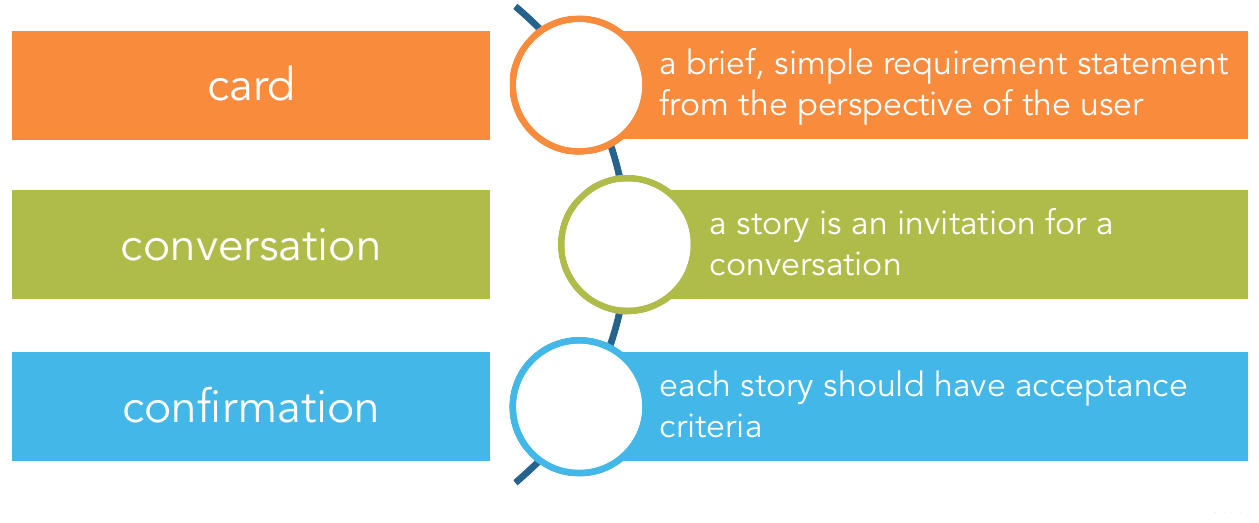
- CARD – Should be written on an index card or sticky note.
- Conversation – Get detailed information from the product owner (Product Owner).
- Confirmation – Ensure it is implemented correctly. Must meet user acceptance criteria.
User Story Format
The format for a user story is as follows:
As a <role>, I want <goal>, so that <benefit>
These two examples demonstrate user stories at different levels, but using the same format:
At the project level:
As a <Marketing Director>, I want <to improve customer service>, so that <we retain our customers>.
- Write SMART Goals & INVEST for User Stories
- Theme vs Epic vs User Story vs Task
- What is DEEP in Product Backlog?
- How to Write Product Vision for Scrum Project?
- How to Use Scrum Board for Agile Development?
- Who Creates Product Backlog Items or User Stories in Scrum?
- What is Agile Estimation?
- What is Story Point in Agile? How to Estimate a User Story?
- User Story Splitting – Vertical Slice vs Horizontal Slice

 English
 Arabic
 Chinese (Simplified)
 Dutch
Dutch French
 German
 Italian
 Japanese
 Korean
 Portuguese
 Russian
 Spanish