Scrum features short release cycles with fixed timeboxes, called Sprints, to meet rapidly changing development needs. The Scrum process distinguishes itself from other Agile frameworks through specific concepts and practices, divided into three categories: Roles, Ceremonies (also known as Events or Meetings), and Artifacts, as shown in the diagram below:
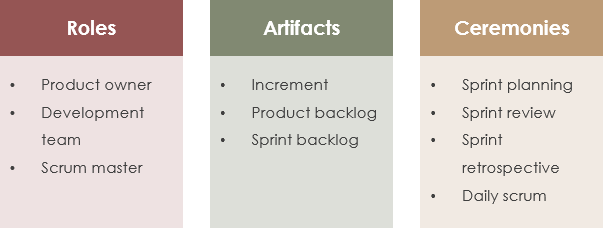
Scrum – Roles, Artifacts, Ceremonies
Ceremonies in the Scrum Cycle
Each Scrum project may have multiple Release Cycles, and each release may include multiple Sprints. A series of recurring meetings are held before, during, and after the Sprint cycle.
Scrum defines three roles: the Team, Scrum Master, and Product Owner; four ceremonies: Sprint Planning, Daily Scrum, Sprint Review, and Sprint Retrospective; and three artifacts: Product Increment, Product Backlog, and Sprint Backlog, as illustrated below:
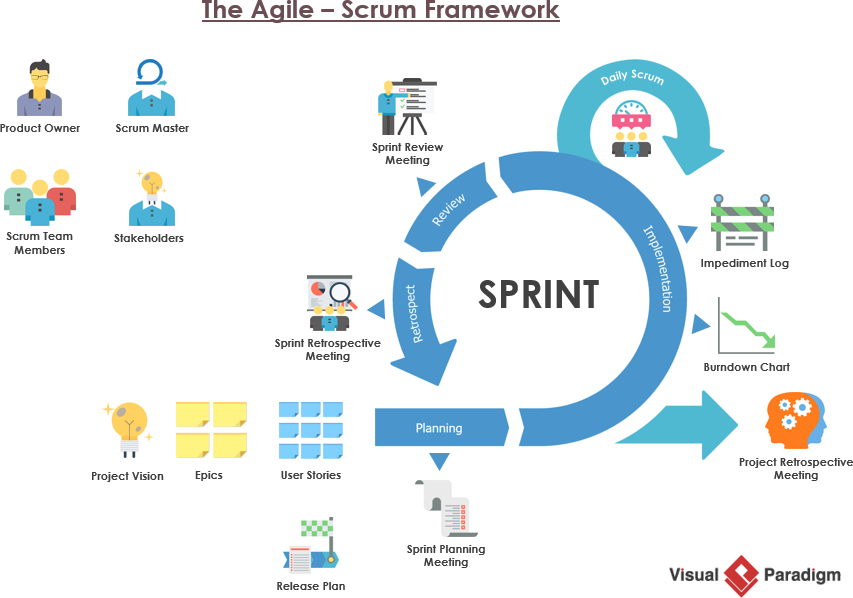
Agile Scrum Framework
Meetings or “ceremonies” are essential components of Agile development. They help share information in a timely manner, align toward a common goal and vision, and keep all team members informed about progress. The full Scrum team participates in all ceremonies except the retrospective, while the Product Owner may or may not attend. Scrum requires these ceremonies to form the structure of each Sprint:
Product Backlog Refinement
Product Backlog Refinement is the process of adding details, estimates, and order to items in the Product Backlog. It is an ongoing activity where the Product Owner and the Development Team collaborate to define and clarify backlog items. During refinement, items are reviewed and adjusted.
As mentioned above, Product Backlog Refinement is an ongoing activity, not limited to time-boxed events (or meetings). However, nothing prevents the team from timeboxing each refinement session. Generally, using timeboxing is a good practice.
Sprint Planning Meeting
The goal of Sprint Planning is to answer “What will we do, and how will we do it?” This meeting is crucial for the team to align on a shared goal and commitment before starting the Sprint. The team plans the list of items to be worked on during the specific Sprint. Then, they break these items down into tasks, typically no more than 2 days of work.
Daily Scrum Meeting
Once the Sprint begins, we hold what is commonly known as the Daily Scrum. The Daily Scrum is facilitated by the Scrum Master and typically lasts 15 minutes. It is a standing meeting to synchronize team members’ work: what was completed yesterday, what will be done today, and any blockers. It ensures everyone is aligned on what each person is doing in the Sprint.
Note
At the end of the Sprint, the goal is to have a potentially shippable Product Increment (PSPI). We aim to deliver value with every Sprint.
Sprint Review Meeting
Held at the end of each Sprint, this meeting demonstrates the new features added. The goal is to gather feedback from the Product Owner and other stakeholders to ensure the delivered Increment meets business needs. Feedback is used to update the Product Backlog, which then becomes the input for future Sprints where the team can reorder and extract items.
Sprint Retrospective Meeting
The retrospective typically lasts 90 minutes and helps embed continuous improvement into the team’s culture and Sprint rhythm. It is a time when the Scrum team reflects on the previous Sprint, asking: What went well? What didn’t go well? What can be improved? This allows the team to focus on overall performance and identify strategies for ongoing improvement.
Summary
The Scrum ceremonies embedded in the process create a rhythm that helps teams maximize productivity, foster collaboration, ensure transparency, and most importantly, inspect and adapt their way of working—enabling continuous learning and improvement.

 English
 Arabic
 Chinese (Simplified)
 Dutch
Dutch French
 German
 Italian
 Japanese
 Korean
 Portuguese
 Russian
 Spanish