The Scrum framework includes the Scrum team, its associated roles, events, artifacts, and rules—each with a specific purpose, all essential for the success and effective use of Scrum.
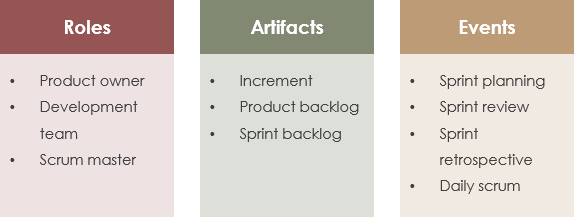
Scrum roles, artifacts, events
Scrum Roles
Scrum defines three primary roles that play key parts within the Scrum team: the Product Owner, the Scrum Master, and the Development Team members. In addition to these roles, you should also expect stakeholders such as business analysts in larger organizations. The Scrum framework requires four key roles:
- Product Owner: The person with the product vision
- Scrum Master: The Scrum expert who helps the team build the product according to the Scrum framework
- Development Team: The team members who perform the work
- Stakeholders: Individuals genuinely interested in the product who continuously review the team’s work and progress, providing ongoing feedback.
These individuals share different tasks and responsibilities related to product delivery. Scrum describes them as a self-organizing and cross-functional team.
Scrum Events
But who participates in Scrum events? Here are the five events in detail:
- Sprint Planning: A time-boxed event that occurs at the start of each Sprint, where the team determines which Product Backlog items they will work on during the Sprint.
- Daily Scrum: A 15-minute time-boxed event for the development team to synchronize activities and plan work for the next 24 hours.
- Sprint Review: A time-boxed event held at the end of the Sprint to inspect the Increment and adjust the Product Backlog as needed.
- Sprint Retrospective: A time-boxed event that gives the Scrum team the opportunity to inspect itself and create a plan for improvements in the next Sprint.
Scrum Artifacts: Scrum artifacts represent work or value, providing transparency and opportunities for inspection and adaptation. The artifacts defined by Scrum are specifically designed to maximize transparency of critical information so that everyone has a shared understanding of the artifact.
Increment: The sum of all completed Product Backlog items from the current Sprint and all previous Sprints.
Product Backlog: An ordered list of everything that might be needed in the product—this is the single source of requirements for any changes to the product. The Product Owner is responsible for the Product Backlog, including its content, accessibility, and ordering.
Sprint Backlog: The selected set of Product Backlog items for the Sprint, along with a plan for delivering the Increment and achieving the Sprint Goal.
Product Backlog Refinement: An ongoing process of refining the Product Backlog, typically performed during each Sprint to prepare items for future Sprints.
Who Attends Which Scrum Event?
As mentioned above, the Scrum framework requires three Scrum roles and four key events—but who attends which event? The table below describes the participants:
| Event | Event Owner | Product Owner | Scrum Master | Developers | Others |
| Sprint Planning Part I | Product Owner | Y | Y | Y | Y |
| Sprint Planning Part II | Development Team | Optional | Y | Y | N |
| Daily Scrum | Development Team | N | Optional | Y | N |
| Sprint Review | Product Owner | Y | Y | Y | Y |
| Sprint Retrospective | Scrum Master | Y | Y | Y | N |
| Product Review | Product Owner | Y | Y | Y | N |
Note:
In Scrum, there is no formal event dedicated to Product Backlog refinement. Instead, the Scrum Guide states, “The Scrum Team decides how and when to do refinement,” and refinement typically does not exceed 10% of the Development Team’s capacity.

 English
 Arabic
 Chinese (Simplified)
 Dutch
Dutch French
 German
 Italian
 Japanese
 Korean
 Portuguese
 Russian
 Spanish