Timeboxing assigns a fixed maximum time unit to an activity. That time unit is called a timebox. The goal of a timebox is to define and limit the amount of time dedicated to an activity. Timeboxing is a common feature in many project management methodologies because it keeps teams focused on completing the task at hand by providing a clear Definition of Done.
The Five Scrum Events
In Scrum, timeboxing is a key component of all five events. Some Scrum teams also use timeboxing during the Sprint to explicitly define open tasks. In our other articles, we’ve discussed the 3 Scrum roles and 3 artifacts. There are five events in the agile Scrum framework. In this article, we’ll discuss the five events in the Scrum framework—each of which is timeboxed.
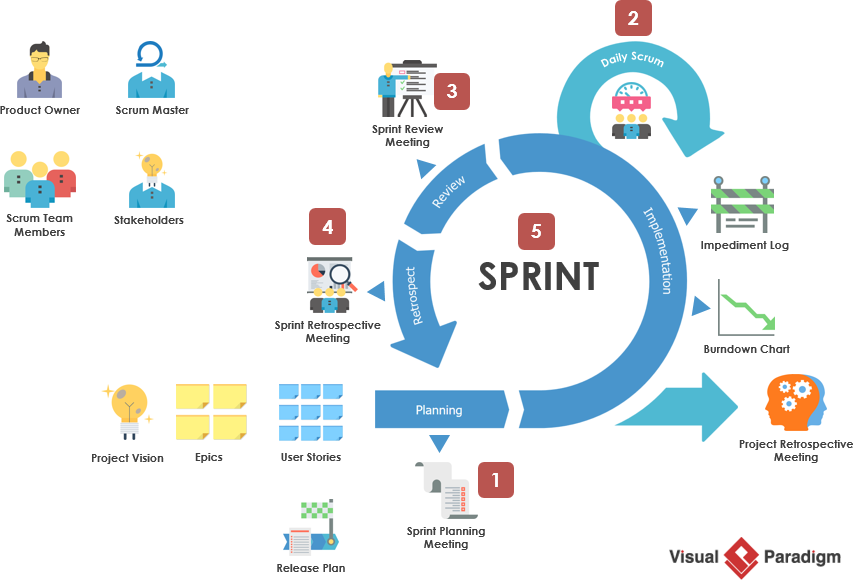
Five Scrum Events
- Sprint Planning: When the team starts, they establish a timebox for the Sprint Planning meeting. As stated in the Scrum Guide, the Sprint Planning meeting should last no more than 8 hours for a one-month Sprint. The shorter the Sprint, the shorter the timebox for Sprint Planning. At Scrum Inc., we recommend a two-hour timebox for a one-week Sprint.
- Daily Scrum: Daily Scrum is a 15-minute timebox that helps the Scrum team synchronize activities and surface any impediments to achieving the Sprint Goal.
- Sprint Review: Sprint Review is a timebox of up to four hours for a one-month Sprint. During the Sprint Review, the Sprint Backlog items are demonstrated and inspected. It’s also the time to adjust the backlog based on feedback.
- Sprint Retrospective: Sprint Retrospective is a timebox of up to three hours for a one-month Sprint. This is the event where the team inspects itself and identifies process improvements to implement in the next Sprint.
- Sprint: Timeboxing is used to define the length of the Sprint. A Sprint is a timebox of no more than one month, during which the Scrum team achieves the Sprint Goal. At Scrum Inc., our recommended Sprint length is one week, which we advise our coached teams to follow.
How Timeboxing Works: Numbers and Percentages
The timeboxes are based on a one-month Sprint. For shorter Sprints, the events are proportionally shorter. The timeboxes are as follows:
- Daily Scrum: 4.5 minutes
- Sprint Planning: up to 8 hours
- Sprint Review: up to 4 hours
- Sprint Retrospective: up to 3 hours
If we also consider ongoing Product Backlog refinement as part of the Scrum process, the development team should allocate an average of 10% of their capacity.
For a full-time developer on a four-week Sprint, Scrum events consume a maximum of 22.5% of their time:
- Full-time: 160 hours per Sprint
- Scrum Events: 20 hours
- Backlog Refinement: up to 16 hours
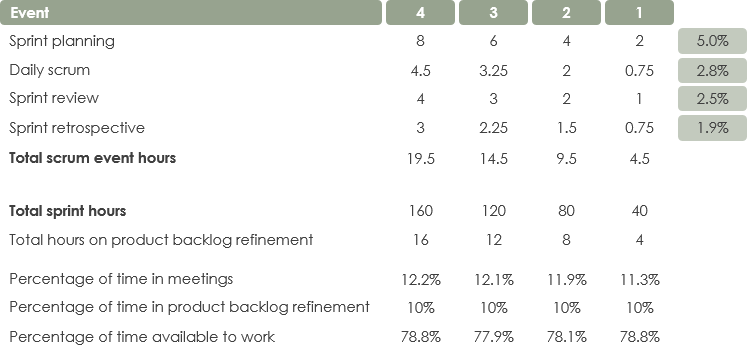
Timeboxed Scrum Events
The following pie chart shows the percentage of time each of the five Scrum events takes:
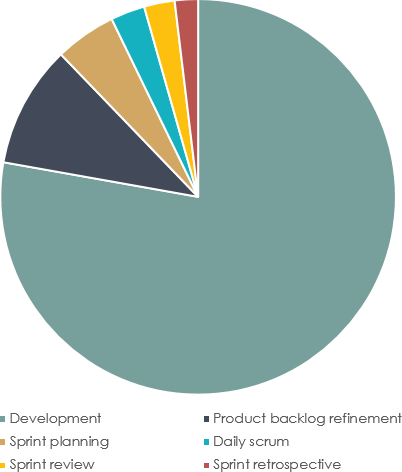
Timeboxed Scrum Events Chart
Summary
Scrum uses timeboxed events so that each event has a maximum duration. This ensures that an appropriate amount of time is spent on each event without wasting time during the Sprint. The defined events in Scrum create regularity and prevent the need for undefined events. The Sprint itself is the container for all other four Scrum events, each with a clear purpose, providing opportunities to inspect and adapt various aspects to achieve their respective goals.

 English
 Arabic
 Chinese (Simplified)
 Dutch
Dutch French
 German
 Italian
 Japanese
 Korean
 Portuguese
 Russian
 Spanish