The purpose of a release plan is to outline when various features or the product will be delivered to the customer, enabling the Scrum team to communicate the roadmap and delivery schedule for the product under development. Through long-term planning, the team can meet the expectations of the Product Owner and project stakeholders, and help answer key questions such as:
- When will we be done?
- What features can I have by the end of the year?
- How much will this cost?
- Identify key dates and milestones
- Coordinate development timelines for dependent systems
- Help balance business value and overall quality within constraints of scope, schedule, and budget
Release Planning Patterns
Many organizations have their own rhythm for releasing products to customers. Some choose to release after every Sprint. Others group the outcomes of multiple Sprints into a single version, as shown in the diagram below. Others release immediately after each feature is completed—this approach is commonly known as continuous deployment or continuous delivery.
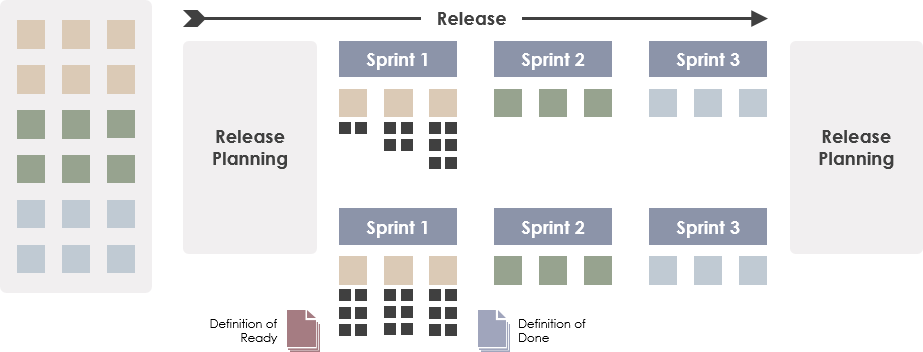
Definition of Ready
A release plan is a roadmap that reflects expectations about which features will be implemented and when they will be completed. Depending on the development strategy, it can be feature-driven—where the goal is to deliver a release once a predefined set of features is developed—or date-driven, where the release happens at a predefined checkpoint. If the project is feature-driven, the total sum of all features in a release can be divided by the expected velocity to estimate the number of Sprints required to complete the requested features.
Do You Need a Pre-Release Plan?
Release planning is a controversial topic in Agile. While we’re often asked to provide forecasts about cost and timeline in the business world, Scrum does not recommend creating a rigid pre-defined release plan. Here are some arguments against upfront release planning:
- Customers often see no value in release plans and view them as waste
- Rapid changes in many domains validate the “You Aren’t Gonna Need It” (YAGNI) principle—meaning pre-planning releases is unnecessary
- Thus, the only value in a release plan may be the initial date and budget—nothing more
Why Do We Still Need Release Planning?
Nevertheless, real-world delivery dates in Agile environments often fall short of promised targets. However, having a general release roadmap can build trust and set expectations between your team and stakeholders. Additionally, a release should account for all additional work that must be completed, such as updating public websites and training customer support teams. Here are the main reasons for conducting release planning in Scrum:
- Communication
- Planning tool
- Validate value versus cost
- Set the overall context
Release Planning Example:
Release plans come in many formats. Here’s an example for feature/data-driven planning:
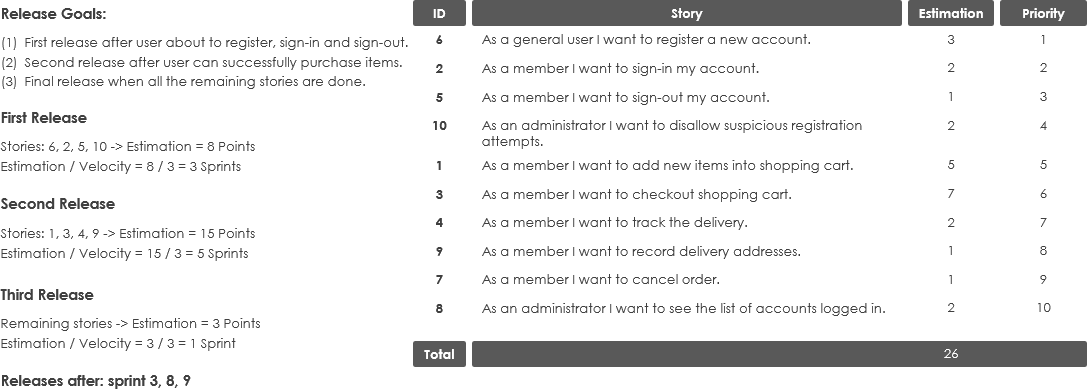
Release Planning Example
If the project is date-driven, we can simply multiply velocity by the number of Sprints to determine the total amount of work that can be completed within a given timeline.
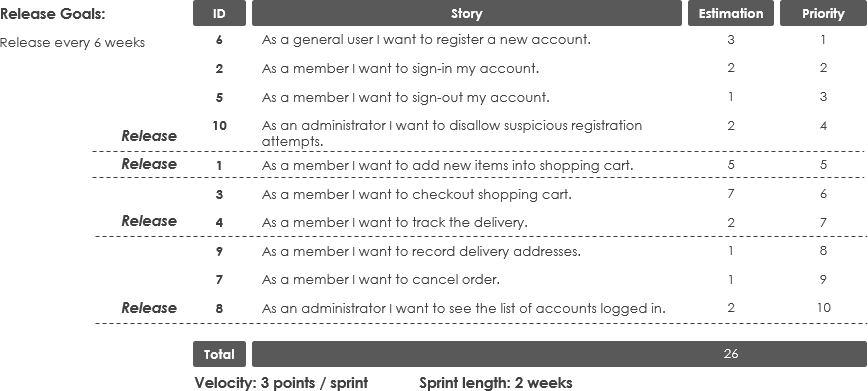
Release Planning Driven by Velocity
A release plan is not a static document—it must be revisited and updated regularly as we manage our Product Backlog. When new insights become available (e.g., entries in the Scrum Product Backlog are updated or adjusted), the release plan should be reviewed and revised accordingly.

 English
 Arabic
 Chinese (Simplified)
 Dutch
Dutch French
 German
 Italian
 Japanese
 Korean
 Portuguese
 Russian
 Spanish