A Scrum team is a group of individuals (typically between 5 to 9 members) collaborating to deliver the required product increment. The Scrum framework encourages high-level communication among team members so that the team can:
- Follow a common goal
- Abide by the same norms and rules
- Respect one another
Scrum Team Structure
The Scrum team consists of:
- Product Owner
- Scrum Master, and
- Development Team
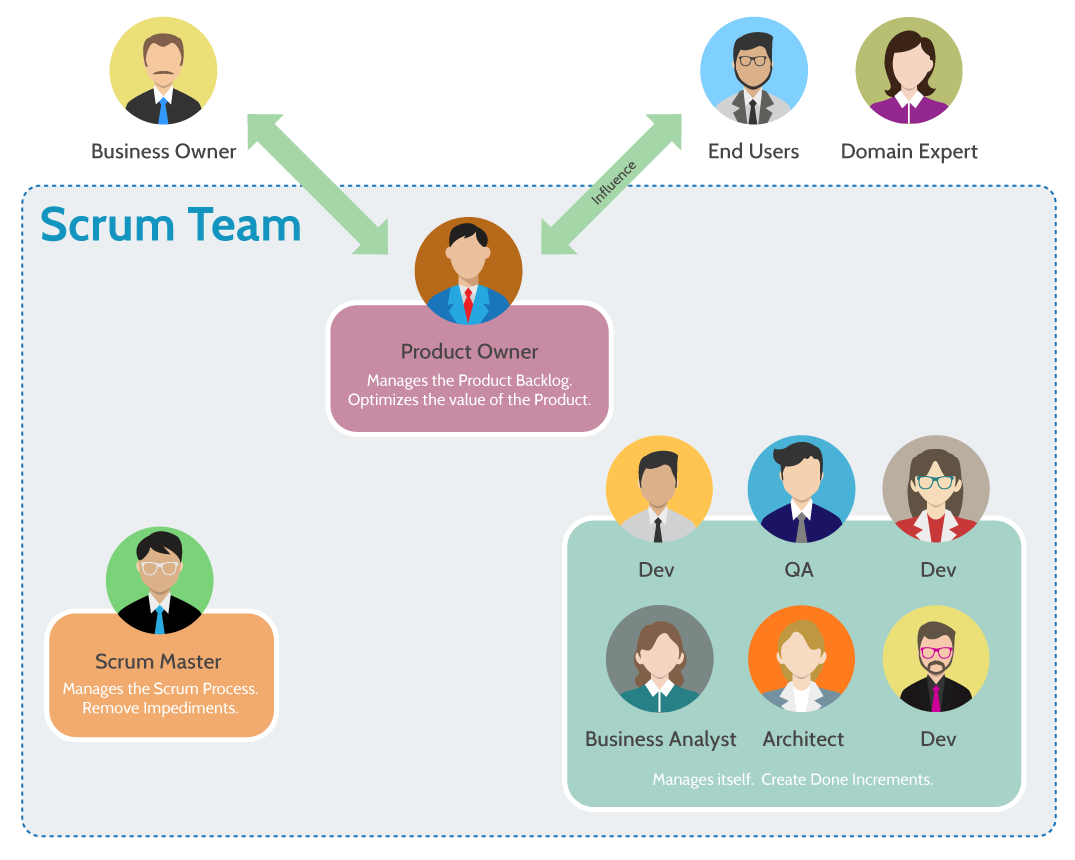
What is a Scrum Team?
Scrum team members share different tasks and responsibilities related to product delivery. Each role is closely interrelated. It is recommended that Scrum team members work together in the same location as much as possible. Let’s examine these roles from the perspectives of responsibilities, authorities, and characteristics.
Product Owner
The Product Owner is the team member who understands what the customer wants and the relative business value. They translate customer needs and values back to the Scrum team. The Product Owner must understand the business case for the product and the features the customer requires. They must negotiate with the team to ensure the product vision is implemented correctly. Most importantly, they must have the authority to make all decisions necessary to complete the project. In other words, the Product Owner is responsible for managing the Product Backlog, which includes:
- Clearly expressing Product Backlog items
- Ordering Product Backlog items to best achieve goals and objectives
- Optimizing the value of the work the team performs
- Ensuring the Product Backlog is visible, transparent, and clear, and shows what the team will work on next
- Ensuring the team understands the items in the Product Backlog to the required level
Scrum Master
The Scrum Master helps the team stay accountable for business commitments and removes any obstacles that may hinder team productivity. They meet regularly with the team to review work and deliverables—typically on a weekly basis. The Scrum Master’s role is to guide and inspire team members, rather than enforce rules. Key responsibilities include:
- Ensuring the process runs smoothly
- Eliminating impediments that affect productivity
- Organizing key activities and meetings
Development Team
The Development Team is self-organizing and empowered by the organization to organize and manage their own work. This synergy optimizes the overall efficiency and effectiveness of the development team. The Development Team has the following characteristics:
- They are self-organizing: No one (not even the Scrum Master) tells the Development Team how to turn the Product Backlog into a potentially shippable increment;
- The Development Team is cross-functional, possessing all the skills needed to create a product increment;
- Scrum does not recognize any titles for Development Team members, regardless of the work they perform;
- Scrum does not acknowledge sub-teams within the Development Team, no matter the area of focus such as testing, architecture, operations, or business analysis;
- Individual team members may have specialized skills and areas of expertise, but accountability rests with the entire Development Team.

 English
 Arabic
 Chinese (Simplified)
 Dutch
Dutch French
 German
 Italian
 Japanese
 Korean
 Portuguese
 Russian
 Spanish