What is Agile?
Agile is a mindset and philosophy that describes a set of principles outlined in the Agile Manifesto. On the other hand, Scrum is a framework that defines the roles, events, artifacts, and rules/guidelines required to implement this mindset. In other words, Agile is the mindset, and Scrum is the framework that specifies how to implement the Agile philosophy.
Scrum Umbrella
Agile refers to a collection of methods and practices based on the values and principles expressed in the Agile Manifesto. It is a mindset that enables teams and organizations to innovate, respond quickly to changing requirements, and reduce risks. Organizations can adopt various available Agile frameworks, such as Scrum, Kanban, Lean, and Extreme Programming (XP).
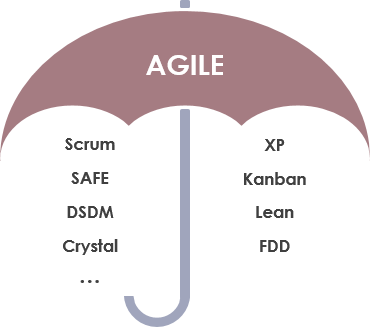
What is Agile?
The Agile movement presents an alternative to traditional project management. Agile methodologies are often used in software development to help organizations respond to unpredictability. This refers to a set of software development approaches based on iterative development, where requirements and solutions evolve through collaboration between self-organizing, cross-functional teams. The primary goal of Agile is to empower development teams to create and respond to change, enabling success in uncertain and volatile environments.
What is Scrum?
Scrum is different from Agile, but it is one of the Agile processes. They are both based on iterative development. The Agile requirement and solution are achieved through collaboration between cross-functional and self-organizing teams. When implemented correctly, Scrum helps teams solve complex problems by delivering the highest-value product incrementally while reducing risk.
Scrum involves timely inspection and adaptation, enhanced by leadership philosophy, accountability, and self-organization, along with engineering best practices, to foster team collaboration and deliver high-quality software promptly.
How does Scrum work?
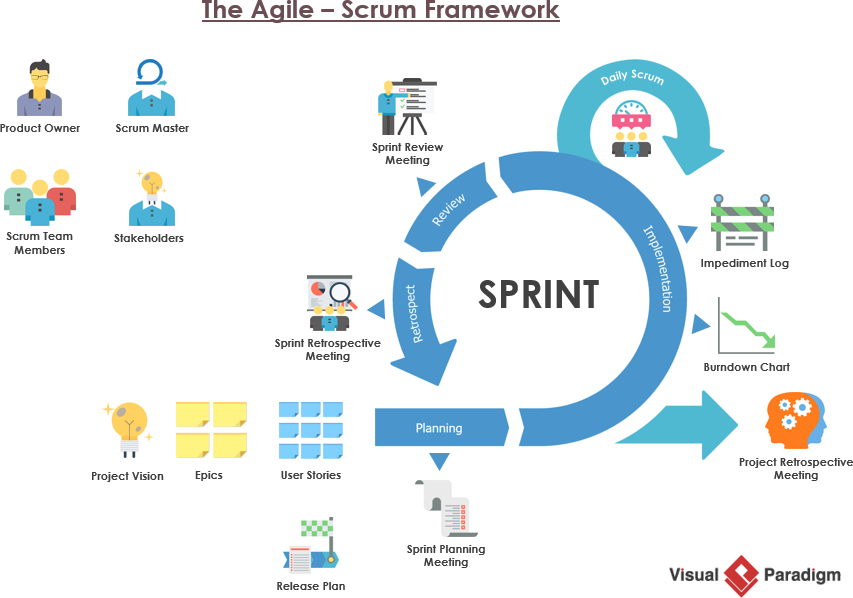
Scrum distinguishes itself from other Agile processes through specific concepts and practices, categorized into three roles (Product Owner, Scrum Master, Development Team, and other stakeholders), events, artifacts, and rules.
To initiate the Scrum process, the Product Owner creates a prioritized list called the Product Backlog. During Sprint Planning, the backlog items are sized based on complexity and business value (priority). The Product Owner (customer) and the Development Team decide which backlog items to include in the Sprint. The team has a fixed amount of time (called a Sprint, typically two to four weeks) to complete their work, but they meet daily to assess their progress (Daily Scrum). Throughout this process, the Scrum Master keeps the team focused on their goals. At the end of the Sprint, the team reviews their progress, demonstrates the working product to the customer, and evaluates what went well and what needs improvement for the next Sprint. The cycle then repeats.
Note:
Scrum encourages holding five key events during a Sprint, which are designed to help the team collaborate effectively and efficiently, improve their knowledge, and become more effective in the future. These five events are:
- Sprint Planning
- Daily Scrum
- Sprint Review
- Sprint Retrospective
- Sprint (Sprint)

 English
 Arabic
 Chinese (Simplified)
 Dutch
Dutch French
 German
 Italian
 Japanese
 Korean
 Portuguese
 Russian
 Spanish