ArchiMate is an open standard maintained by The Open Group ArchiMate Forum.
Subsequent versions are released periodically, with the latest being ArchiMate 3.0, published in mid-2016. It includes the specification of the enterprise architecture modeling language as well as the ArchiMate framework.
In ArchiMate, a model is defined as a “collection of concepts,” and a concept is defined as an “element or relationship.” The enterprise architecture modeling language specification provides precise definitions and explanations of concepts specific to the enterprise architecture domain. This modeling language can be used to represent enterprise architectures as well as to describe their evolution over time.
ArchiMate Framework


Figure 1: The ArchiMate framework as defined in the ArchiMate 3.0 specification.
[Source: ArchiMate 3.0 Specification, an Open Group Standard. The Open Group, 2016.]
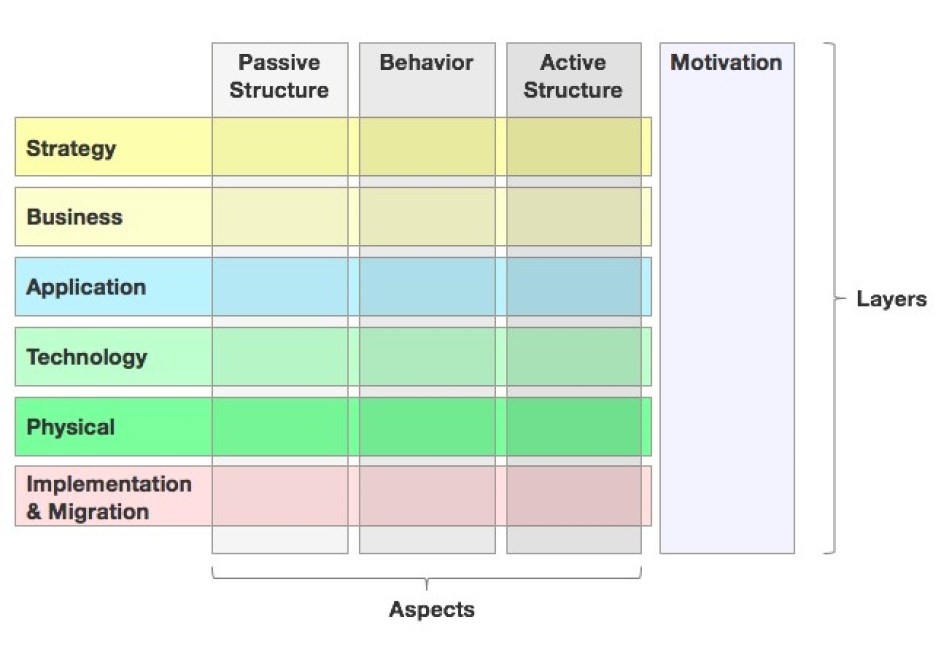

The ArchiMate framework (as shown in Figure 1) supports the classification of the core entities defined in the ArchiMate modeling language. It organizes these core entities along two dimensions.
The first dimension assigns core entities to different layers of the enterprise architecture model. In the updated ArchiMate 3.0, the enterprise architecture model is divided into layers including Strategy (e.g., capabilities), Business (e.g., business actors), Application (e.g., application functions), Technology (e.g., artifacts), Physical (e.g., facilities), and Implementation & Migration (e.g., deliverables). In graphical representations of individual entities, the layer to which an entity belongs is indicated by different colors.
The second dimension consists of four aspects, to which core entities are assigned. In the graphical notation of elements, the assignment to an aspect is visualized using different shapes. The first aspect is Active Structure, which captures the subjects that exhibit actual behavior (who?). Active structure elements are represented with square-cornered boxes and icons in the top-right corner. The Behavior aspect represents the behavior performed by active structure elements (how?) and is visualized with rounded-corner boxes and icons in the top-right corner. Passive Structure represents the objects on which behavior is performed (what?). There is no universal shape-based method to visualize them globally.
Finally, Motivation is the fourth aspect of the ArchiMate framework (why?). Elements assigned to this aspect are depicted with diagonal boxes and are also color-coded, indicating that it also forms a layer.
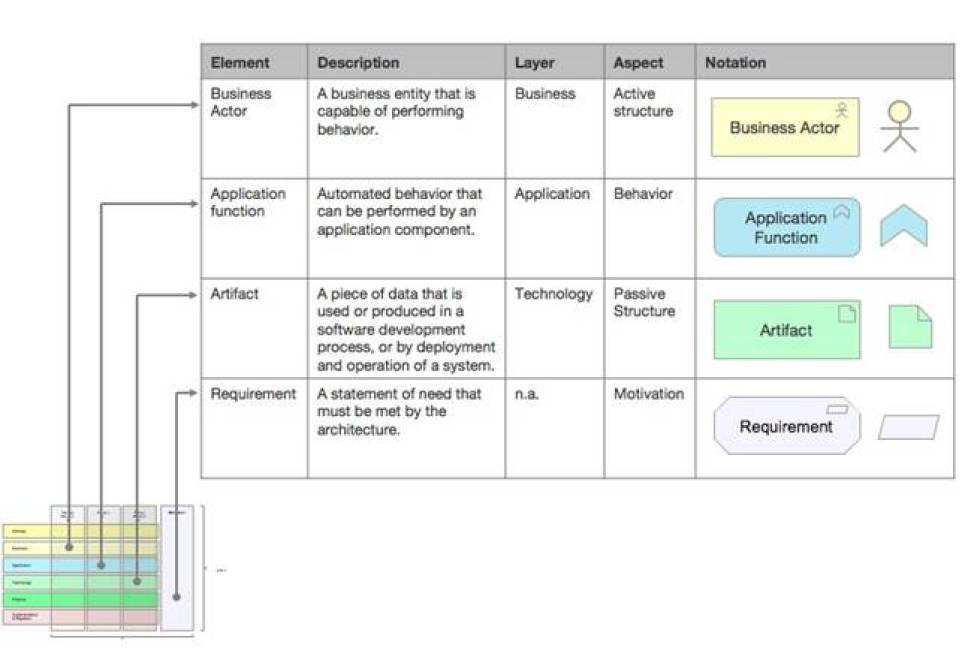

Figure 2: Excerpt of language symbols for ArchiMate modeling language elements, including their definitions, assignments to layers and aspects, and assigned icons.
A set of connector icons can be used to classify and visualize relationships between these elements. The general relationship types defined in ArchiMate include Structural Relationships, Dependency Relationships, Dynamic Relationships, and Other Relationships. Figure 3 provides an excerpt of these relationship types, their definitions, and icons.
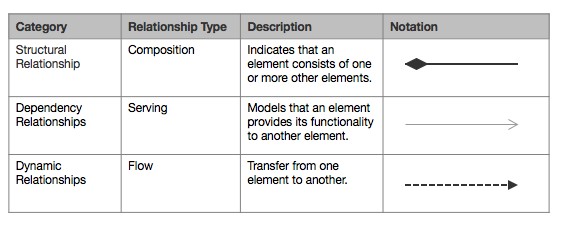

Figure 3: Excerpt of relationship types in ArchiMate, their definitions, and icons. [Based on: ArchiMate 3.0 Specification, an Open Group Standard. The Open Group, 2016.]
Relationship Between ArchiMate and TOGAF
ArchiMate is closely related to the TOGAF standard and provides a modeling language that can be applied to models created within TOGAF. The ArchiMate framework can be mapped to the TOGAF ADM, as shown in Figure 4.
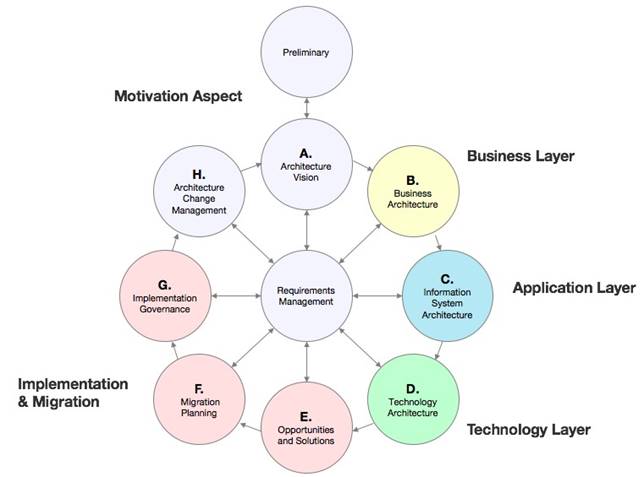

Figure 4: Mapping of the ArchiMate framework to the TOGAF ADM. [Based on: ArchiMate 3.0 Specification, an Open Group Standard. The Open Group, 2016.]
Advantages and Disadvantages of ArchiMate
One advantage of ArchiMate is that it allows visualization of architecture at individual layers while also describing cross-layer relationships, as illustrated in the example in Figure 5.
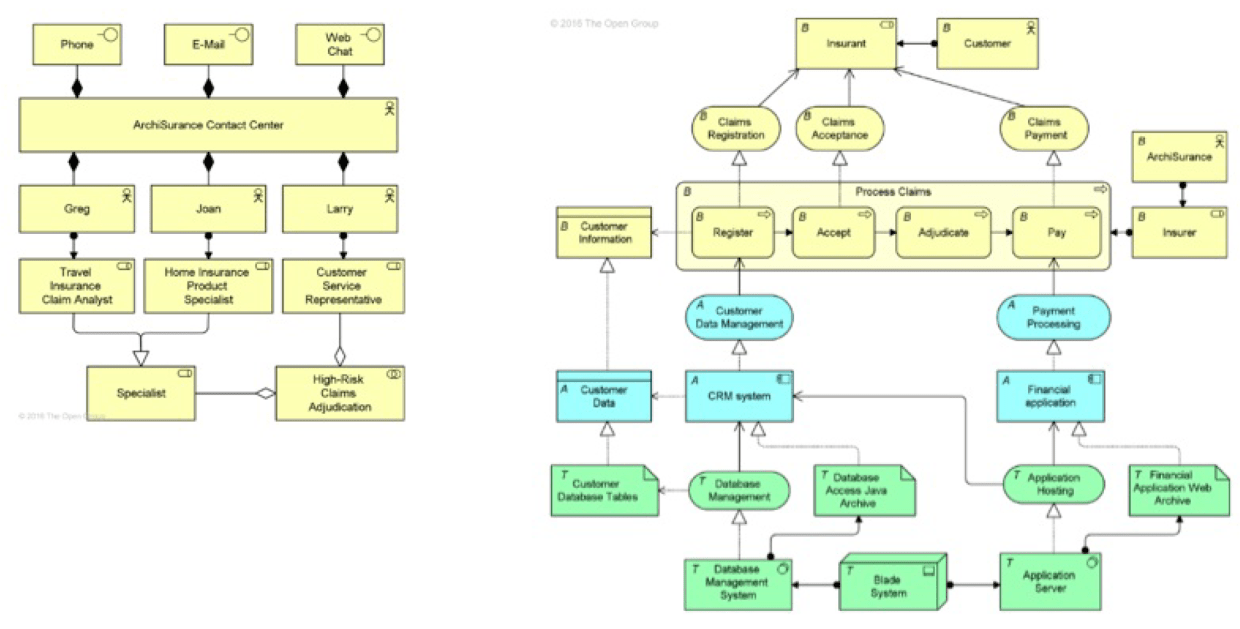

Figure 5: Examples of single-layer and cross-layer enterprise architecture models.
[Source: ArchiMate 3.0 Specification, an Open Group Standard. The Open Group, 2016.]
In addition, ArchiMate provides an extensive list of enterprise architecture entities, a predefined metamodel, some simplified standard viewpoints, and comprehensive publicly available documentation. Tool support is also available for modeling enterprise architectures using this architecture description language [BBL12].
One disadvantage of ArchiMate is its limited extensibility. Furthermore, some concepts are ambiguous, and modelers require training to apply the framework successfully. Finally, when implementing ArchiMate, terminology mapping is often necessary to assign existing concepts to ArchiMate concepts.
The ArchiMate 3.0 specification is available for online download or viewing.

 English
 Arabic
 Chinese (Simplified)
 Dutch
Dutch French
 German
 Italian
 Japanese
 Korean
 Portuguese
 Russian
 Spanish