Timeboxing is the practice of allocating a fixed amount of time to a specific task or activity, which is one of the most effective ways to improve productivity and break projects into defined time periods. This time management technique provides the opportunity to set a predetermined limit on how much time can be spent on a particular activity.
In the Scrum framework, all activities are timeboxed — also known as time-boxed events — which provide a “fixed duration” period for specific events or activities. That fixed time unit is called a timebox. The goal of a timebox is to define and limit the amount of time dedicated to a specific activity. Scrum uses timeboxing for all Scrum events and as a tool to clearly define open-ended or ambiguous tasks.
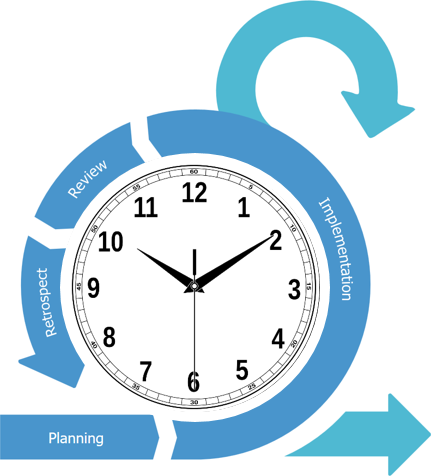
Scrum Sprint Timeboxing
Timeboxed Events in Scrum
In Scrum, timeboxing is a key component of all five events. Some Scrum teams also use timeboxing during the Sprint to clearly define open-ended tasks. An example of an open-ended task could be conducting research, which is necessary for the team to make decisions or estimate the size and complexity of upcoming stories.
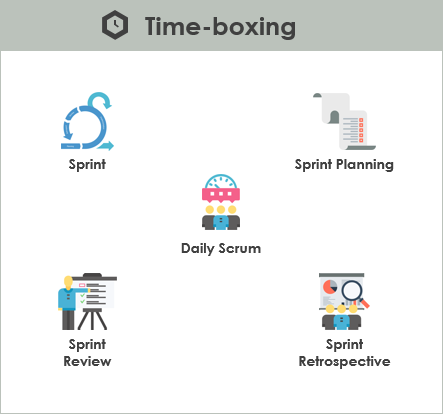
Scrum Time-Boxing
Here are the “timeboxes” for the five events corresponding to a 1-week Scrum Sprint:
- Sprint Planning: Timebox should not exceed 2 hours per Sprint (for a 1-week Sprint).
- Daily Scrum: Timebox should not exceed 15 minutes.
- Sprint Review: Timebox should not exceed 1 hour per Sprint (for a 1-week Sprint).
- Sprint Retrospective: Timebox should not exceed 1 hour per Sprint (for a 1-week Sprint).
The following diagram shows the conversion of time-boxed events into percentages within Scrum:
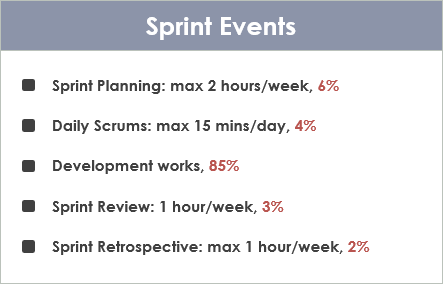
Scrum Time-Boxed Events
Advantages and Disadvantages of Timeboxing
Timeboxing is a common feature in many project management methodologies because it helps teams focus on completing tasks by providing a clear Definition of Done.
Benefits of Timeboxing
- Prioritization: All activities during this period must be prioritized.
- Focus: Keeps the team focused on the most important things within the time constraint.
- Stop-loss: Establishes a natural stopping point based on time, preventing endless discussion or work.
- Rhythm: Helps develop a consistent and predictable work rhythm.
Drawbacks of Timeboxing
- Incomplete Work: Not all work may be completed on time. This can result in “partially done” deliverables.
- Unspoken Issues: Discussions may be cut short. Some people or topics might not get a chance to speak.
- Inaccuracy: The topic may be discussed too quickly or not enough, leading to inaccurate time estimates.
Summary
The goal of timeboxing is to define and limit the amount of time allocated to a specific activity. Timeboxing prevents tasks from exceeding their time limits. Scrum specifically uses sprints — timeboxes of one month or less — during which the Scrum team delivers a Sprint Goal. Scrum uses timeboxing as a tool to clearly define open-ended or ambiguous tasks.

 English
 Arabic
 Chinese (Simplified)
 Dutch
Dutch French
 German
 Italian
 Japanese
 Korean
 Portuguese
 Russian
 Spanish