Building a doghouse can be done by one person. It involves a simple process using basic tools such as nails, hammers, saws, and tape. In just a few hours, you can finish a dog house—no help needed. The modeling effort is minimal or sometimes unnecessary.
What if you’re building a house for the same family? Is it possible? Yes, but it requires detailed planning, some sketches, and careful coordination. Building a house is best achieved by a team—it demands thorough modeling, well-defined processes, and powerful tools.
How about a high-rise building? Modeling is undoubtedly a critical part of any construction project!

What about software development? Grady Booch said:
“Modeling is at the heart of all activities leading to the deployment of quality software. We build models to communicate the structure and behavior our systems require. We build models to visualize and control the architecture of our systems. We build models to better understand the systems we are building, often exposing opportunities for simplification and reuse. We build models to manage risk.”
The Importance of Modeling
Modeling is a well-established and widely accepted engineering practice. In architecture, we develop building models—whether for a house or a high-rise—to help visualize the final product. In Unified Modeling Language (UML), a model can be structural (focusing on system organization) or behavioral (focusing on system dynamics). A model is a simplification of reality, providing a blueprint of the system. UML enables you to:
- Specify the structure or behavior of a system.
- Visualize the system effectively.
- Provide a template for building the system.
- Break down and understand complex systems step by step.
- Document the decisions you’ve made.
We build models to better understand the system we are developing. A model can include an overview of the system, as well as detailed plans for design, implementation, and testing.
UML Modeling Principles
1. The Right Model Matters
Choosing which model to create profoundly affects how you approach the problem and how the solution evolves. You need to choose your model wisely.
- The right model highlights the most critical development challenges.
- The wrong model misleads you, leading you to focus on irrelevant issues.
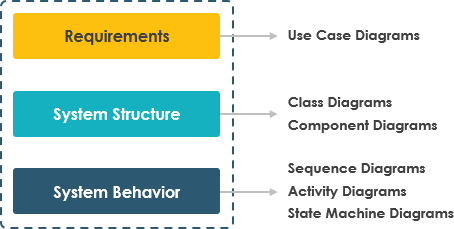
For example: You can use different types of diagrams at various stages of software development.
2. Models Can Be Expressed at Different Levels of Detail
For example:
- If you’re building a high-rise, you might need a 30,000-foot view to help investors see how the building will look and feel.
- But at other times—say, when dealing with a tricky pipe layout or an unusual structural element—you’ll need to zoom in for detailed planning.
3. The Best Models Reflect Reality
All models simplify reality. A good model reflects the most important, critical features.
4. No Single Model Is Enough
Every non-trivial system is best addressed through a set of nearly independent models. Create models that can be developed and studied separately but still remain interconnected. In the case of buildings:
- You can study electrical plans independently.
- But you can also see how they map to floor plans—and even how they interact with plumbing layouts.
Learn UML. Draw UML.
Get Visual Paradigm Community Edition, a free UML tool that helps you learn UML faster and more effectively. Visual Paradigm Community Edition supports all UML diagram types. Its award-winning UML modeling tool is intuitive and easy to use.
Related Links
- Online UML Diagram Tool
- Visual Paradigm Online. (n.d.). Online UML Diagram Tool.
- How to Draw Class Diagram Using Visual Paradigm || Step by Step
- YouTube. (2021, January 17). How to Draw Class Diagram Using Visual Paradigm || Step by Step.
- Overview of the 14 UML Diagram Types
- Visual Paradigm. (n.d.). Overview of the 14 UML Diagram Types.
- What is Unified Modeling Language (UML)?
- Visual Paradigm. (n.d.). What is Unified Modeling Language (UML)?.
- UML Diagrams Gallery – Unified Modeling Language Tool
- Visual Paradigm. (n.d.). UML Diagrams Gallery – Unified Modeling Language Tool.
- UML Practical Guide – All You Need to Know About UML Modeling
- Visual Paradigm. (n.d.). UML Practical Guide – All You Need to Know About UML Modeling.
- UML Class Diagram Tutorial
- Visual Paradigm. (2022, September 2). UML Class Diagram Tutorial.
- Free Online UML Tool
- Visual Paradigm Online. (n.d.). Free Online UML Tool.
- UML Modeling – Unified Modeling Language Tool
- Visual Paradigm. (n.d.). UML Modeling – Unified Modeling Language Tool.
- How to Draw Class Diagram? – Visual Paradigm
- Visual Paradigm. (2022, February 9). How to Draw Class Diagram? – Visual Paradigm.


 English
 Arabic
 Chinese (Simplified)
 Dutch
Dutch French
 German
 Italian
 Japanese
 Korean
 Portuguese
 Russian
 Spanish