


“The future of enterprise architecture isn’t about more complexity—it’s about clarity, connection, and coherence.”
— The Open Group, ArchiMate Specification Snapshot 1 (Mid-2025)
The release of the new ArchiMate Specification Snapshot 1 in mid-2025 marks a pivotal turning point in the evolution of enterprise architecture (EA). As the anticipated precursor to ArchiMate 4.0, this groundbreaking update redefines how organizations model, communicate, and align their digital transformation journeys. More than a refinement, ArchiMate 4 represents a philosophical and structural revolution—replacing outdated hierarchies with dynamic interconnectivity, simplifying complexity, and embracing the realities of modern hybrid enterprises.
This article explores the transformative changes introduced in ArchiMate 4, unpacking its core innovations, technical enhancements, and implications for practitioners, architects, and stakeholders across industries.
🔮 A Vision for the Future: Why ArchiMate 4?
For over a decade, ArchiMate 3.2 has served as the de facto standard for enterprise modeling. Yet, as digital transformation accelerates and organizations adopt AI, automation, and decentralized systems, the limitations of the traditional layered approach have become increasingly apparent:
- Overly rigid layering that fails to reflect real-world interdependencies.
- Redundant elements across layers (e.g., Business Process vs. Application Service).
- Cognitive overload for new architects and non-specialists.
- Poor alignment with hybrid human-AI ecosystems.
ArchiMate 4 answers these challenges head-on. Its mission is clear: reduce cognitive friction while amplifying expressive power. It aims to make enterprise architecture more accessible, intuitive, and relevant—not just for seasoned architects, but for product owners, developers, business leaders, and even AI agents.
“We’re not just updating a language—we’re reimagining how we think about enterprise systems.”
— Dr. Elena Torres, Chief Architect, The Open Group
🌀 1. The Hexagonion: A Visual and Structural Revolution
From Layers to a Living Ecosystem
The most visible and profound change in ArchiMate 4 is the replacement of the traditional rectangular layered matrix with the Hexagonion Framework—a radical departure from the “top-down” mindset that has defined EA for years.
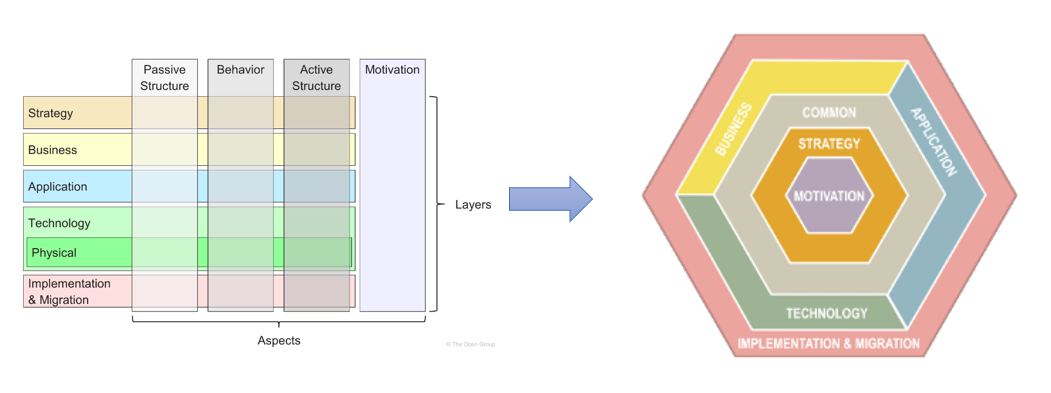
The Hexagonion is not merely a new diagram style; it’s a paradigm shift in how we conceptualize enterprise architecture. It reflects the reality of today’s organizations: where humans, software, and AI collaborate at the same level, and where business, application, and technology domains are deeply intertwined.
Structure of the Hexagonion
| Position | Domain | Purpose |
|---|---|---|
| Center Hub | Core Building Blocks | Active Structure, Behavior, Passive Structure — the foundational elements of all models |
| Top (Central Hexagon) | Operational Core | Merged domains: Business, Application, and Technology — unified into a single operational plane |
| Top Left & Right | Strategy & Motivation | Goals, Drivers, Requirements, Value Streams — the “why” behind enterprise actions |
| Bottom Left & Right | Implementation & Migration | Projects, Changes, Transitions, Deliverables — the “how” of transformation |
Why the Hexagonion Matters
- Eliminates top-down bias: No longer does the model imply that business “controls” applications, which in turn “control” technology.
- Promotes holistic thinking: Encourages architects to view the enterprise as a network of interdependent actors and processes.
- Supports hybrid environments: Enables seamless modeling of human-AI collaboration, where AI services behave like any other active structure.
- Improves stakeholder engagement: The symmetrical, balanced layout is more intuitive and visually engaging for non-technical audiences.
💡 Insight: Early adopters report that the Hexagonion has already improved cross-functional workshops—executives grasp the model faster, and developers see their roles in context.
🔗 2. Unification of Core Concepts: Breaking Down Silos
ArchiMate 4 boldly dismantles the artificial boundaries between layers. Instead of layer-specific elements, the language now embraces domain-agnostic modeling, promoting consistency and reducing duplication.
Unified Behavior Elements
No more “Business Process” vs. “Application Service.” In ArchiMate 4, behavior is behavior—regardless of layer.
The new generic behavior types are:
| Element | Description |
|---|---|
| Service | A capability offered to others (e.g., a payment service, an AI inference engine) |
| Process | A sequence of activities that achieve a purpose (e.g., onboarding a customer) |
| Function | A defined responsibility or role (e.g., “Risk Assessment”) |
| Event | A significant occurrence that triggers behavior (e.g., “System Alert”, “User Login”) |
These elements can be applied across any domain—a Business Function can be performed by a human, a software component, or an AI agent.
✅ Example: A “Customer Onboarding Process” can include:
- A Human Role (Customer Service Agent),
- An AI Function (Document Verification),
- A Software Service (CRM Integration),
- All connected via a single Process element.
Generic Role: The Democratization of Identity
The concept of “Business Role” is replaced by a generic Role in the Common Domain.
- Roles are now assigned to any Active Structure, including:
- Human actors
- Software components
- AI models
- Hardware devices
This enables richer modeling of delegation, responsibility, and accountability across hybrid teams.
🛠️ Use Case: In a smart factory, an AI model can be assigned the Role of “Quality Inspector”, just like a human worker—making the model’s function explicit and traceable.
Unified Collaboration: One Way to Model Interaction
All cross-layer interactions are now modeled using a single Collaboration element.
- Replaces:
- Business Collaboration
- Application Collaboration
- Technology Collaboration
This simplifies the metamodel and reflects reality: interactions don’t care about layers. A user interacting with a chatbot, a system calling an API, or a team sharing a document—all are forms of collaboration.
✅ Benefit: Architects no longer need to decide which “type” of collaboration to use—just model the interaction.
🧼 3. Cutting the Metamodel Clutter: Simplicity by Design
ArchiMate 4 isn’t about adding features—it’s about removing noise. The team at The Open Group conducted extensive analysis of real-world models and found that many elements were rarely used, poorly understood, or caused confusion.
Elements Removed (and Why)
| Removed Element | Replacement | Rationale |
|---|---|---|
| Composition Relationship | Aggregation or Assignment | Often confused with aggregation; redundant when assignment suffices |
| Business/Application/Technology Interaction | Collaboration or Service | Redundant; all interactions are now unified |
| Constraint | Requirement (specialized) | Constraints are a form of requirement; better modeled as such |
| Contract | Agreement (specialized) | Merged into broader contractual relationships |
| Gap | Assessment or Deliverable | Gaps are outcomes of assessments, not standalone entities |
| Representation | Artifact or Document | Redundant with existing passive structure elements |
🚫 No more “Which layer does this go in?”
With fewer elements and clearer semantics, modeling becomes faster and more intuitive.
🛠️ 4. Metamodel Enhancements: Precision Without Complexity
Beyond simplification, ArchiMate 4 introduces subtle but powerful enhancements that improve semantic precision and model integrity.
Cardinalities on Relationships
One of the most anticipated features: multiplicities (cardinalities) can now be specified on relationships.
- Example: A Service may have 0..* (zero to many) Consumers
- A Process may involve 1..1 (exactly one) Owner Role
This allows architects to express instance-level constraints directly in the model—critical for integration, compliance, and system design.
✅ Impact: No more guessing how many instances of a service exist—this is now explicit and verifiable.
Path Element: Reimagined and Re-located
The Path element—previously aggregated from a technology component—has been moved to the Common Domain.
- New Relationship: A Realization relationship links an Active Structure (e.g., a Service) to a Path (e.g., a data flow, API route, or workflow path).
- This better reflects that a path is realized by a structure, not owned by it.
🔄 Before:
Technology Component → Path(aggregation)
After:Service → Path(Realization)
This change improves model accuracy and supports traceability in complex systems.
Standardization for Interoperability
To ensure consistency across tools and teams:
- RGB color codes are now standardized (e.g., Business = #2E8B57, Technology = #00008B)
- Viewpoint mechanisms follow a unified pattern
- Naming conventions and iconography are aligned across vendors
✅ Result: Models created in one tool can be seamlessly interpreted in another—no more “translation” headaches.
🔄 5. Backward Compatibility and Migration Path
The Open Group has prioritized smooth transition from ArchiMate 3.2 to ArchiMate 4. Most existing models can be migrated with minimal effort—especially those using core concepts.
Migration Guide: From 3.2 to 4
| ArchiMate 3.2 Element | ArchiMate 4 Replacement | Notes |
|---|---|---|
Composition |
Aggregation or Assignment |
Use aggregation for part-of relationships; assignment for ownership |
Business Interaction |
Collaboration or Service |
Choose based on intent: collaboration = interaction, service = capability |
Constraint |
Requirement (with stereotype) |
Add constraint stereotype to clarify intent |
Gap |
Assessment or Deliverable |
Model gaps as outcomes of assessments |
Implementation Event |
Generic Event |
Use Event with appropriate context (e.g., “System Upgrade”) |
🌍 Community Perspective: Excitement, Caution, and Opportunity
Early feedback from the EA community has been overwhelmingly positive—but with thoughtful caveats.
✅ What Practitioners Love
- “The Hexagonion is a game-changer.”
— James Lin, Enterprise Architect, Global Retailer - “I can now model AI agents the same way I model humans. It finally makes sense.”
— Dr. Amina Patel, AI & EA Lead, Financial Services - “The simplified metamodel means less training time and faster onboarding.”
— Maria Chen, EA Consultant, Digital Transformation Firm
⚠️ Constructive Concerns
- Loss of Layer-Specific Nuance?
Some experts warn that unifying behavior across layers might obscure critical distinctions in large, complex systems—especially where business logic differs fundamentally from application logic. - Risk of Oversimplification?
“We must be careful not to lose the depth that made ArchiMate powerful,” cautions Thomas Reed, Lead EA at a Defense Contractor. “Unification is great—but we still need ways to express architectural intent at scale.”
✅ The Open Group Response: ArchiMate 4 is not a one-size-fits-all model. It provides a common foundation, but advanced modeling is still possible through stereotypes, viewpoints, and extensions.
📌 Conclusion: A New Era for Enterprise Architecture
ArchiMate 4 is more than a specification update—it’s a rebirth of enterprise architecture.
It answers the call for:
- Simpler models that are easier to learn and communicate.
- More inclusive language that speaks to business, tech, and AI alike.
- Greater alignment with modern realities—hybrid teams, AI integration, and continuous transformation.
While ArchiMate 4.0 is still in development, Snapshot 1 sets the course:
Enterprise architecture is no longer about hierarchy—it’s about connection.
📚 What’s Next?
- Final ArchiMate 4.0 Standard: Expected Q2 2026
- Training & Certification Updates: New ArchiMate 4 Foundation & Practitioner exams
- Community Labs: Open-source model templates, migration tools, and Hexagonion visualization kits
- AI Integration: Experimental support for AI-driven model generation and validation
🔗 Resources
- Comprehensive Tutorial: Generating ArchiMate Diagrams with AI: This in-depth tutorial demonstrates how to use Visual Paradigm’s AI diagram generator to create ArchiMate diagrams and viewpoints efficiently.
- Ultimate Guide to C4 Model Visualization Using Visual Paradigm’s AI Tools: A comprehensive guide on leveraging AI-powered tools to automate and enhance C4 model visualization for smarter software architecture design.
- Visual Paradigm: The Premier Tool for ArchiMate EA Modeling: An overview of Visual Paradigm as a leading enterprise architecture tool for creating and managing ArchiMate models to support business and IT alignment.
- Introducing AI-Powered ArchiMate Viewpoints Generator in Visual Paradigm: This release details an AI-driven generator that automates the creation of enterprise architecture views, significantly enhancing modeling accuracy.
- The Ultimate Guide to C4-PlantUML Studio: This resource explains how the studio combines AI-driven automation, C4 model clarity, and PlantUML’s flexibility to revolutionize architecture design.
- A Comprehensive Guide to Visual Paradigm’s AI-Powered C4 PlantUML Studio: This guide explores a purpose-built tool that transforms natural language into correct, layered C4 diagrams across the four core levels.
- Generating and Modifying C4 Component Diagrams with AI Chatbot: A specialized tutorial demonstrating how to use the AI-powered Chatbot to create and iteratively refine a C4 Component Diagram for specific system architectures.
- The Essential Guide to ArchiMate: Strengths and Overcoming Challenges with AI: This guide explains the framework’s mechanics and how AI-powered generation addresses traditional disadvantages of ArchiMate modeling.
- ArchiMate Tutorial: Guide to Enterprise Architecture Modeling: A beginner-friendly resource providing step-by-step instructions on creating and using ArchiMate diagrams for structured enterprise modeling.
- AI ArchiMate Diagram Generator Features: This page details the advanced capabilities of the generator, which uses natural language processing to build ArchiMate diagrams.
Final Thought:
“The best models aren’t the most complex—they’re the ones that make the most sense.”
— ArchiMate 4 Manifesto
Related posts:
 Comprehensive Guide: Using ArchiMate 4 in Visual Paradigm 18.0
 Accelerating Enterprise Architecture with AI-Generated ArchiMate Diagrams
 Leveraging ArchiMate Viewpoints for Effective Enterprise Architecture Modeling: A Case Study of ArchiSurance
 ArchiMate and TOGAF ADM: Standalone vs. Integrated Use in Enterprise Architecture

 English
 Arabic
 Chinese (Simplified)
 Dutch
Dutch French
 German
 Italian
 Japanese
 Korean
 Portuguese
 Russian
 Spanish