


Enterprise architecture requires more than just drawing diagrams. It demands a structured way to communicate complex systems to diverse audiences. The ArchiMate specification provides a standardized language for modeling, but the true power lies in how this language is applied to specific stakeholder needs. This is where the concept of ArchiMate Viewpoints becomes essential. A viewpoint defines the perspective from which a specific architecture view is constructed, ensuring that the information presented is relevant, complete, and consistent.
For enterprise architects, understanding the nuances of viewpoints is not optional; it is a fundamental requirement for successful delivery. This guide explores the architecture of viewpoints, their relationship to views, the specific categories defined in the specification, and practical strategies for designing effective architectural documentation.
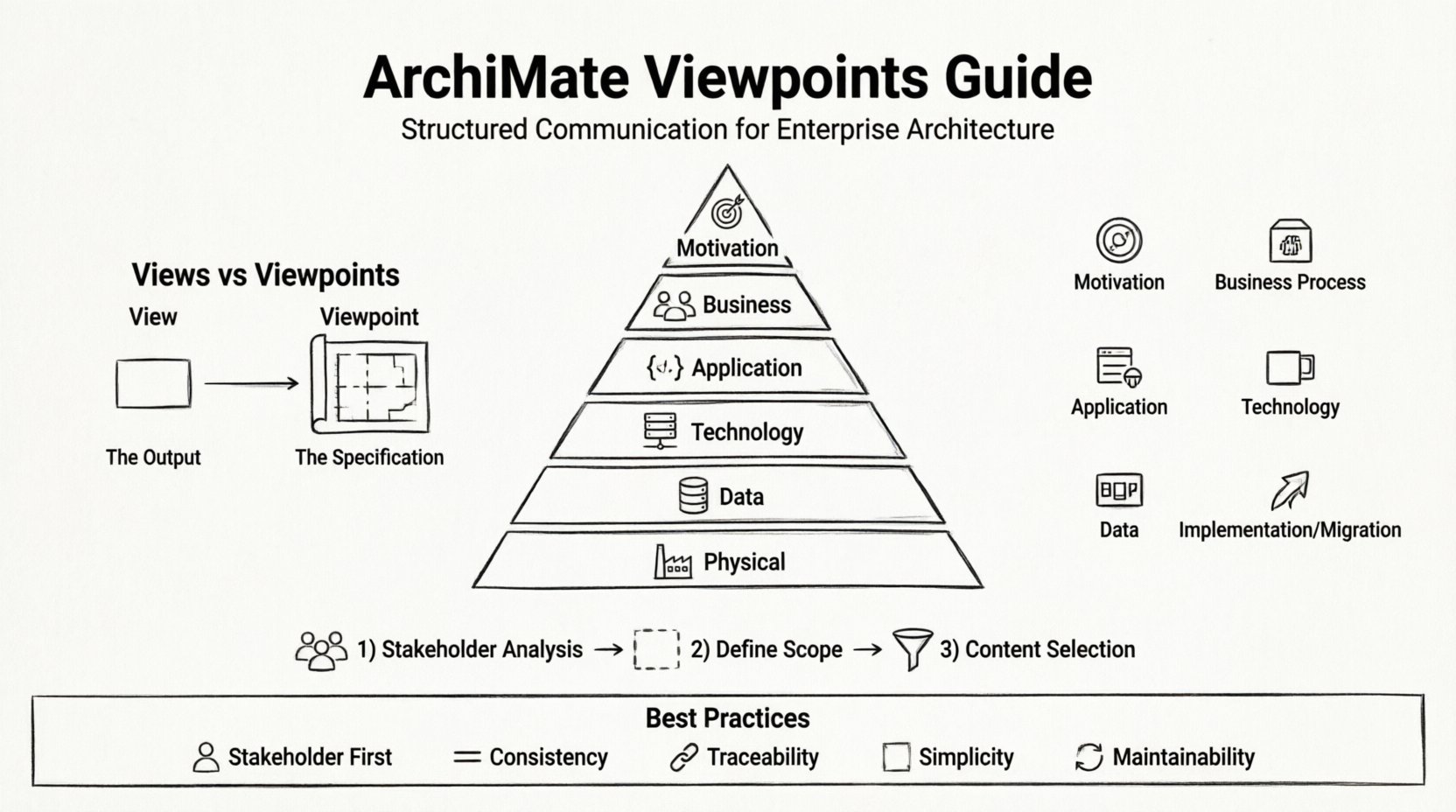
🔍 Views vs. Viewpoints: The Core Distinction
Before diving into specific types, it is crucial to distinguish between a View and a Viewpoint. These terms are often used interchangeably, yet they serve different functions in the architecture framework.
- View: A representation of a system from the perspective of a related stakeholder. It is the actual output, the diagram, or the document that shows specific elements and relationships.
- Viewpoint: A template or specification that defines the concerns of a stakeholder group. It dictates which elements, relationships, and languages are appropriate for a specific view.
Think of a viewpoint as a blueprint for a house. It tells you what rooms are needed, what materials to use, and where the plumbing goes. The view is the actual house built according to those specifications. Without a defined viewpoint, a view may include irrelevant details that confuse the audience or omit critical information that the stakeholder needs to make decisions.
🧩 The ArchiMate Structure: Layers and Domains
To understand viewpoints, one must understand the underlying structure of the ArchiMate language. The specification organizes architecture into layers and domains. Viewpoints are designed to slice through this structure to address specific concerns.
📐 The Layers
ArchiMate defines several layers that represent different aspects of the enterprise:
- Motivation: Deals with the why. Elements like Goals, Principles, and Requirements.
- Business: Deals with the what. Elements like Business Processes, Actors, and Roles.
- Application: Deals with the how (software). Elements like Application Functions and Application Components.
- Technology: Deals with the infrastructure. Elements like Nodes and Devices.
- Data: Deals with information. Elements like Data Objects and Data Entities.
- Physical: Deals with the hardware. Elements like Equipment and Facilities.
🌐 The Domains
In addition to layers, the architecture is divided into domains that group elements by their nature:
- Business Domain: Includes Business, Data, and Motivation layers.
- Application Domain: Includes Application and Data layers.
- Technology Domain: Includes Technology, Physical, and Data layers.
| Layer | Primary Concern | Typical Stakeholders |
|---|---|---|
| Motivation | Strategy & Goals | C-Suite, Strategy Office |
| Business | Operations & Processes | Business Managers, Process Owners |
| Application | Software Capabilities | IT Managers, Developers |
| Technology | Infrastructure | Infrastructure Engineers, Ops |
| Implementation | Projects & Migration | Project Managers, Architects |
📋 Key Viewpoint Categories
The ArchiMate specification includes a set of standard viewpoints designed to cover common stakeholder concerns. While organizations often create custom viewpoints, understanding the standard ones provides a solid foundation.
🎯 Motivation Viewpoint
This viewpoint focuses on the strategic drivers behind an architecture. It connects business strategy to architectural decisions.
- Key Elements: Goal, Objective, Principle, Requirement, Assessment, Stakeholder.
- Key Relationships: Satisfies, Assigns, Triggers, Realizes, Influences.
- Usage: Used to justify why an architecture change is necessary. It maps business goals to the requirements that drive the implementation.
🏢 Business Process Viewpoint
This is perhaps the most common viewpoint, used to visualize how the business operates. It is crucial for business analysts and operational managers.
- Key Elements: Business Process, Business Object, Business Actor, Business Role, Business Service.
- Key Relationships: Access, Trigger, Communication, Assignment, Flow.
- Usage: Clarifies responsibilities and workflows. It helps identify bottlenecks or redundancies in operational procedures.
💾 Application Viewpoint
This viewpoint details the software landscape. It is essential for IT managers and developers who need to understand system interactions.
- Key Elements: Application Function, Application Component, Application Interface, Application Service.
- Key Relationships: Access, Communication, Flow, Aggregation, Composition.
- Usage: Maps out which software components support specific business services. It is often used for migration planning and technical debt assessment.
🖥️ Technology Viewpoint
This viewpoint describes the infrastructure that hosts the application and business layers. It is critical for infrastructure teams.
- Key Elements: Node, Device, System Software, Network, Data Object, Data Store.
- Key Relationships: Realization, Communication, Aggregation, Composition, Assignment.
- Usage: Shows how software is deployed on hardware. It helps in capacity planning and security assessment.
📊 Data Viewpoint
Data is a cross-cutting concern in ArchiMate. The Data Viewpoint focuses specifically on information objects and their flow.
- Key Elements: Data Object, Data Entity, Data Structure.
- Key Relationships: Access, Flow, Aggregation, Composition.
- Usage: Ensures data consistency across different layers. It is used to track how information moves from business processes through applications to storage.
🚀 Implementation & Migration Viewpoint
This viewpoint is vital for planning change. It connects the current state (as-is) to the target state (to-be) through specific projects.
- Key Elements: Implementation Event, Migration, Work Package, Project, Phase, Goal, Requirement, Deliverable, Assessment.
- Key Relationships: Satisfies, Realizes, Accesses, Triggers, Assignment.
- Usage: Defines the roadmap for change. It ensures that architectural goals are met through executable work packages and projects.
🎯 Designing Effective Viewpoints
Creating a viewpoint is more than selecting a template. It requires careful consideration of the audience and the specific problem being solved. The following steps guide the design process.
1. Stakeholder Analysis
Start by identifying who will consume the architecture documentation. Different stakeholders have different concerns.
- Executives: Need high-level strategy and cost implications. They require the Motivation and Business layers.
- Business Managers: Need process clarity and service definitions. They require the Business layer.
- Developers: Need technical specifications and interface definitions. They require the Application and Technology layers.
Matching the viewpoint to the stakeholder prevents information overload. A technical diagram shown to a C-level executive often fails to communicate value.
2. Defining the Scope
A viewpoint must define boundaries. What is included and what is excluded? A common mistake is trying to show the entire enterprise in a single view. This creates clutter and reduces usability.
- Horizontal Scope: Which layers are included? (e.g., Business and Application only).
- Vertical Scope: Which specific business units or regions are covered? (e.g., Finance Department only).
- Depth of Detail: How granular should the elements be? (e.g., High-level processes vs. detailed task steps).
3. Content Selection
Not all elements of the ArchiMate language are relevant to every viewpoint. The viewpoint specification should explicitly state which elements are allowed.
- Focus on Relationships: Ensure the relationships depicted are meaningful. Avoid cluttering the diagram with weak or generic connections.
- Consistency: Use consistent naming conventions across all views generated from the viewpoint.
- Layering: Use layered views to separate concerns. Do not mix technology infrastructure details with business strategy goals in the same diagram unless specifically necessary.
⚠️ Common Pitfalls in Viewpoint Design
Even experienced architects make mistakes when defining viewpoints. Recognizing these pitfalls can improve the quality of architectural documentation.
- Over-Engineering: Creating overly complex viewpoints that are difficult to maintain. Simpler is often better for communication.
- Ignoring the Motivation Layer: Many architectures fail because they focus solely on the “what” and “how” without explaining the “why”. The Motivation layer provides the justification for investment.
- Inconsistent Abstraction: Mixing high-level strategic goals with low-level technical details in the same view confuses the reader. Keep levels of abstraction consistent.
- Static Documentation: Architecture is dynamic. Viewpoints should be designed to support updates. If a viewpoint is too rigid, it becomes obsolete quickly.
- Lack of Traceability: Ensure that elements in one view can be traced back to the source model. This allows for impact analysis when changes occur.
🔄 Integration with Methodologies
ArchiMate is a modeling language, not a methodology. It is often integrated with frameworks like TOGAF or SABSA. Viewpoints play a critical role in this integration.
For example, in TOGAF, the Architecture Development Method (ADM) produces artifacts at each phase. Viewpoints help map these artifacts to the appropriate audience.
- Phase A (Architecture Vision): Use the Motivation Viewpoint to define the scope and constraints.
- Phase B (Business Architecture): Use the Business Process Viewpoint to model capabilities.
- Phase C (Information Systems Architecture): Use Application and Data Viewpoints to model the system landscape.
- Phase D (Technology Architecture): Use the Technology Viewpoint to model infrastructure.
- Phase G (Migration Planning): Use the Implementation & Migration Viewpoint to plan the transition.
This alignment ensures that the architectural artifacts produced are not just diagrams, but actionable deliverables that fit within the broader governance framework.
✅ Summary of Best Practices
To conclude, effective use of ArchiMate Viewpoints relies on discipline and clarity. Here are the core principles to remember:
- Stakeholder First: Always design the view for the person who will read it.
- Consistency: Maintain a standard set of viewpoints across the enterprise.
- Traceability: Ensure every element can be traced to a business requirement or strategic goal.
- Simplicity: Avoid unnecessary complexity. A clear, simple diagram is better than a complex, confusing one.
- Maintainability: Ensure the model can be updated as the enterprise evolves.
By adhering to these principles, enterprise architects can create documentation that truly supports decision-making and drives successful transformation. The ArchiMate specification provides the tools; the viewpoint defines how those tools are used to solve real business problems.

 English
 Arabic
 Chinese (Simplified)
 Dutch
Dutch French
 German
 Italian
 Japanese
 Korean
 Portuguese
 Russian
 Spanish