


Enterprise architecture is evolving rapidly. The standardization of modeling languages allows organizations to communicate complex structures effectively. Within this landscape, ArchiMate Viewpoints serve as the critical lens through which stakeholders understand the enterprise. They filter complexity, focusing attention on specific concerns such as business processes, application functionality, or technology infrastructure. As digital transformation accelerates, the static nature of traditional diagrams is no longer sufficient. The future of ArchiMate Viewpoints lies in dynamic integration, automation, and real-time alignment with operational reality.
This guide explores how these perspectives are shifting. We examine the trajectory from static documentation to living models. We analyze the integration with modern development practices. We also discuss the implications for data governance and security. Understanding these shifts ensures that architecture remains a strategic asset rather than a bureaucratic exercise.
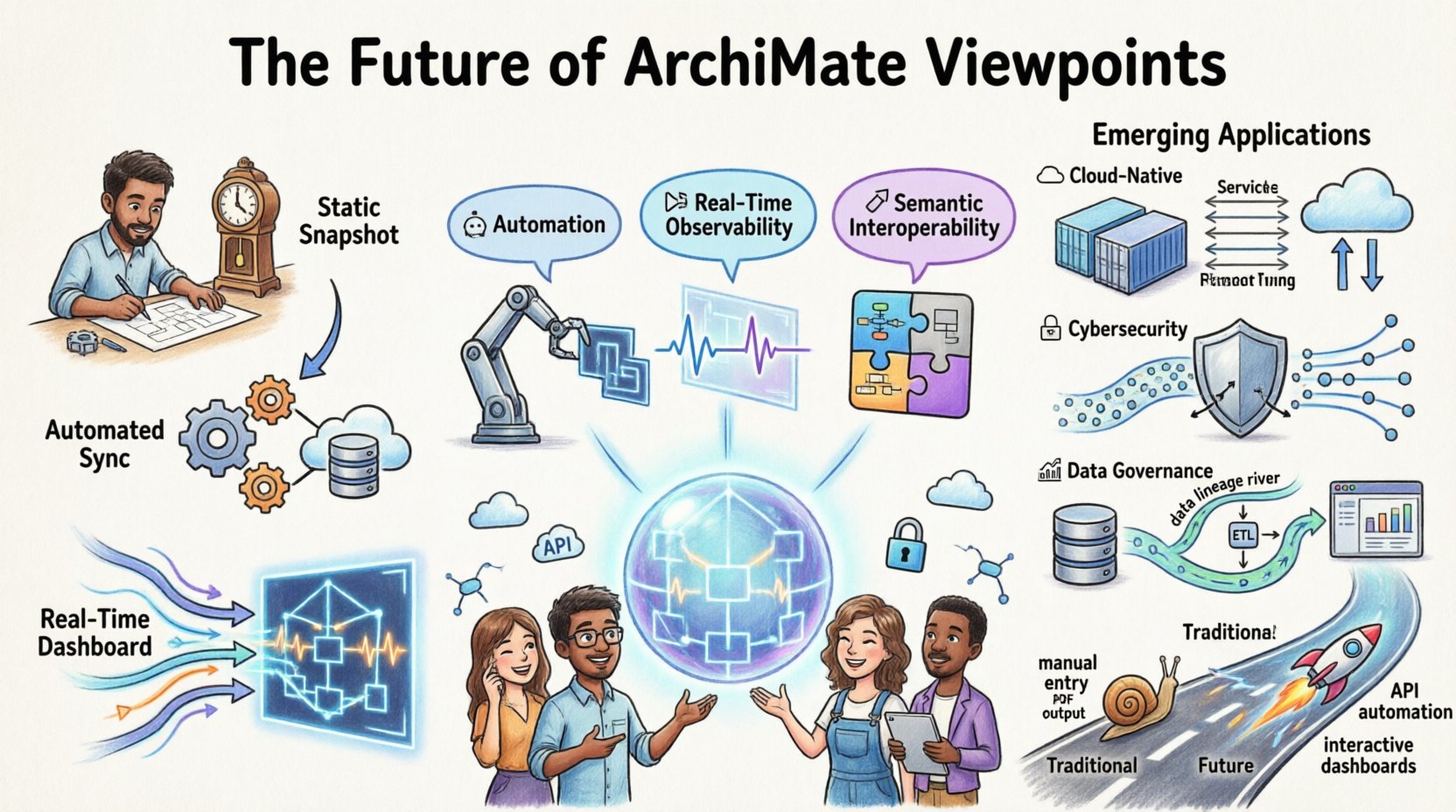
📈 The Evolution of Architecture Modeling
ArchiMate has established itself as the lingua franca for enterprise architecture. Originally designed to bridge the gap between business and IT, its core strength lies in the separation of concerns. Viewpoints enable this separation by defining what information is relevant to a specific audience. However, the context in which these views are consumed has changed.
- From Static to Dynamic: Early adoption focused on capturing a “snapshot” of the enterprise. This served as a reference point for large transformation projects. Today, the business environment changes faster than annual planning cycles. Static models quickly become outdated upon publication.
- From Manual to Automated: Historically, creating and maintaining models required significant manual effort. Architects spent hours drawing shapes and connecting lines. The future demands automated synchronization between the model and the actual implementation.
- From Siloed to Integrated: Architecture tools often operated in isolation. Data was stored in proprietary formats. Interoperability with other standards like BPMN, UML, and CIM is now a requirement, not a luxury.
The shift in viewpoint capabilities reflects a broader change in organizational maturity. Organizations are moving towards Model-Based Architecture. This approach treats the architecture model as the single source of truth. It drives downstream activities such as code generation, documentation creation, and compliance reporting.
🤖 Key Trends Shaping the Future
Several technological and methodological trends are influencing how ArchiMate Viewpoints are designed and utilized. These trends address the limitations of previous iterations and align with the pace of modern software delivery.
1. Automation and Model-Driven Engineering
Automation is the most significant driver of change. The goal is to reduce the gap between the design intent and the deployed reality. When a model is the source of truth, changes in the deployment pipeline should ideally reflect back in the architecture repository.
- Automated Synchronization: Tools can now parse infrastructure code or API definitions to update architectural models automatically. This ensures that the Viewpoint reflects the current state of the system.
- Validation Rules: Automated checks can verify compliance with architectural principles. If a developer attempts to introduce a pattern that violates a business rule, the model flags the inconsistency immediately.
- Documentation Generation: Viewpoints can be configured to output specific documentation formats. This reduces the administrative burden on architects, allowing them to focus on analysis rather than formatting.
2. Real-Time Architecture and Observability
The concept of “Architecture in Production” is gaining traction. Instead of a model that represents a past state, the Viewpoint will eventually represent the live system. This requires deep integration with observability platforms.
- Runtime Monitoring: Metrics from the application layer feed into the architecture model. This allows architects to see which components are under stress or experiencing latency.
- Event-Driven Updates: When a microservice is deployed or retired, the event triggers an update in the architecture model. This keeps the Viewpoint synchronized with the deployment pipeline.
- Health Dashboards: Viewpoints can display system health alongside structural information. Stakeholders can understand not just what the system looks like, but how it is performing.
3. Semantic Interoperability
Standards do not exist in a vacuum. Enterprise architecture must coexist with data models, security protocols, and business processes. Future Viewpoints must support richer semantic relationships.
- Ontology Alignment: Aligning ArchiMate concepts with domain ontologies allows for better reasoning. For example, linking a specific business capability to a specific data domain ontology enables impact analysis across the enterprise.
- API-First Design: Viewpoints need to accommodate API specifications (like OpenAPI or AsyncAPI). This bridges the gap between high-level business goals and low-level interface definitions.
- Data Governance Integration: As data governance becomes critical, Viewpoints must explicitly show data flows, ownership, and classification. This ensures that architecture supports regulatory compliance.
🌐 Emerging Applications of Viewpoints
Beyond standard business and IT alignment, ArchiMate Viewpoints are finding new homes. Specific domains are adopting these models to solve complex challenges. The flexibility of the language allows for specialized adaptations.
1. Cloud-Native Architecture
Moving to the cloud introduces complexity regarding service mesh, container orchestration, and serverless functions. Traditional application layers are no longer sufficient to describe this environment.
- Service Mesh Modeling: Viewpoints can be extended to represent service-to-service communication patterns. This helps in understanding traffic flow and security boundaries within the cluster.
- Infrastructure as Code (IaC): Linking architectural components to IaC templates ensures consistency. If the architecture changes, the deployment configuration updates accordingly.
- Multi-Cloud Strategies: Viewpoints help visualize workload distribution across different cloud providers. This is essential for cost management and avoiding vendor lock-in.
2. Cybersecurity and Risk Management
Security is often treated as an add-on. Integrating it into the core architecture model ensures it is considered from the design phase. Viewpoints focused on security provide a clear map of threats and controls.
- Threat Modeling: Specific Viewpoints map assets to potential threats. This supports the identification of critical vulnerabilities before deployment.
- Access Control Visualization: Showing who has access to what data and application is crucial. A security Viewpoint clarifies permissions and identifies over-provisioned access rights.
- Compliance Mapping: Regulations like GDPR or SOC2 require specific controls. Architecture models can tag components with compliance requirements, simplifying audit preparation.
3. Data Governance and Analytics
Data is the fuel of modern enterprise. Understanding how data flows between systems is as important as understanding the systems themselves. Viewpoints provide the context for data lineage.
- Data Lineage: Viewpoints track data from its origin (source system) to its consumption (dashboard or report). This is vital for data quality and trust.
- Master Data Management: Identifying where master data resides and how it is managed helps prevent fragmentation. Architecture models highlight the central sources of truth.
- Analytics Integration: Linking business capabilities to analytics tools shows where insights are generated. This ensures that data initiatives align with business value.
📊 Comparison: Traditional vs. Future Viewpoints
To understand the magnitude of this shift, we can compare the characteristics of traditional modeling with the emerging requirements of the future. The table below highlights the key differences.
| Feature | Traditional Viewpoints | Future Viewpoints |
|---|---|---|
| Update Frequency | Annual or Project-Based | Real-Time or Continuous |
| Data SourceManual Entry | Automated Ingestion (APIs, Logs) | |
| Focus | Static Structure | Dynamic Behavior & Performance |
| Stakeholders | IT Managers & Architects | Developers, DevOps, Security, Business |
| Integration | Siloed Repositories | Interoperable Ecosystem |
| Output | PDF Reports | Interactive Dashboards & APIs |
This comparison illustrates that the role of the Viewpoint is expanding. It is no longer just a diagram for a slide deck. It is an interface for the enterprise system.
⚠️ Challenges and Considerations
While the future holds promise, significant challenges remain. Adopting these new capabilities requires careful planning and a shift in culture. Organizations must navigate technical debt and resistance to change.
- Data Quality: Automated synchronization relies on clean data. If the source systems do not expose metadata correctly, the model becomes garbage in, garbage out. Governance of the metadata is essential.
- Tool Complexity: Integrating multiple systems increases the complexity of the architecture stack. Choosing the right integration patterns is critical to avoid creating a new silo.
- Skill Gaps: Architects need new skills. Understanding APIs, cloud infrastructure, and data engineering is becoming as important as knowing the modeling notation. Training programs must evolve.
- Cultural Adoption: Developers may view architecture models as overhead. The value proposition must be clear. If the model helps them ship faster or reduces bugs, adoption will increase.
🛠️ Best Practices for Future-Proofing
To prepare for these changes, organizations should adopt specific practices. These steps ensure that the architecture capability remains relevant and valuable in the coming years.
1. Define Clear Scope and Granularity
Not every Viewpoint needs to be real-time. Define which models require automation and which can remain static. High-level strategic models can stay manual. Operational models should be automated. This balances effort with value.
2. Prioritize Interoperability Standards
Ensure that the modeling platform supports open standards. XMI, JSON, and REST APIs should be the norm, not the exception. Avoid proprietary formats that lock data into a single vendor. This preserves flexibility.
3. Embed Architecture in the CI/CD Pipeline
Architecture validation should be part of the build process. If a change violates an architectural principle, the pipeline should fail. This enforces governance without human intervention. It shifts the culture from policing to enabling.
4. Foster Cross-Functional Collaboration
Architecture is not a department; it is a practice. Involve developers, security teams, and business analysts in the modeling process. When multiple disciplines contribute to the Viewpoint, the model becomes more accurate and useful.
5. Invest in Knowledge Management
Models are only as good as the understanding behind them. Documentation should explain the “why” behind the “what”. Retaining institutional knowledge is vital when team members change. Archiving decisions and rationales is part of the model.
🌟 The Human Element in Architecture
Technology trends often overshadow the human aspect. However, the purpose of ArchiMate Viewpoints remains communication. Regardless of how advanced the automation becomes, the goal is to facilitate understanding among people.
- Visual Clarity: As models become more complex, visual design becomes more important. Viewpoints must remain readable. Cluttered diagrams defeat the purpose of abstraction.
- Storytelling: Models tell a story about the enterprise. They explain how the business works. Future Viewpoints should support narrative capabilities, not just structural definitions.
- Decision Support: The ultimate value of a Viewpoint is the decisions it supports. Whether it is a choice of technology or a change in process, the model should provide the evidence needed to decide.
🔮 Long-Term Outlook
Looking further ahead, we can anticipate further convergence. The distinction between architecture, operations, and development may blur. The Viewpoint becomes the shared interface for the entire organization.
- AI-Assisted Modeling: Artificial Intelligence can suggest architectural patterns based on historical data. It can predict potential bottlenecks before they occur. This moves architecture from reactive to proactive.
- Virtual Reality Visualization: Complex systems might be explored in 3D environments. Architects and stakeholders could “walk through” the enterprise architecture to understand dependencies better.
- Global Collaboration: Cloud-based modeling platforms enable real-time collaboration across geographies. Teams can work on the same Viewpoint simultaneously, regardless of location.
The trajectory is clear. ArchiMate Viewpoints are moving from static documentation to dynamic intelligence. They are becoming integral to the operating system of the enterprise. By embracing these trends, organizations can ensure their architecture function drives value rather than just recording history.
📝 Summary of Key Takeaways
The transformation of ArchiMate Viewpoints is driven by the need for speed, accuracy, and integration. The following points summarize the critical shifts:
- Automation is essential. Manual maintenance cannot keep pace with modern deployment rates.
- Integration is key. Models must connect with code, infrastructure, and business processes.
- Security and Data are central. These domains require specialized Viewpoints to manage risk and governance.
- Human communication remains the goal. Technology serves the people who build and run the enterprise.
- Standards enable flexibility. Open formats prevent vendor lock-in and ensure longevity.
Organizations that adapt to these changes will find their architecture function becoming a strategic partner. Those that remain static risk becoming a bottleneck. The future belongs to those who can model the dynamic nature of their enterprise effectively.

 English
 Arabic
 Chinese (Simplified)
 Dutch
Dutch French
 German
 Italian
 Japanese
 Korean
 Portuguese
 Russian
 Spanish