


Enterprise architecture demands precision. When we talk about ArchiMate, we often discuss layers, domains, and relationships. However, the bridge between complex models and actionable business insight lies in the Viewpoint. Despite its central role in the specification, misconceptions abound. These myths can lead to confusion, wasted effort, and models that fail to communicate.
This guide cuts through the noise. We will examine the core concepts of ArchiMate Viewpoints, dismantle common falsehoods, and establish a foundation for effective modeling. Whether you are defining standards for an enterprise or designing a specific project model, clarity on viewpoints is non-negotiable. Let us proceed with a critical look at what these artifacts truly are.
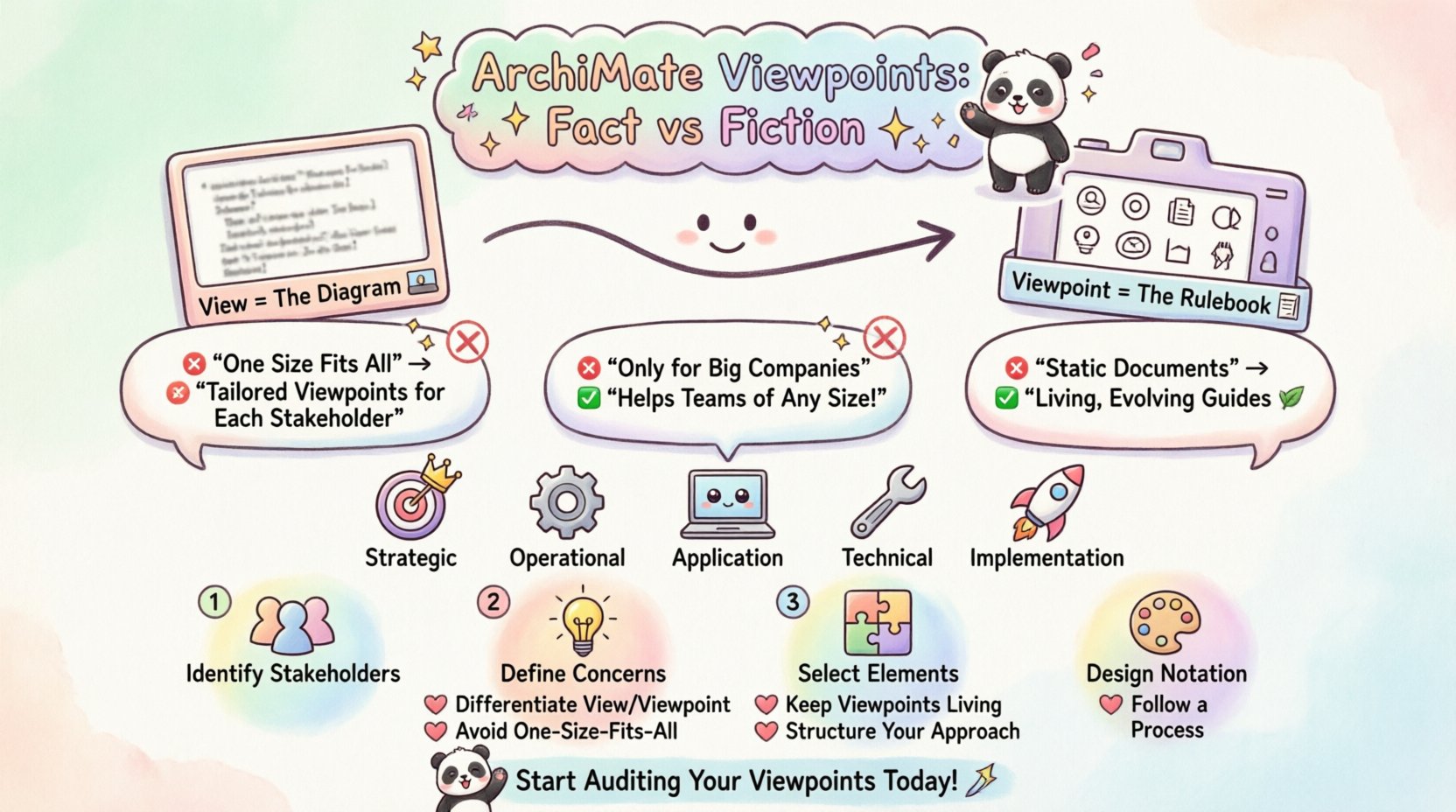
🛠️ Defining the Viewpoint: Fact vs. Fiction
To understand the myths, we must first ground ourselves in the definition provided by the ArchiMate specification. A Viewpoint is not merely a screen or a report. It is a specification for a view.
The Distinction
- View: A representation of a system from the perspective of a particular stakeholder. It is the actual diagram or document.
- Viewpoint: A specification that defines how a view is created. It sets the rules, scope, and notation.
Many practitioners confuse these two terms. They assume the Viewpoint is the diagram itself. This is incorrect. The Viewpoint is the template, the rulebook, or the lens through which the model is viewed.
Core Components of a Viewpoint
A proper Viewpoint specification must address several key elements. Without these, the resulting view lacks context and utility.
- Stakeholders: Who is the intended audience? Executives? Developers? Auditors?
- Concerns: What specific questions must this view answer? Cost? Security? Process flow?
- Language: Which ArchiMate language elements are permitted? Business, Application, or Technology?
- Notation: How should the visual representation look? Color coding, line styles, or specific layouts?
By rigorously defining these four components, you ensure consistency. This consistency is vital when multiple architects contribute to the same repository.
🚫 Common Myth #1: One Viewpoint Fits All
The most pervasive myth in enterprise architecture is the belief that a single Viewpoint can serve every purpose. This approach often stems from a desire for simplicity or a lack of resources. However, reality dictates otherwise.
A CTO requires different information than a Business Process Analyst. A CTO focuses on infrastructure, scalability, and technical debt. A Business Analyst focuses on capabilities, value streams, and process efficiency.
Why This Myth Persists
- Resource Constraints: Creating multiple Viewpoints requires time and discipline.
- Tool Limitations: Some tools make it difficult to manage multiple standards simultaneously.
- Overconfidence: Believing the model is so clear that context is unnecessary.
The Reality
Effective architecture relies on segmentation. You need a hierarchy of Viewpoints. At the top, you have high-level strategic Viewpoints. At the bottom, you have detailed technical Viewpoints. Mixing them creates cognitive overload.
Consider the impact of mixing layers:
- Showing a database schema (Technology) to a Marketing Director (Business) creates confusion.
- Showing a high-level value stream (Business) to a DevOps Engineer (Technology) lacks the necessary detail for implementation.
The solution is a curated set of Viewpoints. Each one targets a specific concern for a specific group. This specialization increases the value of every diagram produced.
🚫 Common Myth #2: Viewpoints Are Only for Large Enterprises
There is a belief that formal Viewpoint management is reserved for massive organizations with hundreds of architects. Small teams often skip this step, assuming their internal communication is sufficient.
The Risk of Informality
Even in smaller teams, assumptions lead to errors. When an architect creates a diagram without a defined Viewpoint:
- They might use notation that the next architect does not recognize.
- They might omit critical relationships that are standard in the organization.
- They might include irrelevant details that obscure the main message.
The Benefit for Small Teams
For smaller groups, Viewpoints act as a lightweight governance mechanism. They are not about bureaucracy; they are about shared understanding.
- Onboarding: New members learn the standard quickly.
- Consistency: Diagrams look familiar, reducing the learning curve for stakeholders.
- Scalability: When the team grows, the standards are already in place.
Abandoning Viewpoints for the sake of speed is a short-term gain that costs long-term maintenance. A lightweight Viewpoint specification takes minutes to draft but saves hours of explanation later.
🚫 Common Myth #3: Viewpoints Are Static Documents
Many treat Viewpoints as static artifacts written once and filed away. In a dynamic enterprise, requirements change. Stakeholders change. The technology landscape shifts.
The Evolution of Viewpoints
Viewpoints must be living documents. They require periodic review.
- Relevance Check: Is this Viewpoint still being used? If no one looks at the “Legacy System Migration” Viewpoint, it might be retired.
- Update Check: Has the business language changed? If a new capability category is introduced, the Viewpoint should reflect this.
- Feedback Loop: Stakeholders should provide feedback on whether the Viewpoint helps them make decisions.
Version Control
Just like the architecture model itself, Viewpoints should be versioned. This allows you to track changes over time. If a Viewpoint changes, you know exactly when and why.
This approach prevents the “unknown change” problem. If a stakeholder notices a diagram looks different from last quarter, they need to know if it is a new version of the Viewpoint or an error.
📊 Structuring Your Viewpoint Strategy
How do you organize this in practice? A structured approach ensures that every diagram serves a purpose. Below is a breakdown of how to categorize Viewpoints based on their function.
| Category | Primary Audience | Key Concern | Typical Content |
|---|---|---|---|
| Strategic | Executive Board | Alignment & Vision | Value Streams, Capabilities, Strategic Goals |
| Operational | Process Owners | Efficiency & Flow | Business Processes, Collaboration, Organization |
| Application | Software Architects | Functionality & Integration | Application Services, Components, Interfaces |
| Technical | Infrastructure Team | Performance & Security | Nodes, Devices, Networks, System Software |
| Implementation | Project Managers | Migration & Deployment | Implementation Events, Work Packages, Solutions |
🎯 Building Effective Viewpoints: A Step-by-Step Guide
Creating a Viewpoint is a deliberate process. It requires understanding the audience before selecting the notation. Follow this logical sequence to ensure success.
Step 1: Identify the Stakeholders
Who are we talking to? Do not guess. Interview the decision-makers.
- Identify Roles: CIO, CFO, Business Analyst, Developer.
- Identify Needs: What information do they need to approve a budget? What do they need to fix a bug?
- Identify Constraints: Do they have time to read complex diagrams? Do they need high-level summaries?
Step 2: Define the Concerns
Once you know the stakeholders, define the problem they need to solve. A Viewpoint addresses a specific concern.
- Scope: Limit the scope to the specific business domain.
- Depth: Determine how deep the model needs to go.
- Focus: Is the focus on cost, risk, speed, or compliance?
Step 3: Select the Language Elements
ArchiMate has many elements. Not all are needed for every Viewpoint. Using too many elements creates clutter.
- Restriction: Only include elements that answer the defined concern.
- Standardization: Use standard elements to ensure interoperability.
- Clarity: Avoid proprietary or custom extensions unless absolutely necessary.
Step 4: Design the Notation
How will it look? Visual cues help comprehension.
- Color Coding: Use specific colors for specific layers (e.g., Business = Blue, Technology = Green).
- Layout: Use consistent positioning for actors and processes.
- Annotations: Add explanatory text where the diagram is not self-explanatory.
🤔 The Relationship Between Viewpoints and Methods
Viewpoints do not exist in a vacuum. They are often integrated with architecture methods like TOGAF. Understanding this relationship is crucial for compliance and structure.
Integration Points
- Architecture Vision: High-level Viewpoints support the Vision phase.
- Business Architecture: Specific Viewpoints define the Business Scope.
- Information Systems: Viewpoints guide the data and application structure.
- Technology Architecture: Viewpoints manage the infrastructure standards.
Benefits of Integration
Linking Viewpoints to a formal method ensures that the architecture is not just a collection of diagrams. It becomes a structured body of knowledge.
- Traceability: You can trace a diagram back to a specific phase in the methodology.
- Completeness: The method ensures all required Viewpoints are created.
- Consistency: The method enforces standards across the enterprise.
⚠️ Common Pitfalls to Avoid
Even with the best intentions, pitfalls can derail your Viewpoint strategy. Awareness of these traps helps you avoid them.
1. Over-Engineering
Creating a Viewpoint that is too rigid can stifle creativity and innovation. If the rules are too strict, architects will find workarounds that break the rules anyway.
- Solution: Allow flexibility for specific project needs while maintaining core standards.
2. Under-Communication
If a Viewpoint is not documented well, no one will use it. It becomes a hidden artifact.
- Solution: Publish Viewpoint definitions in a central repository. Train architects on how to use them.
3. Ignoring the “Why”
Creating a Viewpoint without a clear purpose is a waste of resources. Every Viewpoint must justify its existence.
- Solution: Regularly audit your Viewpoints. Remove those that no longer serve a business need.
4. Mixing Layers Indiscriminately
While cross-layer diagrams exist, mixing too many layers confuses the reader. A Viewpoint should generally focus on one primary layer with limited cross-references.
- Solution: Define clear boundaries for cross-layer relationships in the Viewpoint specification.
🔮 Future-Proofing Your Viewpoints
Enterprise architecture is not static. Technology evolves, and business models shift. Your Viewpoints must adapt to remain relevant.
Adapting to Change
- Cloud Computing: Traditional technology Viewpoints may need to evolve to account for cloud services versus on-premise infrastructure.
- Microservices: Application Viewpoints may need to shift from monolithic components to service interfaces.
- Agile: Implementation Viewpoints may need to align with sprint cycles rather than annual planning.
Continuous Improvement
Establish a feedback mechanism. When a Viewpoint fails to answer a stakeholder’s question, that is a signal to update the specification.
- Metrics: Track how often Viewpoints are accessed and referenced.
- Reviews: Schedule annual reviews of the Viewpoint catalog.
- Updates: Document changes to the Viewpoint standards in a change log.
🔗 The Human Element
Finally, remember that Viewpoints are human artifacts. They are designed for people, not machines. A technically perfect Viewpoint that no one understands is a failure.
Usability Over Perfection
- Readability: Ensure the diagrams are readable without zooming in excessively.
- Clarity: Use labels that are clear to the intended audience.
- Context: Provide context for every relationship shown.
Training and Adoption
Introducing new Viewpoints requires training. Do not assume everyone knows the notation.
- Workshops: Conduct workshops to explain the Viewpoint standards.
- Cheatsheets: Provide quick reference guides for common Viewpoints.
- Mentorship: Pair junior architects with seniors during the creation process.
📝 Summary of Key Takeaways
To summarize the essential points for success in ArchiMate Viewpoint management:
- Differentiate View and Viewpoint: One is the output, the other is the specification.
- Avoid One-Size-Fits-All: Tailor Viewpoints to specific stakeholders and concerns.
- Keep it Living: Review and update Viewpoints regularly.
- Structure Your Approach: Categorize Viewpoints by audience and function.
- Follow a Process: Identify stakeholders, define concerns, select elements, and design notation.
- Integrate with Methods: Align Viewpoints with your overall architecture methodology.
- Avoid Pitfalls: Watch out for over-engineering and under-communication.
By adhering to these principles, you build an architecture practice that is robust, communicative, and valuable. The goal is not just to create diagrams, but to facilitate understanding and decision-making across the enterprise.
🚀 Moving Forward
The journey of architecture is continuous. As you refine your Viewpoints, you will find new ways to communicate complex information. The myths discussed here are obstacles to clear thinking. By removing them, you pave the way for clarity.
Start by auditing your current Viewpoints. Identify which ones are myths in practice. Then, apply the structured approach outlined in this guide. Over time, the quality of your architecture will improve, and the value of your models will become undeniable.
Remember, the power of ArchiMate lies in its ability to standardize communication. Viewpoints are the vehicle for that standardization. Treat them with the respect and attention they deserve, and your architecture practice will thrive.

 English
 Arabic
 Chinese (Simplified)
 Dutch
Dutch French
 German
 Italian
 Japanese
 Korean
 Portuguese
 Russian
 Spanish