


Enterprise Architecture (EA) serves as the blueprint for organizational transformation. It bridges the gap between business strategy and IT execution. However, the complexity of modern systems often obscures critical details. Stakeholders struggle to see the connection between a high-level business goal and a specific database server. This is where ArchiMate Viewpoints become indispensable. They provide the necessary abstraction and focus to communicate effectively.
In this comprehensive guide, we will explore the mechanics, benefits, and application of ArchiMate Viewpoints. We will examine how they facilitate stakeholder alignment and decision-making without getting lost in technical weeds. Understanding these concepts is vital for architects aiming to deliver clarity in chaotic environments.
🧩 Understanding the Architecture Language
Before diving into Viewpoints, one must understand the foundation. ArchiMate is a modeling language designed for Enterprise Architecture. It offers a standardized notation for describing, analyzing, and visualizing the structure and behavior of an enterprise. It covers business, application, and technology layers, along with strategy and implementation.
However, a single diagram cannot tell the whole story. A complex enterprise requires different perspectives for different audiences. A CFO needs to see financial impacts, while a CTO needs to see infrastructure dependencies. ArchiMate Viewpoints solve this by defining what information should be included in a specific view.
🔍 Viewpoint vs. View: The Crucial Distinction
Confusion often arises between the terms Viewpoint and View. Distinguishing them is the first step toward mastery.
- Viewpoint: This is a specification. It defines the conventions, notations, and modeling rules for a specific type of architecture description. It is the template or the lens through which the architecture is observed. Think of it as a camera filter.
- View: This is the actual representation produced by applying a Viewpoint to a model. It is the snapshot or the picture taken through the lens.
For example, a Business Viewpoint is the rule set that says “show me processes and roles.” The resulting diagram showing those elements is the Business View.
🏛️ The Core Layers and Domains
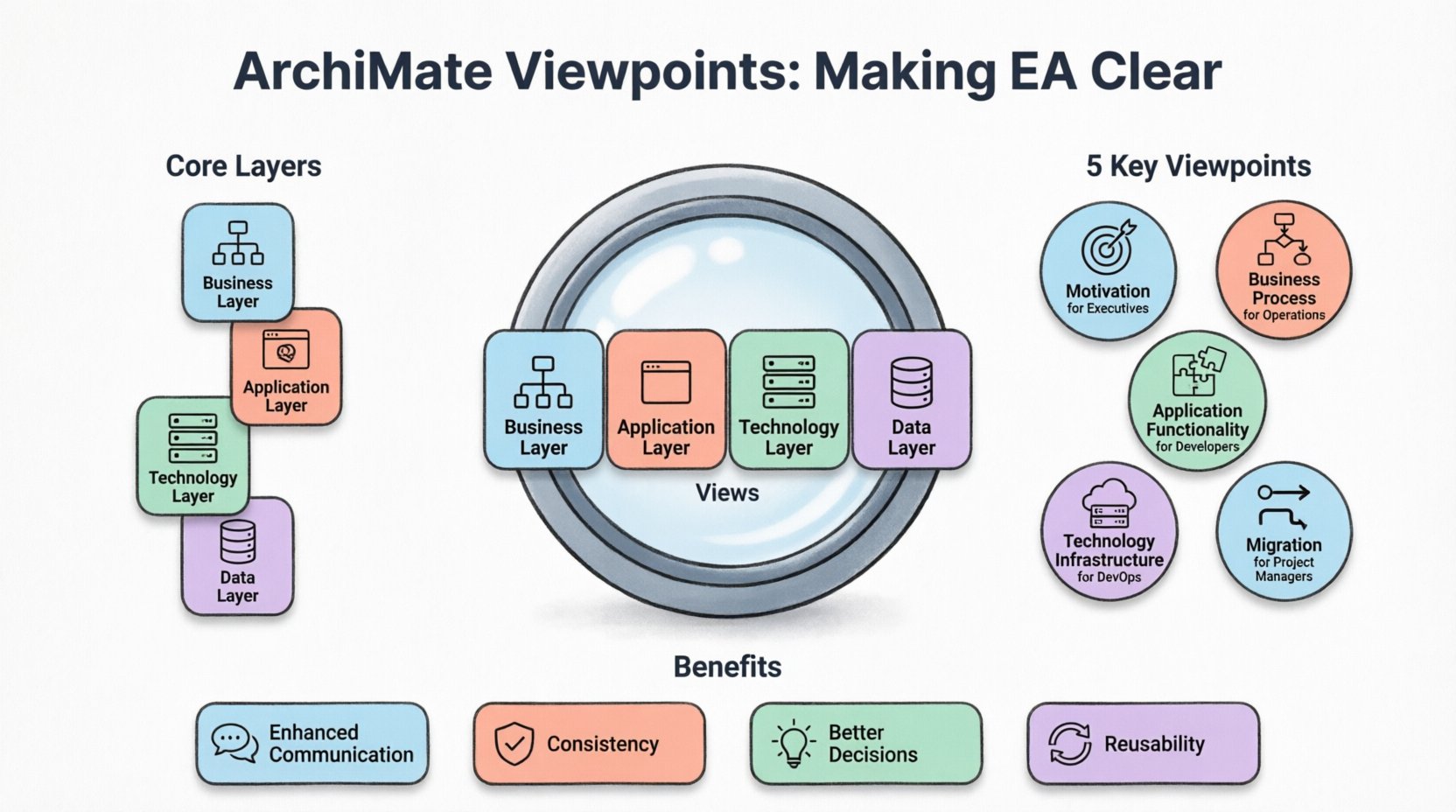
ArchiMate organizes architecture into several layers. Viewpoints determine how these layers are exposed to stakeholders. The primary layers include:
- Business Layer: Concerned with business strategy, governance, organization, and processes. It describes how the organization operates.
- Application Layer: Focuses on the software applications that support business functions. It details the functional requirements and logical architecture.
- Technology Layer: Describes the physical infrastructure and hardware that host the applications. This includes servers, networks, and data centers.
- Data Layer: Often integrated with the Business or Application layer, this describes the data objects and information flows.
Viewpoints allow architects to mix and match these layers based on the question at hand. A technology migration plan might focus heavily on the Technology layer while referencing the Application layer dependencies.
🎯 Key Viewpoint Categories
Not all stakeholders ask the same questions. ArchiMate defines standard viewpoints to address common architectural concerns. Below are the primary categories used in modern practice.
1. Motivation Viewpoint
This viewpoint is critical for aligning architecture with business intent. It focuses on the “why” behind the changes.
- Stakeholders: Business Executives, Strategy Officers.
- Focus: Goals, Principles, Drivers, and Requirements.
- Value: It connects technical implementation to business value. It answers whether a specific project supports a strategic goal.
2. Business Process Viewpoint
Used to understand operational flows and efficiency.
- Stakeholders: Operations Managers, Process Owners.
- Focus: Business Processes, Actors, Roles, and Artifacts.
- Value: Identifies bottlenecks and automation opportunities within daily workflows.
3. Application Functionality Viewpoint
Focuses on the software capabilities required.
- Stakeholders: Application Architects, Developers.
- Focus: Application Components, Services, and Data Objects.
- Value: Ensures software aligns with functional requirements before coding begins.
4. Technology Infrastructure Viewpoint
Deals with the physical and logical hosting environment.
- Stakeholders: Infrastructure Managers, DevOps Teams.
- Focus: Nodes, Devices, Systems Software, and Networks.
- Value: Assists in capacity planning and infrastructure modernization.
5. Implementation and Migration Viewpoint
Essential for planning the journey from current state to target state.
- Stakeholders: Project Managers, Delivery Leads.
- Focus: Projects, Work Packages, Deliverables, and Capabilities.
- Value: Visualizes the roadmap and dependencies between initiatives.
📊 Comparison of Common Viewpoints
The following table summarizes how different viewpoints serve specific needs within the enterprise.
| Viewpoint Type | Primary Audience | Key Elements | Strategic Goal |
|---|---|---|---|
| Motivation | Executive Leadership | Goals, Drivers, Principles | Ensure alignment with business value |
| Business Process | Operations Management | Process, Role, Actor | Optimize efficiency and workflow |
| Application | Software Architects | Application Component, Interface | Manage software dependencies |
| Technology | Infrastructure Teams | Node, Device, System Software | Ensure stability and performance |
| Migration | Project Management | Work Package, Project | Plan the transition path |
💡 Benefits of Structured Viewpoints
Adopting a viewpoint-driven approach offers tangible advantages over ad-hoc modeling.
1. Enhanced Communication
By tailoring views to specific audiences, architects reduce cognitive load. A developer does not need to see financial drivers, and a CFO does not need to see server rack layouts. Viewpoints filter noise and highlight relevant signals.
2. Consistency Across the Organization
Standardized viewpoints ensure that all teams use the same definitions and notation. This consistency is vital when multiple departments collaborate on complex projects. It prevents misinterpretation of architectural artifacts.
3. Improved Decision Making
When stakeholders can clearly see the impact of a change on their specific domain, decisions become more informed. The Motivation viewpoint, for instance, allows leaders to prioritize projects based on strategic alignment rather than technical preference.
4. Reusability and Scalability
Once a Viewpoint is defined, it can be applied to multiple models. This saves time during the creation of new architectures. As the enterprise grows, the same viewpoints can be reused to maintain structure.
🛠️ Implementation Best Practices
Implementing ArchiMate Viewpoints requires discipline and strategy. Here are key practices to follow.
- Start with the Stakeholder: Do not start by drawing models. Start by identifying who needs to make decisions. Define the Viewpoint based on their needs.
- Limit Scope: Avoid cramming every layer into a single diagram. A good Viewpoint is specific. If you need to show both business and technology, ensure the connection is clear, not cluttered.
- Define Naming Conventions: Ensure that all elements used in a Viewpoint follow consistent naming rules. This aids in searchability and maintenance.
- Keep it Updated: Architecture is dynamic. Views must be updated as the enterprise changes. Outdated models lead to poor decisions.
- Use Abstraction Levels: Not every view needs to be at the atomic level. Use high-level views for strategy and detailed views for execution.
🚧 Common Challenges and Solutions
While powerful, this approach has hurdles. Recognizing them early helps mitigate risks.
Challenge 1: Over-Engineering
Teams sometimes create too many Viewpoints for minor issues. This creates maintenance overhead.
- Solution: Adopt a “Just Enough” philosophy. Only create a Viewpoint if it solves a specific communication problem.
Challenge 2: Tool Dependency
Some teams tie Viewpoints to specific software features. This limits flexibility.
- Solution: Treat Viewpoints as conceptual standards. Ensure the modeling environment supports the ArchiMate standard without forcing proprietary features.
Challenge 3: Stakeholder Resistance
Stakeholders may find the notation confusing or feel it adds bureaucracy.
- Solution: Provide training and context. Show how the Viewpoint saves them time by reducing ambiguity.
🔄 Integration with Strategy and Governance
Modern Enterprise Architecture is not just about IT. It is about the entire organization. The Motivation Viewpoint plays a pivotal role here.
It links the operational layers to the strategic layer. By explicitly modeling Principles and Goals, architects can trace a requirement from a server configuration up to a corporate objective. This traceability is essential for governance.
- Compliance: Viewpoints can highlight regulatory requirements and how the architecture meets them.
- Risk Management: They can visualize single points of failure or dependency risks.
- Resource Allocation: They help identify which capabilities are under-invested or over-invested.
🌐 Future Trends in Modeling
The landscape of Enterprise Architecture is evolving. Here is what to expect regarding Viewpoints.
- Real-Time Architecture: Moving from static diagrams to live models that reflect the current state of systems.
- Automation: Automated generation of Views from existing system metadata. This reduces the manual effort of maintaining diagrams.
- Cloud-Native Focus: Viewpoints will increasingly focus on cloud services, containers, and serverless architectures rather than traditional servers.
- Data-Centric Views: With the rise of data analytics, data viewpoints will become more prominent, tracking lineage and governance.
📝 Summary of Key Takeaways
ArchiMate Viewpoints are more than just diagram templates. They are communication tools designed to manage complexity. By separating the what (the model) from the how it is seen (the Viewpoint), architects can serve diverse audiences effectively.
Key elements to remember include:
- Viewpoints define the rules for a specific view.
- Different stakeholders require different levels of abstraction.
- Standardized Viewpoints improve consistency and decision-making.
- Motivation Viewpoints link technical work to business value.
- Implementation requires balancing detail with clarity.
As enterprises continue to navigate digital transformation, the ability to communicate architecture clearly is a competitive advantage. ArchiMate Viewpoints provide the structure needed to turn architectural complexity into business clarity. Adopting them ensures that the architecture function remains relevant and valuable to the organization.

 English
 Arabic
 Chinese (Simplified)
 Dutch
Dutch French
 German
 Italian
 Japanese
 Korean
 Portuguese
 Russian
 Spanish