


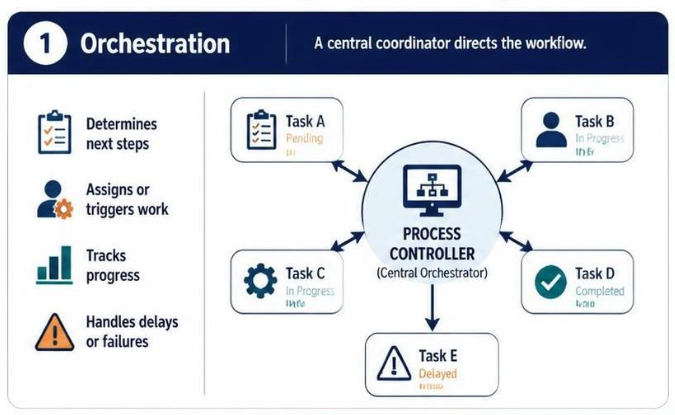
In the complex world of business process modeling, the distinction between how a system coordinates work is critical. Today, we explore the concept of Process Orchestration, a central pattern where a single, authoritative entity manages the lifecycle of a workflow. As illustrated in the diagram above, this approach relies on a central coordinator—often called a Process Controller—to dictate the flow of execution.
What is Process Orchestration?
Process orchestration is the mechanism by which a central authority directs the sequence of activities in a business process. Unlike choreography, where independent participants negotiate their own interactions, orchestration is top-down and directive. The diagram identifies the Process Controller as the central hub, responsible for determining what happens next, assigning tasks, and handling exceptions.
Key Responsibilities of the Orchestrator
The visual representation highlights four critical functions that the central orchestrator must perform to maintain control over the workflow:
- Determines Next Steps: The controller holds the “source of truth” regarding the process state. It evaluates conditions and decides which task should be executed immediately following the completion of the previous one.
- Assigns or Triggers Work: Instead of participants pulling tasks from a queue based on availability, the orchestrator pushes work to specific resources (users, systems, or services) by assigning or triggering the task.
- Tracks Progress: The central node monitors the status of all parallel and sequential branches, ensuring that the overall process remains synchronized.
- Handles Delays or Failures: Perhaps most importantly, the controller manages exceptions. If a task fails or times out, the orchestrator is responsible for initiating the appropriate recovery logic or alerting stakeholders.
Analyzing the System Architecture
Looking at the diagram, we can observe a star-like topology where the Process Controller sits at the center. This architecture is particularly useful for complex workflows where the sequence of events is rigid or requires global visibility.
The diagram depicts five distinct tasks (Task A through Task E), each represented by a unique status indicator:
- Task A (Pending): Waiting for the controller to trigger it.
- Task B (In Progress): Currently being executed by a user or system.
- Task C (In Progress): Another concurrent activity managed by the controller.
- Task D (Completed): A finished task that has reported its status back to the controller.
- Task E (Delayed): An exception state indicating a failure or delay, which the controller must now address.
The Role of the Controller
The controller is not merely a passive observer; it is an active agent. In a software implementation, this could be a workflow engine (like Camunda, BizTalk, or a custom BPMN engine). In a human-centric process, it might be a project manager or a dedicated admin dashboard. The bidirectional arrows in the diagram emphasize the continuous feedback loop: the controller sends commands, and the tasks send status updates back.
Orchestration vs. Choreography
It is vital to distinguish this architecture from Process Choreography. In choreography, there is no central controller. Instead, participants interact based on shared rules and events. If Participant A finishes a task, it broadcasts an event that Participant B listens for. In contrast, the Orchestration model shown here ensures that the flow is strictly controlled by the central node, making it ideal for scenarios requiring strict compliance, auditing, and error handling.
Implementing Orchestration in VPasCode
When modeling this architecture using tools like Visual Paradigm’s VPasCode, you must explicitly define the Control Flow (sequence of activities) separate from the Data Flow (information passed). The controller is the root node of the decision tree. By using a central actor, you simplify the logic for the workers (the tasks), as they do not need to know the “big picture” of the entire process—they only need to execute their assigned action and report back.
For developers and architects, recognizing the “Central Orchestrator” pattern is the first step toward building robust, fault-tolerant systems. By centralizing the logic, you gain the ability to pause, resume, or modify the process flow dynamically without changing the individual components of the system.

 English
 Arabic
 Chinese (Simplified)
 Dutch
 French
 German
 Italian
 Japanese
 Korean
 Portuguese
 Russian
 Spanish