


Scrum is a highly popular and well-known framework within Agile software development. Several years ago, Scrum introduced five core values to guide team members’ decisions. While not everyone fully understands or appreciates these values, they are essential for successful Scrum implementation and deserve a detailed explanation here.
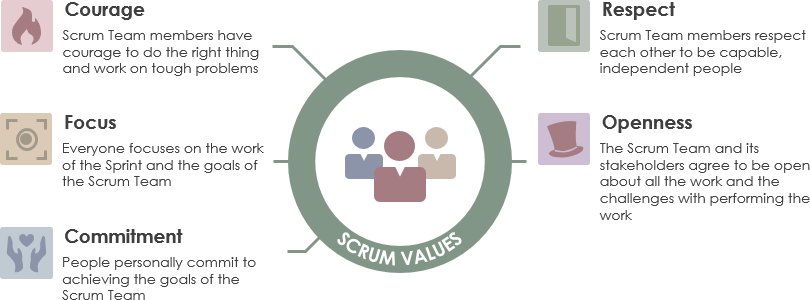 Source: Scrum.org – Scrum Values Poster
Courage
Scrum team members have the courage to do what’s right and tackle tough problems. Team members support one another in doing the right thing and taking smart risks so we can learn and improve along our journey, including:
- Acknowledging that no one is perfect
- Releasing a version that can be rolled back
- Sharing all possible information to help the team and organization
- Accepting that perfect requirement capture is impossible and adapting to rapid change is reality
Focus
Everyone focuses on the Sprint work and the Scrum team’s goal. Focus is essential when dealing with complexity and unpredictability, so we can achieve meaningful results. By concentrating on only a few things at a time, we deliver the most valuable items as quickly as possible. The Scrum framework includes elements that help foster focus:
- The team must focus on delivering a “Done” increment at least by the end of each Sprint.
- Each Scrum role has a unique accountability, helping individuals know what to prioritize—ultimately contributing to team outcomes.
- Scrum teams focus on the Sprint Goal to guide what the team delivers.
- The Product Backlog is prioritized, creating a clear focus on what’s most important next.
- Time-boxed Sprint events create a sense of urgency and help keep focus on the purpose of each event.
- Scrum events and artifacts help establish checkpoints for progress and new information, enabling the team to adapt at regular intervals.
Commitment
Scrum team members must be committed to success and willing to set realistic goals and stick to them. Each Scrum role is committed to team success—not just personal achievements—creating an environment of trust, effective problem-solving, and high standards:
- The Product Owner demonstrates commitment by making the best decisions to optimize product value, rather than simply trying to please every stakeholder.
- The Scrum Master commits to upholding the Scrum framework—meaning we don’t extend the Sprint or pressure time-boxes to “get done” in demos.
- The Scrum Master demonstrates commitment by removing impediments the team cannot resolve themselves, rather than tolerating the status quo.
- The Development Team demonstrates commitment by creating an increment that meets their “Done” definition—not just something that’s almost done.
Respect
As a self-organizing team, we cannot function without mutual respect. We foster an environment that is inclusive, productive, and humane for everyone. The Scrum framework includes elements that promote respect:
- Full Scrum team participation in Sprint Planning, Sprint Review, and Sprint Retrospective, fostering respect for each role, responsibility, and perspective.
- The Development Team is cross-functional, meaning they have all the skills needed to deliver a “Done” product increment. This promotes respect for each individual’s experience, skills, and ideas—and also encourages learning and growth.
- The Sprint Backlog is owned by the Development Team. Since they are the ones doing the work, they decide how much they can commit to and how to do it—showing respect for their expertise and sustainable pace.
- By only reviewing the “Done” product in the Sprint Review, we bring transparency to our real progress—demonstrating respect for stakeholders.
- The Product Owner seeks stakeholder input, collaborates, and sets realistic expectations—another expression of respect for stakeholders.
- The Scrum Master focuses on the health of the Scrum team and the effective use of Scrum. Playing the roles of teacher, facilitator, and coach shows respect for individuals, teams, and their capacity to grow.
- Scrum emphasizes delivering value—by not investing in low-value features or things that may never be used, it shows respect for our organization.
- Having a potentially shippable increment at the end of the Sprint shows respect for the organization by not forcing more investment to realize value—it allows the organization to make flexible investment decisions.
Transparency
Scrum’s empirical process requires transparency, openness, and visibility into our work, progress, learning, and challenges. Teams should collaborate openly, across disciplines and skills, with stakeholders and the broader environment—sharing feedback and learning from one another. The Scrum framework includes elements that promote openness:
- Limiting Sprints to 30 days or less enables openness to changing direction based on new information.
- The Sprint Goal is fixed and provides guidance, but the plan to meet it can be adjusted based on what the development team learns.
- A transparent Product Backlog shows openness to stakeholders about what is planned (and what isn’t), and what might come next.
- The Sprint Retrospective focuses on continuous improvement of team interactions, processes, and tools—enabling open feedback, reflection, and changes to how we work.
- The Sprint Review demonstrates openness in sharing progress with stakeholders and welcoming their feedback and collaboration.

 English
 Arabic
 Chinese (Simplified)
 Dutch
Dutch French
 German
 Italian
 Japanese
 Korean
 Portuguese
 Russian
 Spanish