


In fast-changing digital environments, the concept of agility has become increasingly popular. Everyone is talking about Scrum, agile software development, and various other approaches such as Extreme Programming (XP), Scrum, Crystal Methods, Adaptive Software Development (ASD), Feature-Driven Development (FDD), Dynamic Systems Development Method (DSDM), and Lightweight. RUP, Test-Driven Development (TDD), and others, as shown in the diagram below. Among all agile development methodologies, Scrum is the most widely adopted.
This article primarily shares insights into understanding and implementing Scrum, as well as the changes Scrum brings to teams.
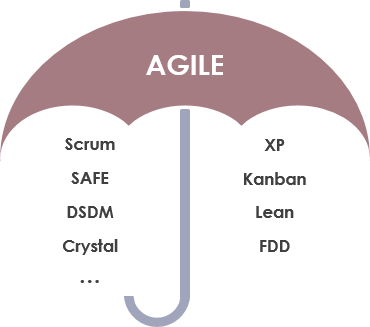
Agile Umbrella
What Is Scrum?
Scrum is a framework for developing and maintaining complex products, following an incremental and iterative development process. In this framework, the entire development process consists of several short iterative cycles, one of which is called a Sprint, lasting between 2 to 4 weeks.
In Scrum, product Backlog is used to manage product requirements. The product backlog is prioritized based on business value. During a Sprint, the Scrum team selects the highest-priority items from the product backlog and, through the Sprint Planning process, creates a Sprint Backlog. The selected Product Backlog Items (PBIs) are discussed, analyzed, and estimated during the Sprint Planning meeting to form a list of tasks to be included in the next Sprint (called the Sprint Backlog). Once the Scrum team completes all selected tasks on the Sprint Backlog, the current Sprint ends and transitions into the next Sprint iteration.
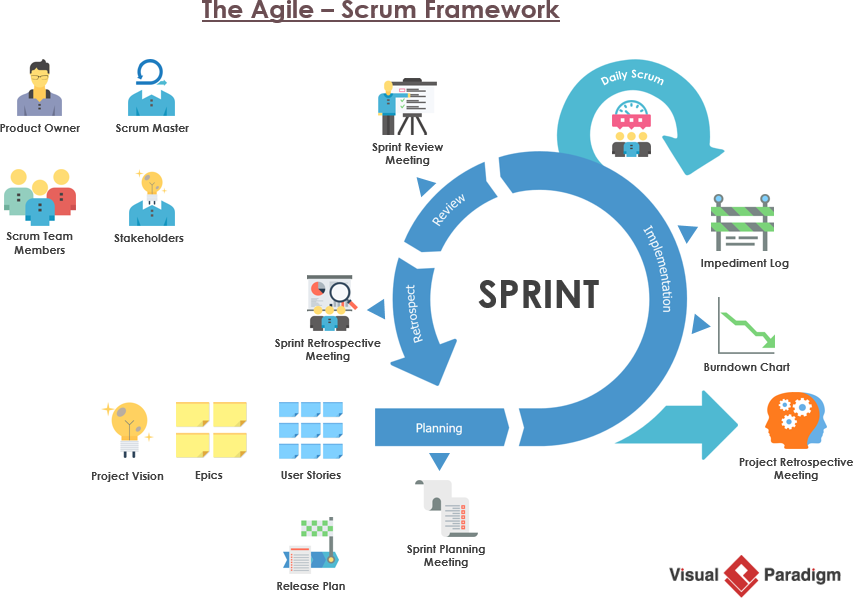
Agile Scrum Framework
Why Is Scrum Hard to Master?
Scrum is highly valuable. However, in some organizations, implementing Scrum is challenging. Some say Scrum has little tangible impact. Why do so many people find Scrum difficult to master or implement? Let’s revisit what the Scrum Guide says about Scrum:
Scrum is
- Lightweight
- Easy to understand
- Hard to master
Since Scrum requires cultural change, it’s difficult to implement. If an organization adopts Scrum for agile development from its traditional team structure, it must provide substantial skills, training, and guidance for all Scrum roles. The responsibilities of each Scrum role are far broader than those in a traditional waterfall environment. Why is Scrum hard to master? The main reasons are:
- Roles in Scrum are much more demanding for all team members.
For example, in a Scrum project, developers are not just “writing code”—they must be responsible for planning, estimating, managing their own work, and integrating it with other team members to deliver a cohesive solution. They are also expected to collaborate directly with business users to understand requirements. - Scrum is an adaptive process requiring significant skill and judgment.
Scrum is based on the empirical process control model, meaning that during project execution, solutions and the process of generating them must be continuously adjusted based on observations. Many skills and judgment calls can only be learned through hands-on experience with some guidance. Many people try to apply Scrum mechanically without understanding its underlying principles, which usually leads to failure. - Scrum requires organizational transformation.
Scrum demands a collaborative partnership between development teams and business users throughout the project lifecycle. This often requires breaking down organizational “silos” to enable effective collaboration.
Ten Strategies for Agile Success
The success strategies for transitioning from traditional methods to agile development come from interviews with agile project managers and practitioners who actively deliver software for various projects worldwide, including: interviews with agile professionals (business, IT, and management), standards organizations (PMI, Scrum.org, Agile Alliance, Scrum.org, DSDM, IEEE, etc.), industry case studies, books, and research institutions (Gartner, Standish, Forrester, etc.).
(Source: Transitioning to Agile: Ten Success Strategies. From Carilli, JFPMI® Global Conference 2013)
- Secure Management Commitment – Management commitment must be ensured before initiating any implementation plan.
- Support Your Teams – Agile provides high transparency and reduces the need for extensive checkpoint reviews.
- Understand Collaborative Culture – Representatives from the business side must drive the agile initiative; their involvement is the cornerstone of agile methodology.
- Embrace Agile Fully – The true value of agile is best realized through full commitment.
- Create Roadmaps and Initial Plans – Agile is part of the overall planning process.
- Engage an Agile Coach and Train Your Team – At least one experienced agile coach, Scrum Master, and at least 20% of the team having agile experience significantly increase the chances of success.
- Start Small and Achieve Early Wins – Nothing boosts momentum for an agile initiative more than demonstrating early, tangible success.
- Establish Agile Performance Metrics – Agile focuses on addressing current business priorities, not conforming to a set of baseline requirements that may no longer reflect the current business direction.
- Create Agile Contracts – Instead of focusing on “what” will be delivered, clearly define and deliver “how” the solution will be defined and delivered.
- Adopt ALM Tools to Enhance Interaction – Agile ALM tools integrate agile processes and governance structures on top of traditional ALM tool integrations.
Based on research and experience, organizations are strongly advised to adopt these strategies, along with strong business and IT management practices, to ensure a smooth transition from traditional development methods to agile.

 English
 Arabic
 Chinese (Simplified)
 Dutch
Dutch French
 German
 Italian
 Japanese
 Korean
 Portuguese
 Russian
 Spanish