


Effective estimation is one of the most challenging aspects software developers face in their work. Regardless of team size, they must define, estimate, and assign work across the entire team. As teams grow, establishing strong habits around planning and estimation becomes even more critical. Poor planning and estimation erode confidence in timelines, damage the relationship between teams and business stakeholders, and make development more difficult for everyone.
Accuracy of Group vs. Individual Estimation
In a study on effort estimation accuracy between individuals and groups in a software project experiment, 20 software professionals from the same company separately estimated the effort required to implement the same software project. Participants had different backgrounds and roles, and the software project had been implemented before. Afterwards, they were grouped into five teams. Each team discussed and combined their knowledge to reach a consensus estimate.
Result – Group-based estimates were more accurate than individual estimates.
What is Planning Poker?
Planning Poker (also known as Scrum Poker) is a gamified consensus-based technique used for estimation, primarily for estimating the effort or relative size of development tasks in software development.
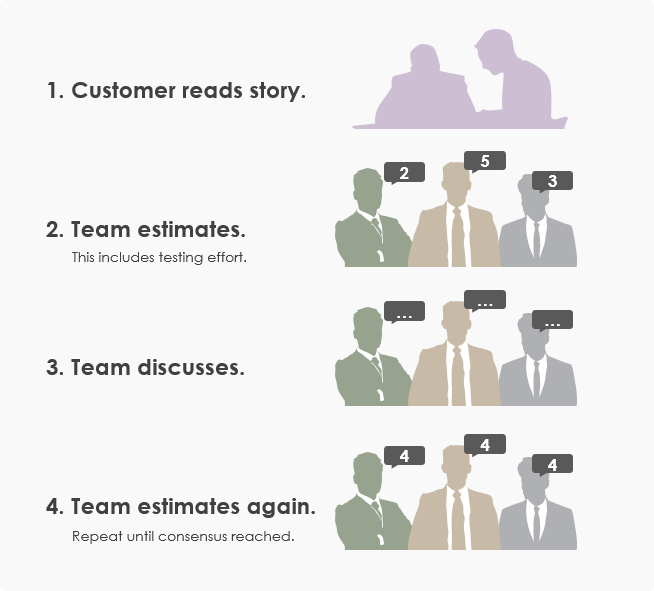
Scrum Planning Poker
Steps of Planning Poker
- To begin a Planning Poker session, the Product Owner or client reads out an Agile user story or describes the feature to the estimators.
Example:- “Customer logs into the booking system”
- “Customer enters search criteria for hotel reservation”
- Team members simultaneously place their numbered cards face-down to hide their estimates (using Fibonacci sequence: 1, 2, 3, 5, 8, 13, 20, 40)
- All cards are revealed at the same time
- Discuss the estimates and explain high or low values
- Repeat as needed until consensus is reached

Scrum Planning Poker Steps
By hiding the numbers in this way, the group avoids anchoring cognitive bias—where the first number spoken sets the precedent for subsequent estimates.
Agile Estimation – Relative vs. Absolute
Estimation is simply an educated guess. We use all the knowledge and experience at hand to guess how long it will take. Instead of evaluating each new work item in isolation, why not compare it to previously completed items? Humans are better at relating to similar things than guessing absolute sizes.
For example, is it close to this tiny thing? Or more like this medium-sized project? Or truly large—just like the task we completed last month? Relative estimation not only reduces the time spent estimating but also significantly improves accuracy.
Our brains cannot make absolute estimates—we always relate what we’re estimating to something we already know.
Fibonacci Sequence and Planning Poker
Planning Poker uses the Fibonacci sequence to assign point values to features or user stories. The Fibonacci sequence is a mathematical series introduced in the 13th century to describe certain aspects of natural patterns, such as tree branching. The sequence is generated by adding the two previous numbers to get the next value: 0, 1, 1, 2, 3, 5, 8, 13, 21, etc.
For Agile estimation purposes, some numbers have been adjusted to form the following sequence: 1, 2, 3, 5, 8, 13, 20, 40, 100, as shown below:
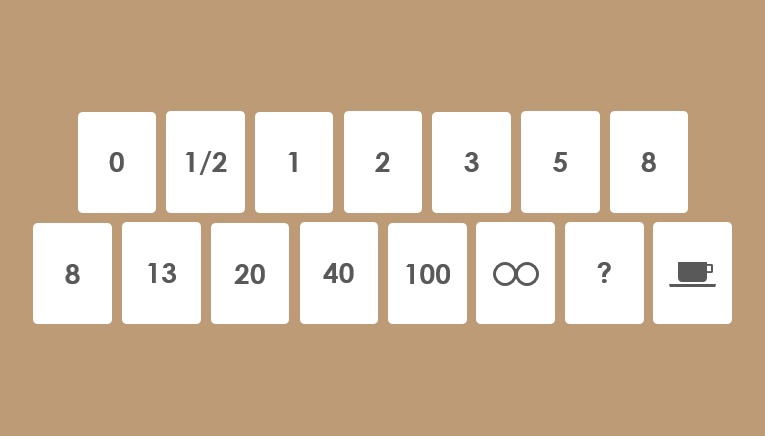
Fibonacci Sequence and Planning Poker
The meaning of the cards used in Planning Poker is explained in the table below:
| Card | Explanation |
| 0 | The task is already completed. |
| 1/2 | The task is very small. |
| 1, 2, 3 | Used for small tasks. |
| 5, 8, 13 | Used for medium-sized tasks. |
| 20, 40 | Used for large tasks. |
| 100 | Used for very large tasks. |
| <Infinity> | The task is enormous. |
| ? | Uncertain how long it will take to complete. |
| <one coffee> | I’m hungry? |
Story Points vs. Hours in Estimation
Why use Story Points instead of time-based values? Story Points allow teams to focus on the complexity and effort involved in delivering work. The team compares new work to what they’ve already completed. They assess the complexity of the new task relative to past challenges and rank difficulty and time required.
For example, we don’t typically consider the “cost of doing business.” Meetings, emails, code reviews—all have time value. But in reality, these are necessary practices in daily life and are not counted as “work.” Story Points isolate software development work from related operational tasks, making point-based estimation more consistent than time-based approaches.
References
- What is Planning Poker in Agile?
- Visual Paradigm. (n.d.). What is Planning Poker in Agile?
- Scrum Poker for Agile Projects – Work Life by Atlassian
- Atlassian. (2023, July 11). Scrum Poker for Agile Projects – Work Life by Atlassian
- Planning poker online | Scrum poker | We Agile You
- Planning Poker Online. (n.d.). Planning poker online | Scrum poker | We Agile You
- Planning Poker: An Agile Estimating and Planning Technique
- Mountain Goat Software. (n.d.). Planning Poker: An Agile Estimating and Planning Technique
- What is Agile Estimation? – Visual Paradigm
- Visual Paradigm. (n.d.). What is Agile Estimation? – Visual Paradigm
- Magic Estimation – FourWeekMBA
- FourWeekMBA. (2024, April 24). Magic Estimation – FourWeekMBA
- What is Planning Poker? | Definition and Overview
- ProductPlan. (2021, September 30). What is Planning Poker? | Definition and Overview
- Planning poker: The agile way to do estimation for scrum teams – LogRocket Blog
- LogRocket Blog. (2023, December 14). Planning poker: The agile way to do estimation for scrum teams – LogRocket Blog
- What is Agile Estimation?
- Visual Paradigm. (n.d.). What is Agile Estimation?
- Planning Poker — Agile Estimation Technique How-to Guide | Easy Agile
- Easy Agile. (n.d.). Planning Poker — Agile Estimation Technique How-to Guide | Easy Agile



 English
 Arabic
 Chinese (Simplified)
 Dutch
Dutch French
 German
 Italian
 Japanese
 Korean
 Portuguese
 Russian
 Spanish