


What is Agile Project Management?
Agile project management is an iterative approach to product delivery that builds progressively from the start of the project, rather than attempting to deliver the entire product at once near the end. This methodology is based on the Agile Manifesto (2001).
Agile Manifesto and Twelve Principles
All Agile software development methods (Scrum, Kanban, XP) include the Agile Manifesto (core values) and the 12 Agile principles, which represent a set of values guiding how people should treat each other within an organization. These values and principles are essential for correctly understanding Agile project management.
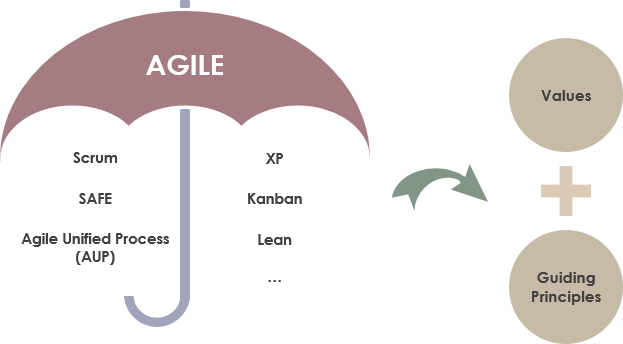
What is the Agile Manifesto?
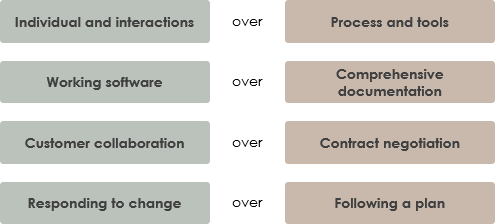
The wording of the manifesto is very deliberate, emphasizing the minimum necessary language to capture the essence of agility:
- Individuals and interactions over processes and tools
- Working software over comprehensive documentation
- Customer collaboration over contract negotiation
- Responding to change over following a plan
Note:
- Key words in all these statements are “over.” The Manifesto is not suggesting to replace the right-hand side with the left-hand side, but rather emphasizing the prioritization of the left over the right.
- The Agile Manifesto was created as an alternative to documentation-heavy, heavyweight software development processes (like the waterfall model).
Principles Behind the Agile Manifesto
As a complement to the core Agile Manifesto, the Twelve Principles further elaborate on what agility means. The Scrum framework promotes Agile principles through various events (e.g., Product Backlog, daily stand-ups, iterative development, retrospectives):
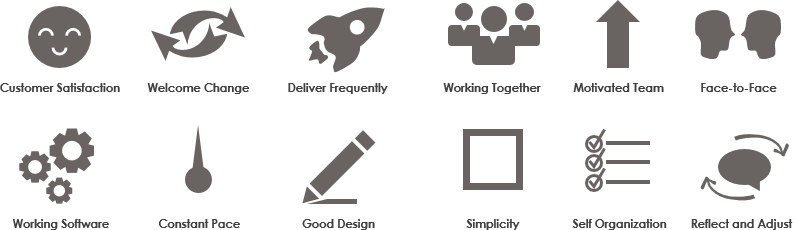
Agile Principles
- Our highest priority is to satisfy the customer through early and continuous delivery of valuable software.
- Welcome changing requirements, even late in development. Agile processes harness change for the customer’s competitive advantage.
- Frequently deliver working software, from a few weeks to a few months, with a preference for shorter timescales.
- Business people and developers must work together daily throughout the project.
- Build projects around motivated individuals. Provide them with the environment and support they need, and trust them to get the job done.
- The most effective method of conveying information to and within a development team is face-to-face conversation.
- Working software is the primary measure of progress.
- Agile processes promote sustainable development. Sponsors, developers, and users should be able to maintain a constant pace indefinitely.
- Continuous attention to technical excellence and good design enhances agility.
- Simplicity—the art of maximizing the amount of work not done—is essential.
- The best architectures, requirements, and designs emerge from self-organizing teams.
- Teams regularly reflect on how to become more effective and then adjust their behavior accordingly.
How Does Scrum Work?
Scrum differs from other Agile processes through specific concepts and practices, divided into three categories: roles (Product Owner, Scrum Master, Development Team, and other stakeholders), events, artifacts, and rules.
To initiate the Scrum process, the Product Owner creates a prioritized wish list called the Product Backlog. During Sprint Planning, the backlog is sized based on complexity and business value (priority). The Product Owner (customer) and development team decide which backlog items to include in the sprint. The team has a fixed time (called a Sprint, typically two to four weeks) to complete their work, but they meet daily to assess progress (Daily Scrum). Throughout this process, the Scrum Master keeps the team focused on their goals. At the end of the sprint, the team reviews their progress, demonstrates the work product to the client, and evaluates what went well and what needs improvement for the next sprint. The cycle then repeats.
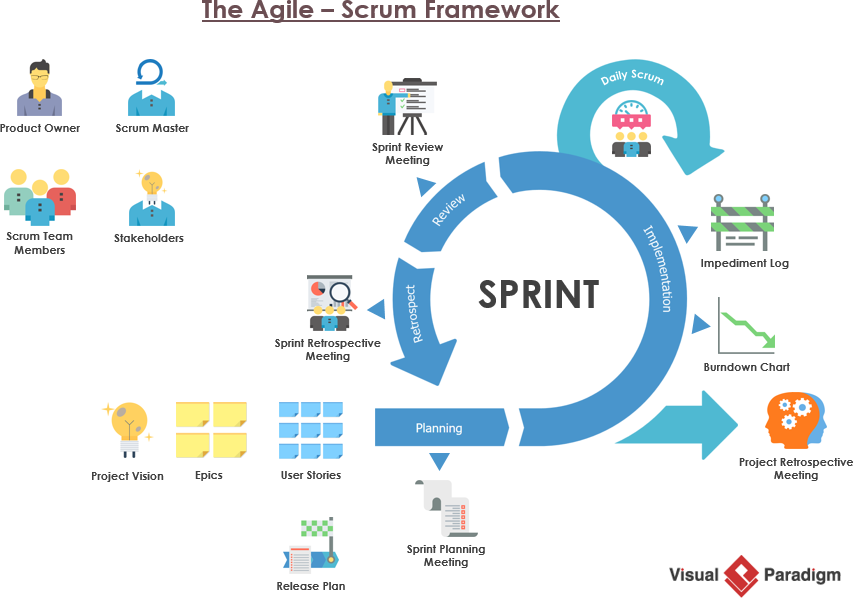
The Agile approach works by breaking the project into small parts of user features, prioritizing them, and delivering them continuously in 2–4 week cycles, known as iterations or sprints.
The team operates in short cycles, aiming for continuous improvement and only developing what users truly want. The work goal is defined by the team at the start of each cycle. If the client has any questions about a feature, the team communicates directly with the client. The client’s priorities are analyzed by the Product Owner and fed back to the team so they can continue working on the highest-priority items. The team estimates how much time it will take to complete the work in an iteration, and how to do it.
Performance is measured by the client at the end of each iteration. Lessons learned during each iteration are captured in retrospectives and applied in future iterations. In this way, the product continuously improves, and the development process also improves.
Note:
Scrum is a framework for developing and maintaining complex products through “inspect and adapt.” It is an Agile approach that follows the Agile Manifesto and principles, integrating three roles, three artifacts, five events, and five values—known as the “3355.”
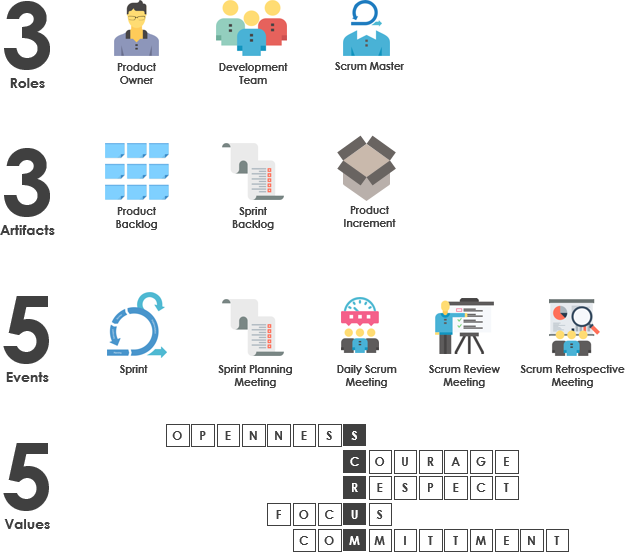
In this framework, the entire development process consists of several short iterative cycles called Sprints. Recommended practices include:
- Each Sprint lasts 1 to 4 weeks.
- Use the Product Backlog to manage product requirements—a prioritized list ordered by value.
- In each iteration, the Scrum Team selects the highest-priority items from the Product Backlog to work on.
- During the Sprint Planning event, selected requirements are discussed, analyzed, and estimated to achieve the corresponding iteration goal and delivery plan, known as the Sprint Backlog.
- Daily Daily Scrum meetings are held throughout the iteration. At the end of each iteration, the Scrum team invites business stakeholders and other interested parties to review the potentially shippable product increment.
- Then, the team reviews and continues to improve their way of working.
- Scrum is not only suitable for software development projects but also for any complex or innovative projects, exploration, and organizational change initiatives.
Scrum Roles
The Scrum framework is defined by three core roles: the Development Team, the Scrum Master, and the Product Owner.
Product Owner
The Product Owner is responsible for maximizing the value of the product and the work of the development team. How this is achieved may vary depending on the organization, Scrum team, and individual.
Product Owner’s Role
The Product Owner is the sole person responsible for managing the Product Backlog. Product Backlog management includes:
- Clearly expressing Product Backlog items;
- Ordering the items in the Product Backlog to best achieve goals and missions;
- Optimizing the value of the work the Development Team performs;
- Ensuring the Product Backlog is visible, transparent, and clear to all, and shows what the Scrum Team will work on next;
- Ensuring the Development Team understands the items in the Product Backlog to the required level.
Scrum Master
The Scrum Master ensures that Scrum is understood and enacted. The Scrum Master does this by ensuring the Scrum Team adheres to Scrum theory, practices, and rules.
The Scrum Master is a servant-leader for the Scrum Team. The Scrum Master helps people outside the Scrum Team understand which interactions with the Scrum Team are helpful and which are not. The Scrum Master helps everyone adjust these interactions to maximize the value created by the Scrum Team.
Scrum Master’s Roles
The Scrum Master serves the Product Owner in multiple ways, including:
- Identifying effective Product Backlog management techniques;
- Helping the Scrum Team understand the need for clear and concise Product Backlog items;
- Understanding product planning in an empirical environment;
- Ensuring the Product Owner knows how to prioritize the Product Backlog to maximize value;
- Understanding and practicing agility;
- Facilitating Scrum Events as needed.
Scrum Master’s Services to the Development Team
The Scrum Master serves the Development Team in various ways, including:
- Guiding the Development Team in self-organization and cross-functionality;
- Helping the Development Team deliver high-value products;
- Removing impediments that hinder the team’s progress;
- Facilitating Scrum Events as needed;
- Guiding the Development Team in organizations that have not yet fully adopted or understood Scrum.
Scrum Master’s Services to the Organization
- The Scrum Master serves the organization in various ways, including:
- Leading and guiding the organization in adopting Scrum;
- Planning Scrum implementation within the organization;
- Helping employees and stakeholders understand and adopt Scrum and empirical product development;
- Driving change to improve Scrum Team productivity;
- Collaborating with other Scrum Masters to improve the effectiveness of Scrum application within the organization.
Development Team
The Development Team consists of professionals responsible for delivering a potentially shippable product increment at the end of each Sprint. Only members of the Development Team can create the increment.
The team is built and empowered by the organization to organize and manage their own work. The resulting synergy optimizes the team’s overall efficiency and effectiveness.
Development Team’s Characteristics
The Development Team has the following characteristics:
- They are self-organizing. No one (not even the Scrum Master) tells the Development Team how to turn Product Backlog items into a potentially shippable increment;
- The Development Team is cross-functional, possessing all the skills needed to create a product increment;
- Scrum does not recognize titles for team members other than “Developer,” regardless of the work being performed. This rule has no exceptions;
- Scrum does not recognize sub-teams within the Development Team, regardless of the specific domain, such as testing or business analysis. This rule has no exceptions;
- Individual team members may have specialized skills and areas of focus, but responsibility lies with the entire Development Team.
Scrum Events
The Scrum framework is marked by five events: Sprint, Sprint Planning, Daily Scrum, Sprint Review, and Sprint Retrospective.
- A Sprint (also called an iteration) is the fundamental unit of development in Scrum. A Sprint is a time-boxed effort; that is, it is limited to a specific duration. The duration of each Sprint is predetermined and typically ranges from one to four weeks, most commonly two weeks.
- Sprint Planning is an event in the Scrum framework where the team determines which Product Backlog items they will work on during the Sprint and discusses their initial plan for completing these items.
- A Daily Stand-up (also called Daily Scrum Meeting) is a short, time-boxed meeting to keep everyone aligned. It usually lasts between 5 to 15 minutes and is sometimes referred to as a stand-up, morning check-in, or daily huddle.
- Sprint Review occurs at the end of the Sprint. During this review, the Product Owner explains which planned work was completed or not completed during the Sprint. The team then demonstrates the completed work and discusses what went well and how issues were resolved.
- Sprint Retrospective takes place after each Sprint Review. It gives the team the opportunity to inspect themselves and create a plan for improvement to be implemented in the next Sprint.
Scrum Artifacts
Artifacts are physical records that provide project details. Scrum artifacts include the Product Backlog, Sprint Backlog, and the Product Increment.
- The Product Backlog is a prioritized list of features, defects, or technical tasks currently not in progress. From the Product Owner’s perspective, it should include all work considered valuable.
- As product requirements change and evolve, the Product Owner and other team members review and adjust the Product Backlog as needed.
- The Sprint Backlog is a list of all items from the Product Backlog that the team committed to work on during the Sprint. This list is compiled by prioritizing items from the Product Backlog until the team believes they have reached their Sprint capacity. Team members follow the self-organizing Scrum framework, registering tasks in the Sprint Backlog based on skills and priority.
- The Product Increment is the sum of all work completed during a Sprint, plus all work completed in previous Sprints. The goal of the Sprint is to produce a potentially shippable product increment. The Scrum Team agrees on the definition of “Done” for the increment, and all members must agree and understand it.
Why Use Agile Principles and Agile Project Management?
Is your organization leaning toward Agile project management? Do you want to expand your skills to include Agile methods? Many organizations are adopting Agile approaches to improve team performance, increase customer satisfaction, and enhance project flexibility. Organizations using Agile methods can respond to dynamic market changes and successfully complete more projects. Agile training is an ideal way to align organizational and project team levels with Agile and related implementation methods. Agile training can clarify many misconceptions about Agile operations and help expose underlying Agile concepts while clarifying differences between various implementation approaches.
Typically, when organizations describe challenges using the term “Agile,” they are referring to the difficulties of executing Agile methods. Having all project team members (technical and business) attend the same training, preferably in the same class, can help resolve some of these issues. The entire team should hear the same information, concepts, and implementation strategies, forming a shared language and perspective. This common understanding greatly increases the team’s ability to use a shared language and jointly check and adapt, reducing future conflicts.
Whether you’re seeking Agile certification to expand your personal Agile knowledge or training multiple levels within your organization on Agile methodologies, we can help you get started quickly with our Agile training. We can teach you all Agile principles and practices, including Scrum, XP, and Lean.
“I took two courses from Project Management Academy: PMP Training and PMI-ACP (Agile) Training. Both of my instructors were outstanding, and I believe investing in these courses was well worth my hard-earned money.”
Benefits of Implementing Agile Methods
End users are encouraged to participate during the project, providing visibility and transparency. Continuous planning and feedback throughout the process create business value from the very beginning.
Organizations embracing the idea of delivering business value early in the process find it easier to reduce development-related risks. Some key benefits of Agile project management include:
High-Quality Products
- Regular testing to verify the product works during development
- Timely definition and detailed specification of requirements
- Incorporating continuous integration and daily testing into the development process
- Sprint retrospectives for continuous process and work improvement
- Software is developed in incremental, rapid cycles.
Higher Customer Satisfaction
- Show customers working features
- Release products to market faster and more frequently
- Maintain customer engagement and involvement
Enhanced Project Control
- Daily Sprint meetings
- Transparency through information radiators
Reduced Risk
- Development occurs within sprints, ensuring short time between feature deliveries
- Agile provides flexibility when implementing recent changes
- Adapts to customer needs and preferences throughout the development process
Faster Return on Investment (ROI)
- Focused on business value, allowing customers to prioritize features
- Functional product ready for market after several iterations
- Agile enables rapid product releases and the ability to measure customer response


 English
 Arabic
 Chinese (Simplified)
 Dutch
Dutch French
 German
 Italian
 Japanese
 Korean
 Portuguese
 Russian
 Spanish