


Understanding the Foundations of the ArchiMate Modeling Language
🔍 1. Introduction
Why This Chapter Matters
Chapter 1 sets the stage for the entire ArchiMate standard. It explains why ArchiMate exists, what it aims to achieve, how conformance is defined, and what key terminology you’ll encounter throughout the specification.
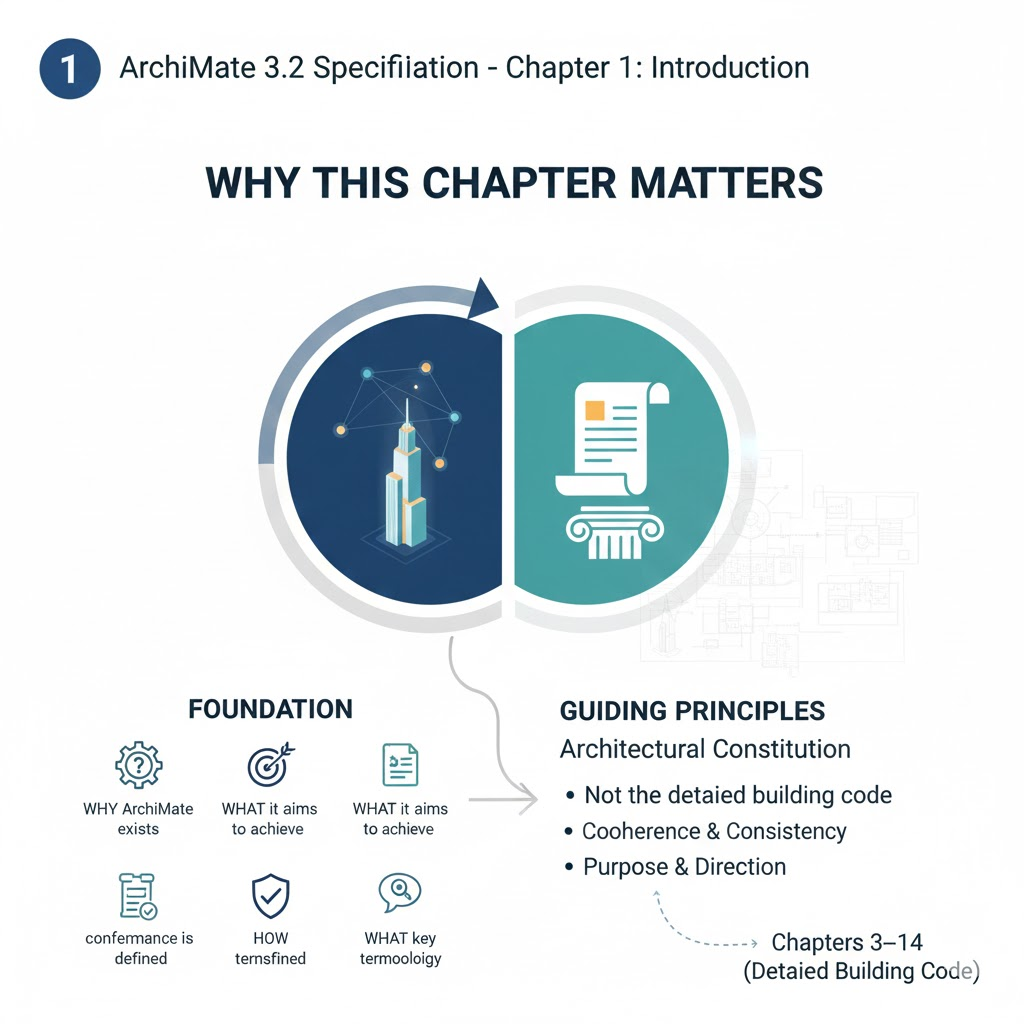
Think of it as the architectural equivalent of a constitution: not the detailed building code (that’s Chapters 3–14), but the guiding principles that ensure coherence, consistency, and purpose.
🧭 2. Section-by-Section Breakdown
1.1 Objective
✅ Key Idea
ArchiMate is a standardized, visual modeling language for describing, analyzing, and communicating Enterprise Architectures over time.
🔑 Core Components
| Component | Description |
|---|---|
| Visual Language | Uses diagrams (not just text or spreadsheets) to convey architecture. |
| Default Iconography | Standardized visual symbols (e.g., rectangles, circles, specific icons) for consistent interpretation. |
| Architecture Descriptions | Formal representations of business, application, and technology structures and their relationships. |
| Change Over Time | Supports modeling evolution (e.g., “as-is” vs. “to-be” states). |
| Exchange Format (XML) | Enables tool interoperability via ArchiMate Model Exchange File Format (.xml). |
💡 Example Use Case
A bank is migrating from legacy core banking to a cloud-native platform. Using ArchiMate:
- Business Layer: Model customer service processes.
- Application Layer: Represent new digital banking apps.
- Technology Layer: Show AWS/Azure infrastructure.
- Cross-layer: Use realization relationships to link strategy → capability → application → microservice.
📦 Without ArchiMate, teams might use inconsistent UML, BPMN, or ad hoc PowerPoint slides — making integration and governance difficult.
1.2 Overview
✅ Key Idea
Enterprise Architecture exists to address stakeholder concerns — and ArchiMate provides the means to model how architecture satisfies them.
🔑 Core Concepts
| Concept | Explanation | Example |
|---|---|---|
| Stakeholders & Concerns | People (e.g., CIO, CFO, regulators) with interests (e.g., cost, compliance, agility). | CFO → Concern: “Reduce IT operational cost by 20%.” |
| Motivation & Strategy | Why the architecture is needed (goals, drivers, principles). | Goal: “Improve digital customer engagement.” |
| Architecture Views & Viewpoints | Tailored diagrams for specific stakeholders (e.g., Business Process Viewpoint for process owners). | A Technology Viewpoint shows servers/networks for infrastructure teams. |
| Layers & Aspects | Structuring mechanism: • Layers: Business, Application, Technology, Physical, Implementation & Migration, Strategy, Motivation. • Aspects: Active Structure (who/what performs), Behavior (what is done), Passive Structure (what is acted upon). |
Application Layer + Behavior Aspect = Application Functions (e.g., “Process Payment”). |
| Service Orientation | Elements provide and use services across layers (e.g., apps provide services to business processes). | A “Loan Approval” business process uses the “Credit Check” application service. |
| Realization Relationships | Concrete elements realize (implement) more abstract ones (e.g., software realizes a capability). | “Fraud Detection Capability” → realized by → “ML-Based Anomaly Detection Microservice”. |
🌐 Layered Service Orientation — Visual Summary
[Business Layer]
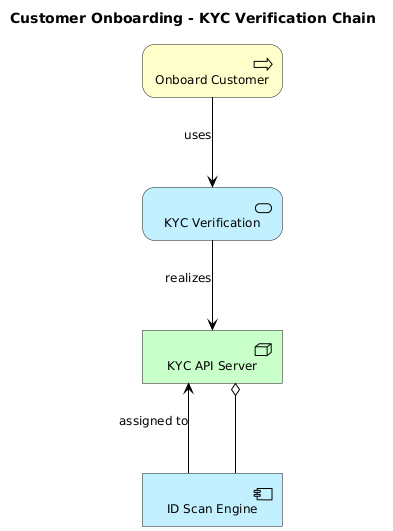
│  ◼ Business Process: "Onboard Customer"
│  ↓ *uses*
[Application Layer]
│  ◼ Application Service: "KYC Verification"
│  ↓ *realizes*
[Technology Layer]
   ◼ Node: "KYC API Server"
     └── Component: "ID Scan Engine"
🔗 This layered, service-based approach prevents siloed thinking — a hallmark of effective EA.
1.3 Conformance
✅ Key Idea
Defines what it means for a tool to be “ArchiMate-compliant” — critical for tool selection, interoperability, and certification.
🔑 Requirements for Conformant Implementations
| Requirement | Meaning | Example in Tools |
|---|---|---|
| Shall support language structure & metamodel | Must implement core entities (e.g., Business Actor, Application Component) and relationships (e.g., assignment, realization). | Archi, Sparx EA, BiZZdesign Architect. |
| Shall support standard iconography | Diagrams must use ArchiMate-specified shapes/colors (e.g., rounded rectangle for business process). | Misusing a UML use-case oval for a business process → non-conformant. |
| Shall support viewpoints | Must allow creating predefined views (e.g., Project Viewpoint for program managers). | Filter diagram elements by stakeholder role. |
| Shall support customization (implementation-defined) | Tools can extend ArchiMate (e.g., add “Data Entity” stereotype), but must document how. | Custom profile for GDPR compliance tags. |
| Shall support relationship rules (Appendix B) | Enforce valid connections (e.g., composition only between elements in same layer/aspect). | Tool prevents linking Business Actor → Technology Node with assignment. |
| May support example viewpoints | Optional — e.g., “Risk & Security Viewpoint” from Appendix C. | Advanced tools often include these out-of-box. |
⚠️ Note: “Shall” = mandatory; “May” = optional; “Implementation-defined” = vendor-specific (must be documented).
1.4 Normative References
- Currently empty in 3.2 — meaning no external standards are required to interpret ArchiMate 3.2.
- Future versions may reference related standards (e.g., TOGAF®, BPMN™).
1.5 Terminology
✅ Key Idea
Standardizes how to read the specification itself — vital for implementors and certifiers.
| Term | Meaning | Why It Matters |
|---|---|---|
| Shall / Shall not | Absolute requirement / prohibition. | Determines conformance. |
| Should | Recommended, but not required. | Best practice guidance. |
| May / Need not | Optional. | Flexibility for tools/users. |
| Can | Possible behavior (not normative). | Descriptive, not prescriptive. |
| Implementation-defined | Vendor-specific choice (must be documented). | Avoids lock-in; ensures transparency. |
| Deprecated | May be removed in next version. | Plan for migration. |
| Obsolescent | Discouraged, but retained for legacy support. | Avoid in new models. |
💡 Practical Tip
When evaluating an EA tool, search its docs for “ArchiMate 3.2 conformance statement.” If it says “supports ArchiMate,” but doesn’t specify which clauses it implements, ask for evidence — especially around viewpoints and relationship validity.
📊 3. Summary Table: Chapter 1 at a Glance
| Section | Purpose | Key Takeaway | Real-World Implication |
|---|---|---|---|
| 1.1 Objective | Define ArchiMate’s scope | Standardized visual EA language + XML exchange | Enables cross-team, cross-tool collaboration |
| 1.2 Overview | Explain EA & ArchiMate philosophy | Address stakeholder concerns via layered, service-oriented modeling | Bridges business & IT strategy |
| 1.3 Conformance | Specify tool compliance rules | “Shall” = mandatory for certification | Ensures model portability & auditability |
| 1.4 References | List dependencies | None in 3.2 | Self-contained standard |
| 1.5 Terminology | Clarify normative language | “Shall” ≠ “Should” ≠ “May” | Critical for correct interpretation & compliance |
🧩 4. Hands-On Mini-Exercise
Scenario: You’re modeling a retail company’s shift to omnichannel sales.
✅ Task: Sketch a minimal ArchiMate diagram (text-based) showing:
- A Business Goal (Motivation Layer)
- A Business Process that supports it (Business Layer)
- An Application Service it uses (Application Layer)
- A Technology Node that hosts it (Technology Layer)
🔁 Use proper relationships and terminology from Section 1.2.
Sample Answer:
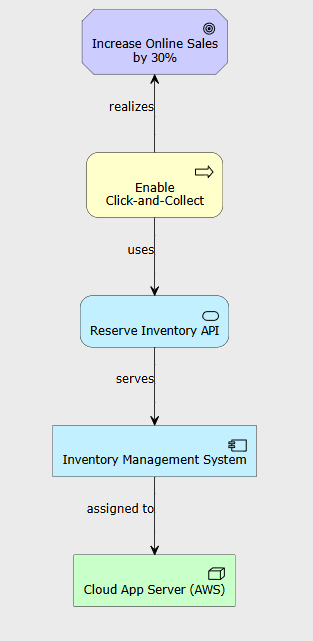
[Motivation Goal: "Increase Online Sales by 30%"]
   ↑ *realizes*
[Business Process: "Enable Click-and-Collect"]
   ↓ *uses*
[Application Service: "Reserve Inventory API"]
   ↓ *serves*
[Application Component: "Inventory Management System"]
   ↓ *assigned to*
[Technology Node: "Cloud App Server (AWS)"]
✅ Check: Layers respected? Relationships valid? Stakeholder concern (sales growth) addressed?
🏁 5. Conclusion
Chapter 1 is deceptively simple — but mastering its principles is essential. It answers three foundational questions:
- Why ArchiMate? → To unify EA communication across stakeholders.
- What makes it work? → Layered service orientation + motivation linkage + standardized notation.
- How do we ensure consistency? → Strict conformance rules and precise terminology.
As you move into Chapters 3–12 (metamodel, layers, relationships), keep returning to Chapter 1’s vision:
ArchiMate is not just about modeling architecture — it’s about making architecture actionable and understandable to those who depend on it.
🧠 Pro Tip: Bookmark this chapter. Revisit it whenever you design a new viewpoint or evaluate a modeling decision — it’s your north star.
📚 Further Learning
- Official: ArchiMate® 3.2 Specification (The Open Group, 2022)
- Tool Practice: Try Visual Paradigm Enterprise Edition (widely used, large user base, feature-rich, fully conformant).
- Certification: Consider TOGAF® + ArchiMate® Combined Certification for career growth.
Let me know if you’d like the tutorial for Chapter 3 (Generic Metamodel) next — complete with relationship matrices and modeling anti-patterns!
Here are the official Visual Paradigm ArchiMate tool recommendations with real, up-to-date URLs:
1. Visual Paradigm Online (Free Online ArchiMate Tool)
- URL: https://online.visual-paradigm.com/diagrams/features/archimate-tool/
- Features: Free online ArchiMate diagram tool supporting ArchiMate 3 notation and syntax. Offers examples, templates, and collaborative features for enterprise architecture modeling.
2. Visual Paradigm Enterprise Edition (Certified ArchiMate 3.1 Tool)
- URL: https://www.visual-paradigm.com/features/archimate-tools/
- Features: Certified by The Open Group, supports all ArchiMate 3.1 vocabulary, notation, and semantics. Includes advanced modeling, collaboration, and AI-powered diagram generation.
3. AI ArchiMate Generator & Viewpoints
- URL: https://updates.visual-paradigm.com/releases/ai-archimate-viewpoints-generator/
- Features: AI-powered generation of ArchiMate diagrams and viewpoints, accelerating EA modeling and stakeholder communication.
4. ArchiMate Viewpoints Guide & Examples
- URL: https://www.visual-paradigm.com/guide/archimate/full-archimate-viewpoints-guide/
- Features: Comprehensive guide to all 23 official ArchiMate viewpoints with examples, drawn using Visual Paradigm’s certified tool.
Note: Visual Paradigm is widely used by Fortune 500 companies, startups, and government entities for enterprise architecture and digital transformation. The tool is certified by The Open Group and supports both ArchiMate 2.1 and 3.1 standards.
Would you like a comparison of features or guidance on getting started with Visual Paradigm’s ArchiMate tools?
© 2025 — For educational use. Not affiliated with The Open Group. ArchiMate® is a registered trademark of The Open Group.

 English
 Arabic
 Chinese (Simplified)
 Dutch
Dutch French
 German
 Italian
 Japanese
 Korean
 Portuguese
 Russian
 Spanish