


In 2025, software development moves faster than ever. Agile teams, microservices, and AI-driven workflows dominate the landscape, and the tools we use must keep pace. Yet, amid this rapid evolution, one question persists:
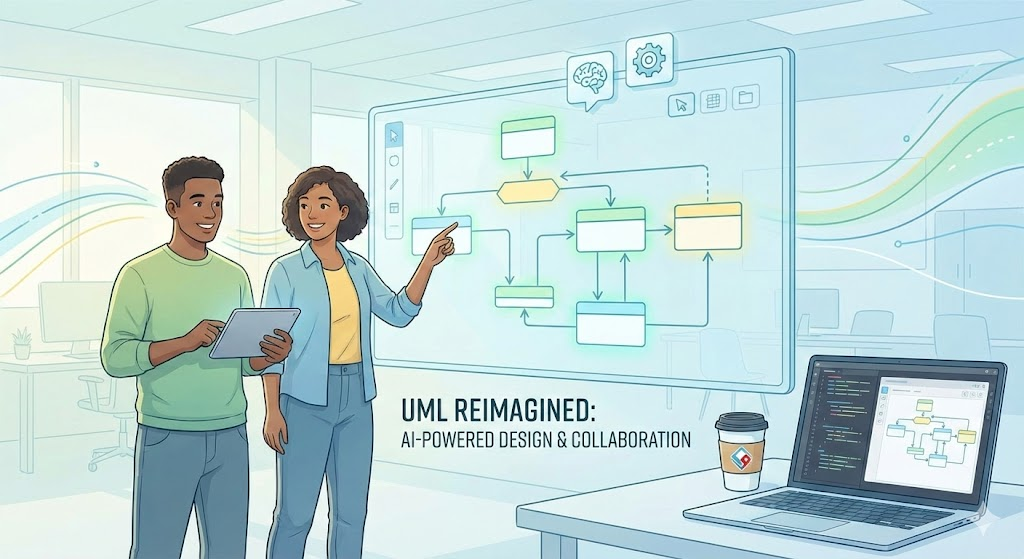
The answer? A resounding yes—but not in the way you remember. UML has evolved from a static, manual diagramming tool into a dynamic, AI-powered ally that accelerates design, enhances collaboration, and bridges the gap between complex ideas and executable code. At the forefront of this transformation is Visual Paradigm, the platform redefining how teams design, communicate, and innovate.
The Problem: Complexity Without Clarity
Meet Alex, a software architect designing a microservices-based e-commerce platform. His challenge? Translating a web of interconnected services—product catalogs, shopping carts, payment gateways, and user authentication—into a system that’s scalable, maintainable, and understandable.
Traditionally, Alex would spend hours (or days) manually sketching UML diagrams, only to realize they’re outdated the moment requirements change. Worse, his non-technical stakeholders struggle to grasp the system’s flow, leading to miscommunication and costly revisions.
This is where AI-powered modeling changes the game.
How Visual Paradigm’s AI Transforms UML
Visual Paradigm isn’t just another diagramming tool—it’s a conversational design partner that understands your intent and turns it into precise, standards-compliant models. Here’s how it works:
1.
Instead of starting with a blank canvas, Alex describes his system in plain English:
“Draw a UML component diagram for an e-commerce platform with components for Product Catalog, Shopping Cart, Order Management, and User Authentication. The Order Management should interact with a Payment Gateway service. Include a Notification Service.”
Visual Paradigm’s AI chatbot generates the diagram instantly, complete with correct notations and relationships. No manual dragging, no guesswork—just a professional-grade model ready for review.
| Before AI | With Visual Paradigm’s AI |
|---|---|
| Hours spent manually drawing diagrams | Diagrams generated in seconds |
| Risk of human error in notation | Standards-compliant, accurate models |
| Static documentation | Dynamic, updatable visuals |
2.
Alex realizes he forgot a Wishlist component. Instead of redrawing the entire diagram, he simply says:
“Add a ‘Wishlist’ component that interacts with ‘User Authentication’ and ‘Product Catalog.’”
The AI updates the diagram in real time, preserving existing relationships and ensuring consistency. This iterative workflow keeps pace with agile development, where requirements evolve rapidly.
3.
Need to explain the Payment Gateway integration to your team? Ask the AI:
“How would the ‘Payment Gateway’ integration typically be realized in a deployment configuration?”
The AI responds with:
- A detailed explanation of architectural patterns (e.g., API gateways, service meshes).
- A C4 System Context Diagram showing external dependencies like shipping providers.
- Suggestions for sequence diagrams to map the checkout process.
This turns UML from a static document into a living knowledge base for your team.
4.
Visual Paradigm’s AI doesn’t stop at UML. It supports:
- C4 Model: High-level system context diagrams for stakeholders.
- ArchiMate: Enterprise architecture viewpoints for business transformation.
- Custom Reports: Generate documentation directly from diagrams.
For example, Alex can ask:
“Generate a C4 System Context Diagram for this e-commerce platform, showing users, the platform, and external systems like the Payment Gateway and Shipping Provider.”
The result? A clear, shareable visual that aligns technical and non-technical teams.
Why This Matters for Your Team
For Developers
- Save time: Skip manual diagramming and focus on coding.
- Reduce errors: AI ensures adherence to UML standards.
- Improve collaboration: Share diagrams and chat histories with a link.
For Architects
- Model complex systems (microservices, distributed architectures) with ease.
- Validate designs before implementation.
- Onboard new team members faster with visual documentation.
For Product Managers & Stakeholders
- Understand system flows without diving into code.
- Provide feedback early in the design process.
- Align teams with a single source of truth.
Key Features of Visual Paradigm’s AI-Powered Modeling
| Feature | Benefit |
|---|---|
| Conversational Diagramming | Describe your system in plain English; the AI generates diagrams. |
| 14+ UML Diagram Types | Class, sequence, component, deployment, and more—all standards-compliant. |
| C4 Model & ArchiMate Support | Model enterprise architectures and system contexts. |
| Real-Time Collaboration | Share chat sessions and diagrams via URL. |
| Contextual Insights | Ask the AI to explain diagrams or suggest improvements. |
| Seamless Integration | Import AI-generated diagrams into Visual Paradigm’s desktop app for advanced editing. |
Want to see Visual Paradigm’s AI in action? Here’s a quick exercise:
- Go to: https://chat.visual-paradigm.com/
- Paste this prompt:
“Draw a UML class diagram for a library management system with classes for Book, Member, and Loan. Include attributes like ‘title’ (Book), ‘name’ (Member), and ‘dueDate’ (Loan). Show relationships between the classes.”
- Ask for refinements:
“Add a ‘Librarian’ class that manages the ‘Loan’ class. Also, generate a sequence diagram for the checkout process.”
In minutes, you’ll have professional-grade diagrams ready to share with your team.
UML isn’t just surviving in 2025—it’s thriving because tools like Visual Paradigm have reinvented it for the AI era. By combining the precision of UML with the power of conversational AI, teams can: ✅ Design faster without sacrificing clarity.
✅ Collaborate seamlessly across technical and non-technical roles.
✅ Future-proof their systems with standards-compliant models.
Ready to transform your design process? Explore Visual Paradigm’s AI-powered modeling today: 🔗 https://chat.visual-paradigm.com/
FAQs
Q: A: Absolutely. UML enhances agile by providing visual documentation that keeps pace with sprints. AI tools like Visual Paradigm make it fast enough for iterative development.
Q: A: Yes! Modify diagrams in the chatbot or import them into Visual Paradigm’s desktop app for advanced editing.
Q: A: Yes—it supports C4 Model, ArchiMate, BPMN, and more, making it ideal for enterprise architecture.
Q: A: The AI generates high-level diagrams (like C4 models) that explain system flows in simple terms, reducing ambiguity.
What’s your biggest challenge in software design? Let’s discuss how Visual Paradigm’s AI can help! 🚀

 English
 Arabic
 Chinese (Simplified)
 Dutch
Dutch French
 German
 Italian
 Japanese
 Korean
 Portuguese
 Russian
 Spanish