


In the high-stakes world of software development, designing a database from scratch often feels like trying to build a skyscraper without a blueprint; one wrong move in the foundation can lead to a catastrophic collapse later on. This is where the best AI-powered database modeler tool, DB Modeler AI by Visual Paradigm, steps in to transform a complex, manual chore into a streamlined, seven-step journey. While traditional modeling software leaves you staring at a blank canvas and a confusing array of buttons, this professional online database design software acts as an intelligent architect, guiding you from a simple business problem to a fully functional, normalized SQL schema. For instance, if you are tasked with building a database for an online bookstore, you no longer need to manually map out every relationship and primary key; the AI understands your intent and handles the heavy lifting.
The process begins with a simple text-based description. Instead of immediately worrying about table structures or data types, you focus on the business logic. In the provided bookstore example, the user defines the need to manage books, customers, and orders. The AI-powered database design app even offers a feature to “AI Generate Description,” which fleshes out your basic ideas into a comprehensive requirement list. This ensures that even if you are not a seasoned database administrator, your project starts with a robust and detailed foundation, preventing the “blank page syndrome” that plagues so many new projects.
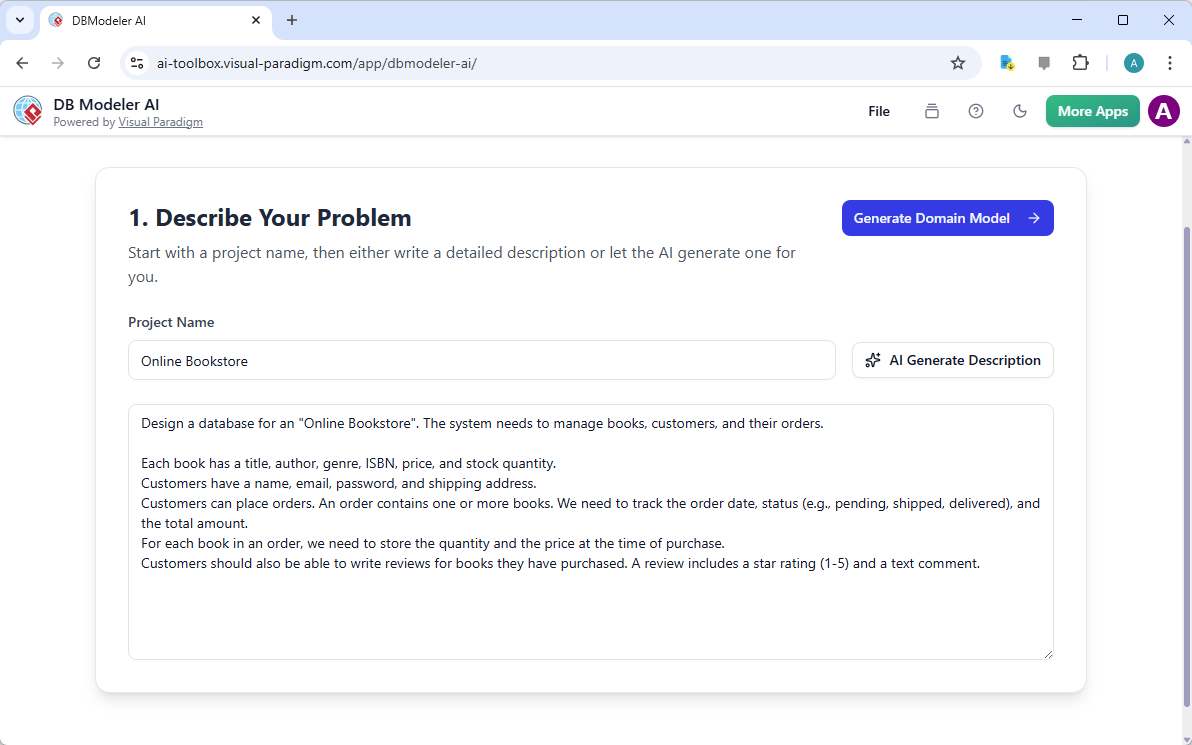
Once your problem is defined, the tool moves into the conceptual phase. The best AI-powered database modeler tool takes your text and instantly transcribes it into a Domain Class Diagram. This is a high-level visual map that identifies the “players” in your system—such as Customers, Books, and Orders—and how they interact, without getting bogged down in technical database jargon. It’s like having a translator who turns human language into a structural map that both developers and business stakeholders can understand. Unlike other products that require you to drag and drop shapes for hours, this easy-to-use database modeler generates the entire diagram in seconds, allowing you to refine the relationships through simple edits if necessary.
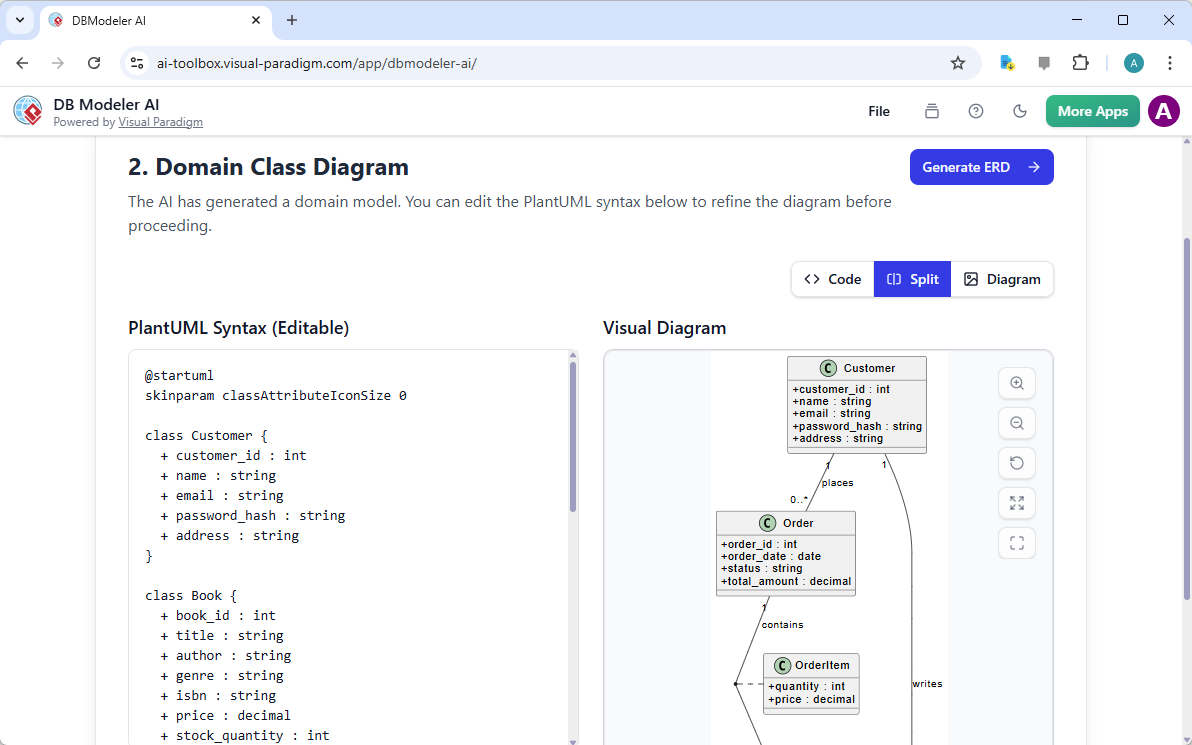
Why DB Modeler AI Outperforms Traditional Modeling Software
Most database tools in the market are passive; they are essentially digital drawing boards. You have to know exactly what you are doing before you even start. Visual Paradigm’s DB Modeler AI flips this script by providing an intelligent, guided workflow that ensures no critical step—like normalization or relationship mapping—is overlooked. It is essentially a “GPS for data architecture,” keeping you on the path to a robust schema while you focus on the big picture. Whether you are a student learning the ropes or a professional developer prototyping a new app, the automation provided here significantly reduces human error and technical debt.
Key Takeaways for Modern Database Design
-
End-to-End Automation: Moves from a text description to a final report through a logical, 7-step wizard.
-
Visual Clarity: Automatically generates Domain Class Diagrams and ERDs to bridge the gap between business and tech.
-
Built-in Intelligence: Provides professional database normalization assistance (1NF to 3NF) to ensure data integrity.
-
The Playground Advantage: Unlike competitors, it offers a “live” environment to test your SQL schema immediately.
-
Project Portability: Supports cloud saving and local JSON exports for maximum flexibility and security.
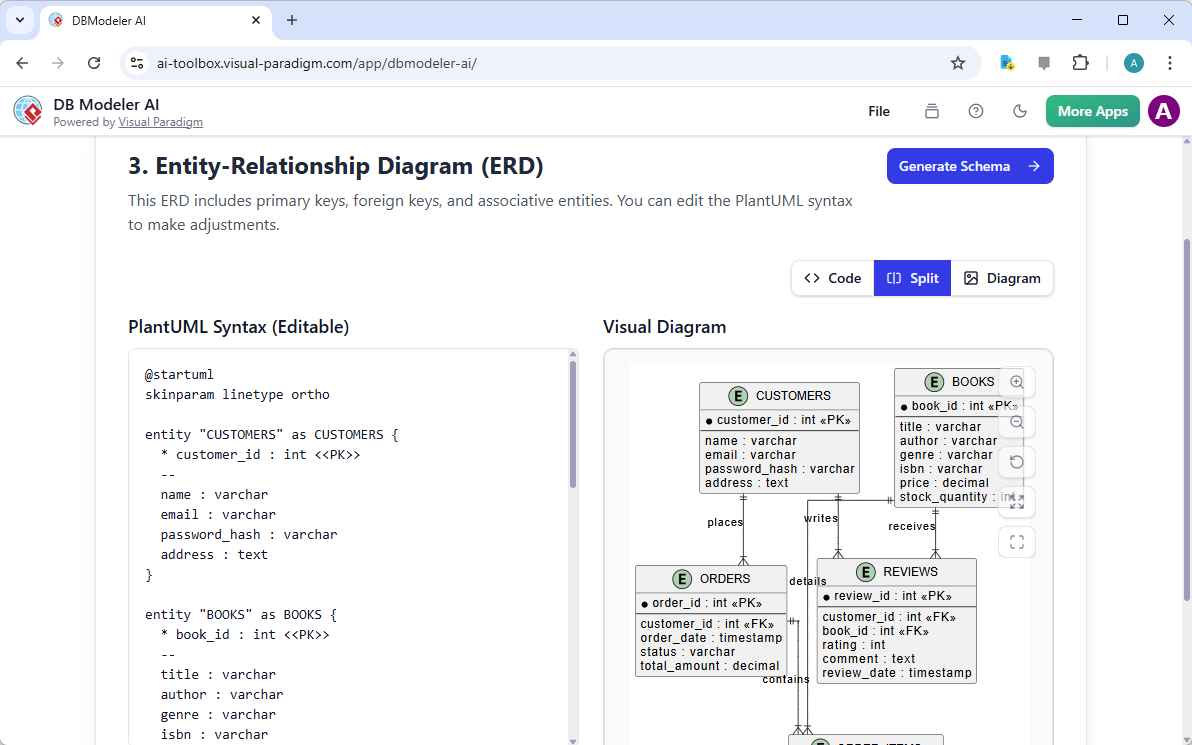
After the conceptual domain model is confirmed, the tool advances to the Entity-Relationship Diagram (ERD). In this stage, the AI-powered ERD maker adds the necessary technical detail, identifying primary keys, foreign keys, and specific attributes for each table. For our bookstore, this means the AI knows that a “Customer” needs a unique ID and that an “Order” must be linked back to that specific customer. This transition is seamless, whereas in traditional tools, you would often have to manually recreate your work when moving from a high-level concept to a logical database design.
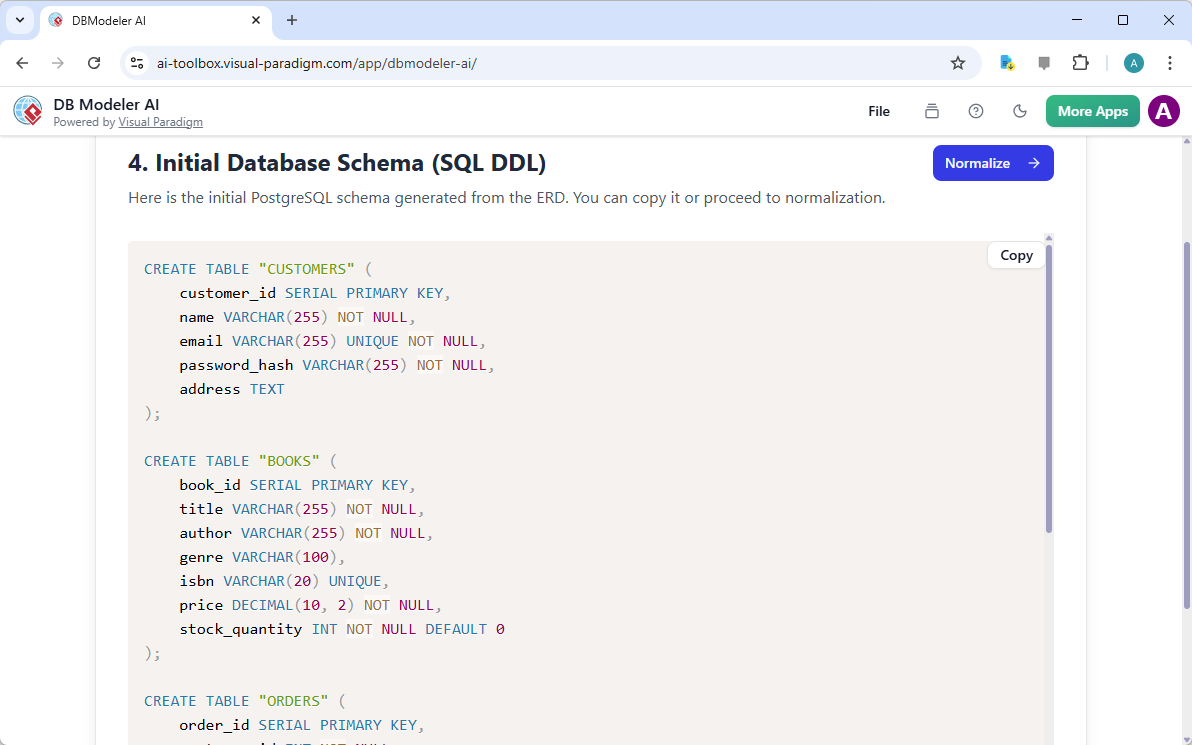
With the ERD in place, the tool generates the Initial Database Schema (SQL DDL). This is the actual code required to build your database in the real world. Many designers find writing DDL (Data Definition Language) tedious and prone to syntax errors. This online SQL schema generator produces clean, professional PostgreSQL or MySQL-compatible code based directly on your visual models. It effectively eliminates the “middleman” of manual coding, ensuring that what you see in your diagram is exactly what gets built in your database environment.
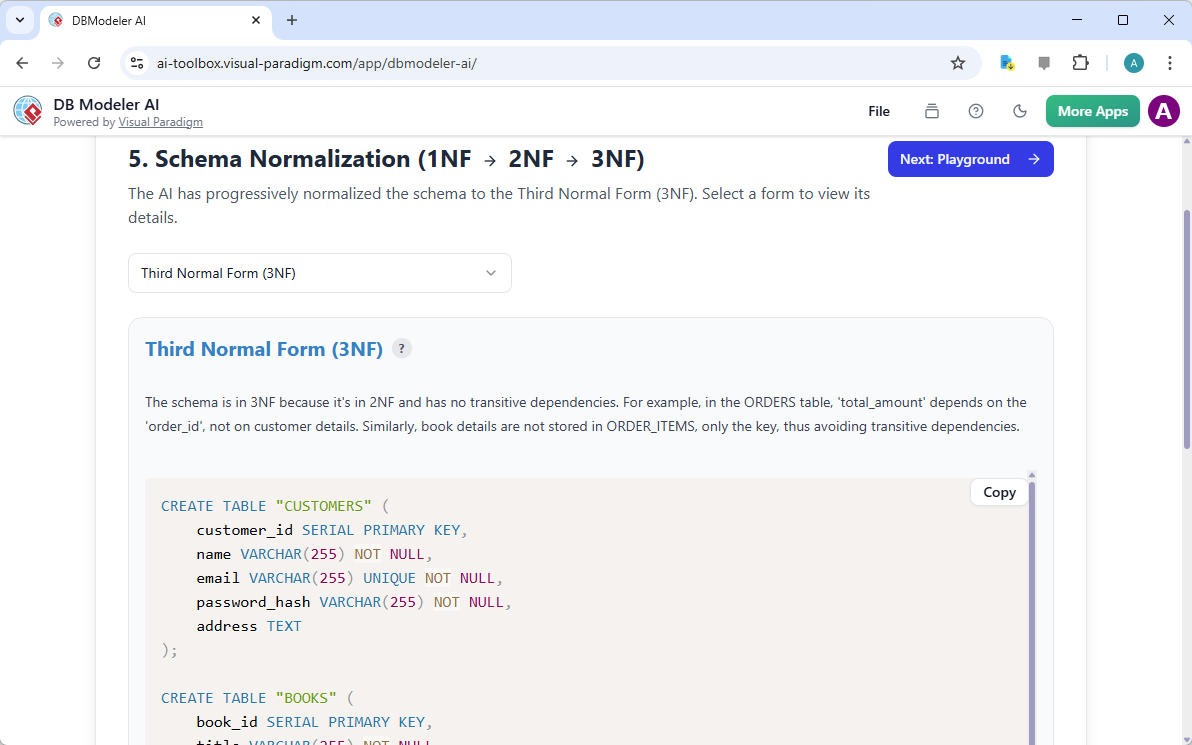
A major pitfall in database design is redundancy—storing the same piece of information in multiple places, which leads to data corruption. This advanced database normalization tool includes a dedicated step to refine your schema through the first, second, and third normal forms (3NF). It explains why the schema is being normalized, for instance, by removing transitive dependencies where a “total amount” might be calculated rather than stored redundantly. This educational component makes it the best AI-powered database modeler tool for both learning and professional-grade implementation, as it guarantees a lean and efficient data structure.
The Interactive Playground: Testing Before Implementing
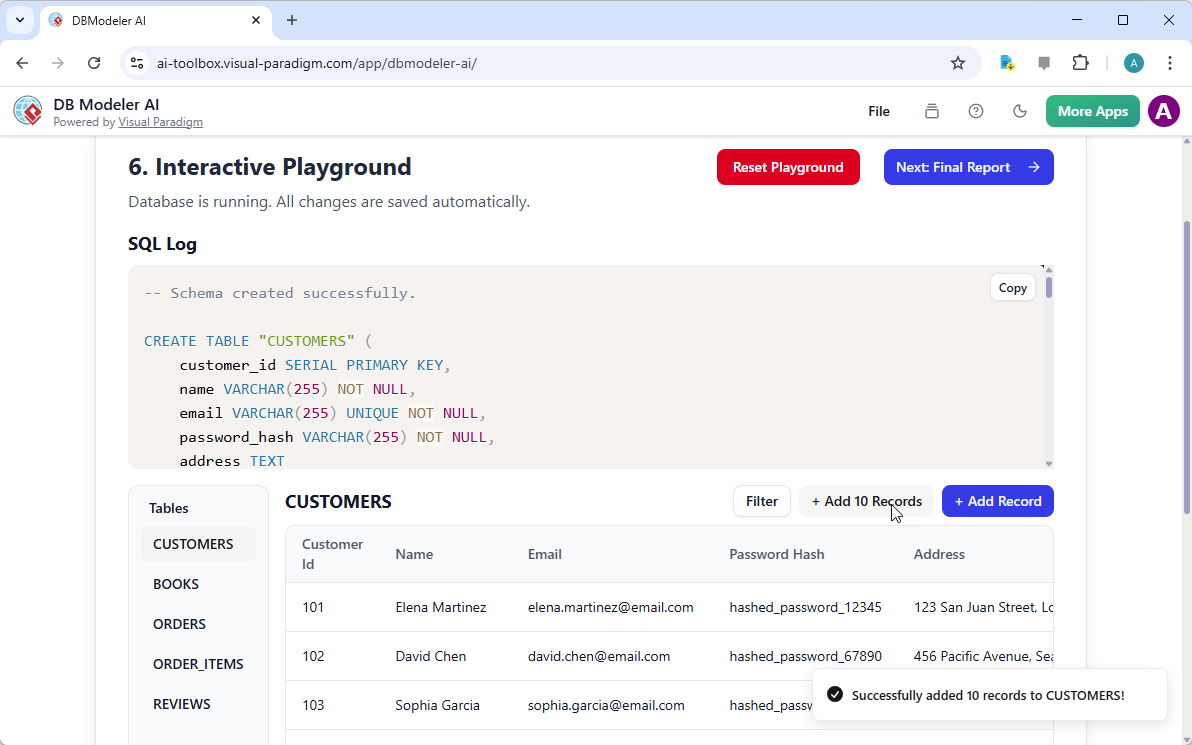
Perhaps the most significant advantage over other market offerings is the “Interactive Playground.” Most modeling tools end their service once the DDL is generated, leaving you to hope that your code works when you finally run it in a production environment. Visual Paradigm Online provides a “sandbox” where you can actually “taste” the result. You can add sample records, run queries, and perform CRUD (Create, Read, Update, Delete) operations directly within the app. It even shows you the SQL statements happening behind the scenes, providing total transparency and immediate validation of your design.
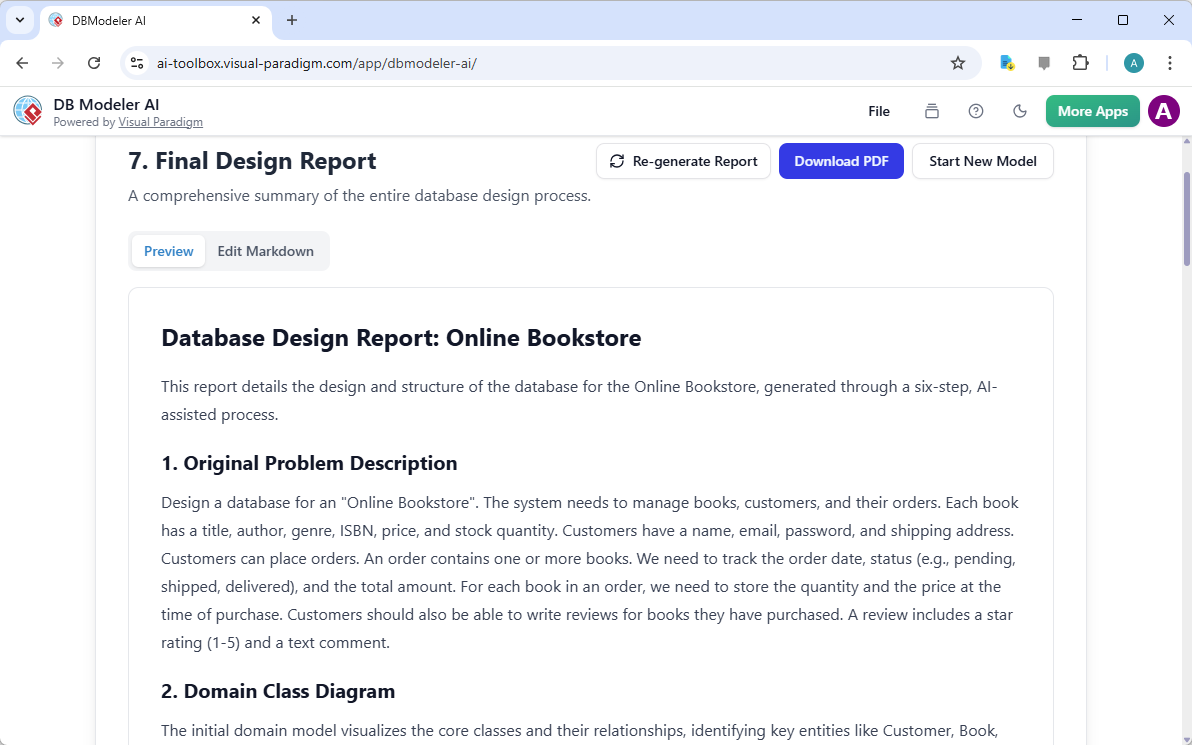
Finally, the process concludes with a comprehensive Final Design Report. This document summarizes every step of your journey, from the original problem description to the final normalized schema and the visual diagrams. This is an invaluable asset for project managers and stakeholders who need to review the underlying data structure of a project without necessarily being experts in SQL. It provides a “single source of truth” that documents the design logic, making future maintenance or hand-offs to other developers incredibly simple.
Conclusion: The Future of Effortless Database Design
Designing a database doesn’t have to be a daunting task filled with manual diagrams and complex syntax. By using the best AI-powered database modeler tool, you transform a potentially error-prone process into a structured, automated, and even enjoyable experience. Visual Paradigm’s DB Modeler AI removes the technical barriers, allowing you to focus on solving business problems while the AI ensures your data architecture is professional, normalized, and ready for action. From the initial bookstore concept to the final interactive playground, this tool proves that easy-to-use database design software can still deliver enterprise-grade results.
Ready to revolutionize your workflow and build databases with unprecedented speed and accuracy? Don’t settle for static drawing tools when you can have an AI-driven architect by your side. Experience the power of structured, intelligent design today.
Try DB Modeler AI Now: Click here to start your first project
Learn More about Visual Paradigm AI: Explore the full features of DB Modeler AI
Related Links
Database design involves utilizing Entity-Relationship Diagrams (ERD) and data modeling techniques to construct scalable, robust database architectures that align with business requirements. Modern platforms have significantly enhanced this process by integrating AI-driven tools such as DBModeler AI, which automates schema generation, database normalization, and SQL testing.
-
Database Design with ERD Tools – Visual Paradigm Guide: A comprehensive resource for building scalable databases using data modeling best practices and schema design.
-
What is an Entity-Relationship Diagram (ERD)?: An introductory guide explaining the core components and the essential role of ERDs in system development.
-
DBModeler AI: Intelligent Database Modeling Tool: An overview of an AI-driven tool used for rapid database design, generating ER diagrams, and creating testable environments.
-
How to Model a Relational Database with ERD: A practical tutorial that walks users through the process from conceptual design to full implementation.
-
Visual Paradigm ERD Tool – Complete Database Solution: A detailed look at a professional toolset used by architects to model, visualize, and generate databases efficiently.
-
Database Design Tutorial with Visual Paradigm: A comprehensive guide to leveraging visual modeling tools for robust database design and development.
-
Reverse Engineering Database to ERD: A step-by-step manual on transforming existing databases into visual models for documentation and analysis.
-
Streamlining ER Modeling from Concept to Implementation: An article focused on simplifying the transition from conceptual modeling to final database deployment.
-
How to Create Database Specifications: A guide for developing precise technical specifications to ensure consistency across the development lifecycle.
-
AI-Powered JSON-to-CRUD Table Generator: A specialized tool that uses AI to automatically generate dynamic CRUD tables and data structures from JSON inputs.

 English
 Arabic
 Chinese (Simplified)
 Dutch
Dutch French
 German
 Italian
 Japanese
 Korean
 Portuguese
 Russian
 Spanish