February 2026 – The Future of Enterprise Architecture Has Arrived
ArchiMate 4 represents a transformative leap forward in enterprise architecture modeling, marking a pivotal shift from the established ArchiMate 3.2 framework. With the core philosophy of “Simplicity over Comprehensiveness,” ArchiMate 4 streamlines the language, reduces redundancy, and enhances clarity—making it more accessible to stakeholders at all levels while preserving precision for advanced modeling needs.
As of early 2026, ArchiMate 4 is in pre-release (often referred to as ArchiMate Next or snapshot versions), with The Open Group finalizing the official specification. Notably, Visual Paradigm has already implemented full support in version 18.0 (Desktop Enterprise edition), becoming the first tool to offer complete, standards-compliant modeling for ArchiMate 4. This early adoption empowers organizations to begin leveraging the new standard today.
Below is a comprehensive guide to the groundbreaking changes, new features, and strategic advantages of ArchiMate 4 compared to its predecessor.
🔷 1. Structural Revolution: From Layers to the ArchiMate Hexagonion
The Problem with Layers
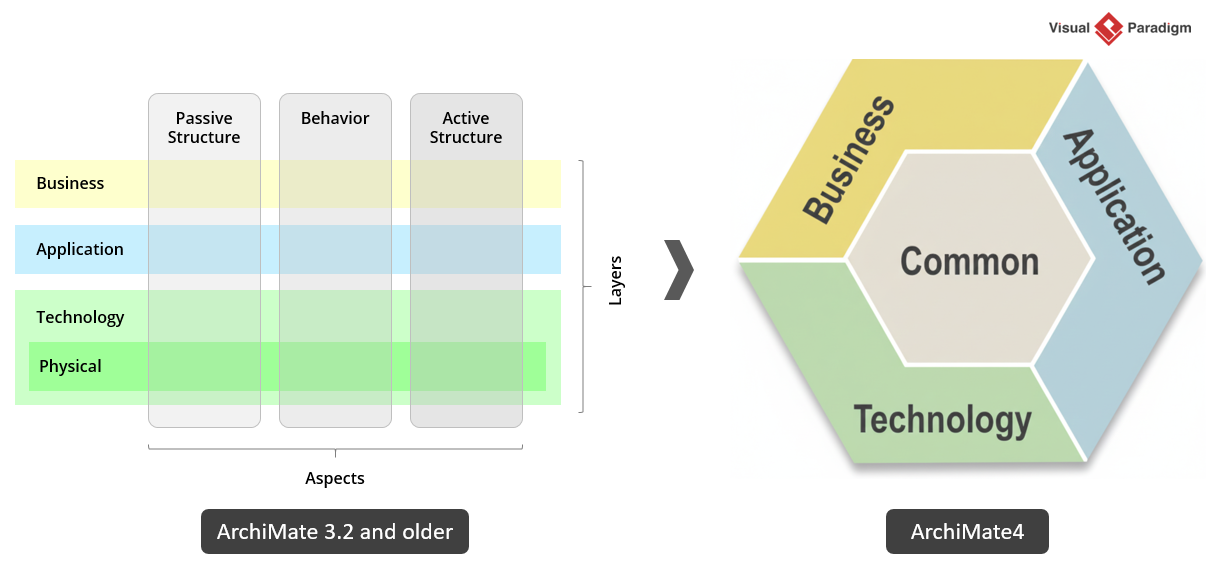
ArchiMate 3.2 relied on a rigid layered architecture model—Business, Application, Technology—combined with aspects like Active Structure, Behavior, and Passive Structure. While effective, this structure often implied strict hierarchies and technical silos, limiting flexibility in modern, hybrid enterprise environments.
Introducing the ArchiMate Hexagonion
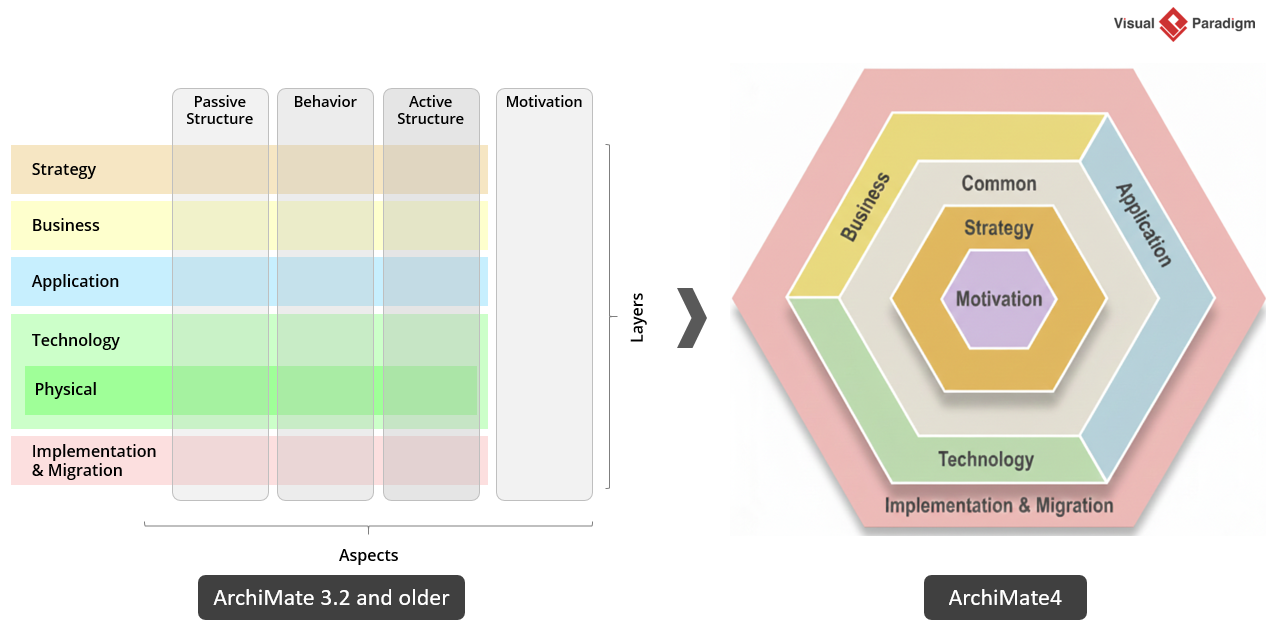
ArchiMate 4 replaces the traditional matrix with the ArchiMate Hexagonion—a dynamic, hexagonal visualization that centers on Motivation, radiating outward to reflect the full scope of enterprise thinking:
Key Changes:
-
“Layer” is replaced by “Domain” – Reflects a more flexible, non-hierarchical view of architecture.
-
Motivation Domain is now central—emphasizing that architecture is driven by goals, outcomes, and stakeholder needs.
-
Seven Core Domains define the new landscape:
-
Motivation Domain (Center) – Stakeholders, goals, drivers, and requirements.
-
Strategy Domain – Strategic direction derived from motivation.
-
Common Domain – Generic elements usable across all domains (e.g., Service, Process, Event).
-
Business Domain – Organizational structure, customer interactions, value delivery.
-
Application Domain – Applications, data, and service interactions.
-
Technology Domain – Infrastructure, hardware, software platforms.
-
Implementation and Migration Domain – Evolution, rollout, and transition planning.
-
✅ Why It Matters
The Hexagonion model reflects modern enterprises: interconnected, goal-driven, and evolving. It moves beyond technical stacks to embrace holistic, outcome-focused architecture—ideal for digital transformation, AI integration, and hybrid human-machine workflows.
🔷 2. Streamlined Elements: Less Complexity, More Power
ArchiMate 4 eliminates redundancy through unified, generic elements, reducing the cognitive load for users while maintaining expressive power.
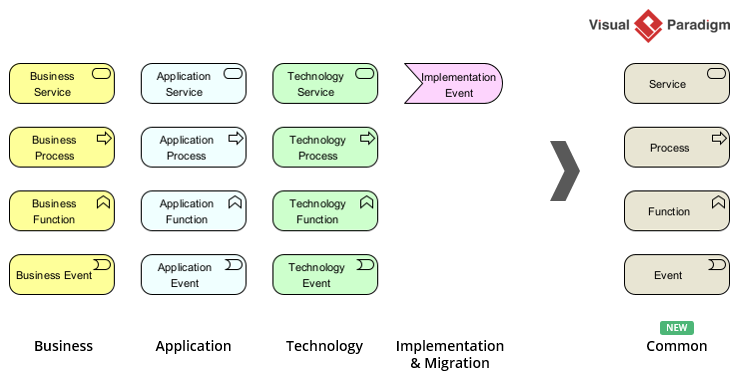
Unified Behavior Elements
-
Retired: Business Process, Application Process, Technology Process
-
Retained & Unified: Process, Service, Function, Event
-
Benefit: One set of behavior elements across all domains. No need to learn separate versions.
Example: A Service can represent a business service (e.g., “Order Fulfillment”) or a technical service (e.g., “Payment Gateway”)—context defines its role.
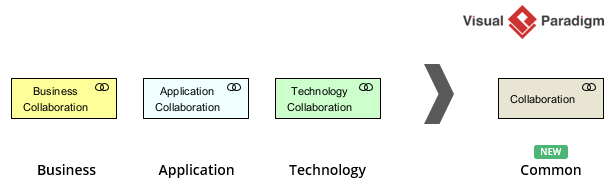
Unified Collaboration
-
Retired: Business Collaboration, Application Collaboration, Technology Collaboration
-
Retained: Collaboration (generic)
-
Use Case: Represents interaction between any two active elements—people, systems, or applications—regardless of domain.
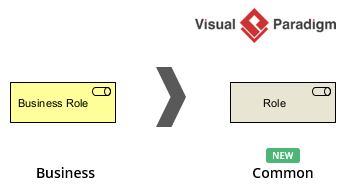
Role: From Business to Universal
-
Retired: Business Role
-
Retained: Role (generic)
-
Now assignable to any active structure element, whether in business, application, or technology domains.
Path: Moved to Common Domain
-
Moved:
Path(formerly in Business Domain) -
Now in Common Domain – Available for cross-domain use.
-
Realization: Active structure elements now Realize a Path (replacing “Aggregate”).
✅ Why It Matters
Fewer elements to learn, less clutter in diagrams, and greater reusability. The “core 80%” of modeling now uses a consistent, intuitive set of constructs.
🔷 3. Enhanced Relationships: Precision with Multiplicity
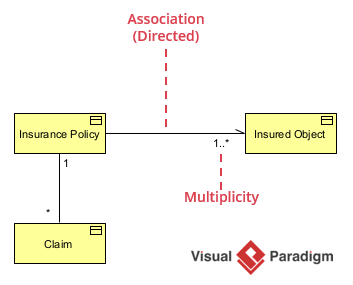
ArchiMate 4 introduces formal multiplicity constraints on relationships—bringing UML-like precision to enterprise architecture.
New Feature: Multiplicity on Relationships
-
Supports:
0..1,1,1..*,0..*,exactly 2, etc. -
Use Case: Express business rules like:
-
“One Customer places many Orders”
-
“A System provides exactly one Service”
-
Example: A Service relationship can now carry
1..*, indicating it is realized by at least one implementation.
Composition Removed
-
Retired:
Composition(was used for strong part-of relationships)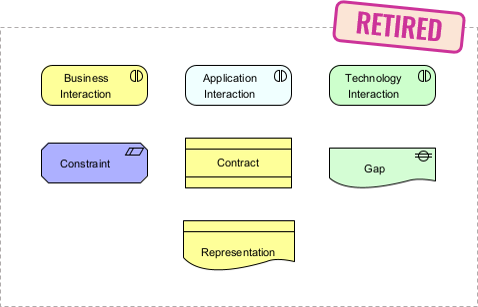
-
Recommended Replacement:
-
Use Aggregation for part-of relationships.
-
Use Grouping element for collections (e.g., a list of deliverables).
-
✅ Why It Matters
More accurate modeling of constraints, improved traceability, and reduced ambiguity. Architects can now formally express business rules directly in diagrams—critical for compliance, governance, and automation.
🔷 4. Retired Elements: Cleaning the Palette
ArchiMate 4 embraces intentional minimalism by retiring redundant or overly specific elements. These are replaced with generic alternatives that can be specialized as needed.
| Retired Element | Recommended Replacement | Migration Tip |
|---|---|---|
| Business Interaction | Collaboration or Service |
Use Collaboration for interaction between roles |
| Application Interaction | Collaboration or Service |
Use Service for application-level interactions |
| Technology Interaction | Collaboration or Service |
Same as above |
| Constraint | Specialize Requirement |
Model as a constraint on a goal or deliverable |
| Contract | Specialize Business Object |
Represent as a formal agreement |
| Gap | Assessment outcome or Deliverable |
Use to document current vs. target state |
| Representation | Specialize Business Object or Data Object |
Model as a data format or artifact |
✅ Why It Matters
Simpler models, cleaner diagrams, and easier onboarding. The focus shifts from memorizing dozens of element types to understanding patterns and relationships.
🔷 5. Backward Compatibility & Smooth Migration
ArchiMate 4 is fully backward compatible with ArchiMate 3.2:
-
Existing models remain editable.
-
No forced migration required.
-
Tools like Visual Paradigm 18.0 support side-by-side editing—you can work on both versions in the same project.
Migration Tips
-
Use specialization to upgrade retired elements (e.g., turn a “Business Role” into a
Role). -
Replace
CompositionwithAggregationorGrouping. -
Add multiplicity to relationships where business rules apply.
✅ Best Practice: Start new models in ArchiMate 4. Retain ArchiMate 3.2 for legacy systems until full transition.
🔷 6. Why ArchiMate 4 Matters: A People-First Approach
“Simplicity over Comprehensiveness” is not just a slogan—it’s a strategic shift.
✅ For Non-Technical Stakeholders:
-
Fewer, clearer elements → easier to understand.
-
Focus on goals, outcomes, and value → better alignment with business strategy.
-
Hexagonion visualization helps executives grasp the big picture.
✅ For Architects & Modelers:
-
More precise modeling with multiplicity and constraints.
-
Greater flexibility with generic elements and specialization.
-
Future-proof design: ready for AI, cloud, hybrid processes, and digital ecosystems.
✅ For Tools & Teams:
-
Visual Paradigm 18.0 supports:
-
Full ArchiMate 4 palette
-
Multiplicity on connectors
-
Enhanced XMI export/import
-
Document generation (PDF, Word)
-
Team collaboration via cloud workspaces
-
📌 Final Thoughts: Embrace the Future of Enterprise Architecture
ArchiMate 4 is not just an update—it’s a paradigm shift. It redefines enterprise architecture as:
-
Goal-driven, not layer-bound.
-
Human-centric, not tool-centric.
-
Simple, yet powerful enough for complex, evolving enterprises.
With Visual Paradigm leading the way in tool support, and The Open Group preparing the final specification, now is the perfect time to:
-
Explore ArchiMate 4 in your next project.
-
Start modeling with the Hexagonion.
-
Leverage multiplicity, unified elements, and retired legacy constructs.
📚 Resources & Next Steps
-
🔗 The Open Group ArchiMate 4 Pre-Release
https://www.opengroup.org/archimate (Check for “ArchiMate Next” or snapshot versions) -
🖥️ Visual Paradigm 18.0 (Enterprise Edition)
https://www.visual-paradigm.com – Full ArchiMate 4 support -
📘 Migration Guide: [Download from Visual Paradigm’s ArchiMate 4 Resources Hub]
“Simplicity is not the absence of complexity—it’s the clarity that makes complexity manageable.”
— Inspired by ArchiMate 4 Philosophy
Ready to modernize your enterprise architecture?
Start with ArchiMate 4—where clarity meets capability.
The future of enterprise modeling is here.

 English
 Arabic
 Chinese (Simplified)
 Dutch
Dutch French
 German
 Italian
 Japanese
 Korean
 Portuguese
 Russian
 Spanish