


Enterprise architecture is often described as the blueprint for an organization’s digital transformation. However, without a clear method to communicate this blueprint to various stakeholders, the effort can become opaque and ineffective. This is where the concept of viewpoints becomes critical. Viewpoints provide the lens through which complex architectural models are observed, ensuring that the right information reaches the right people at the right time.
Architecting with confidence requires more than just drawing diagrams; it demands a structured approach to abstraction. By utilizing ArchiMate specifications effectively, teams can manage complexity and align technical capabilities with business goals. This guide explores the mechanics of viewpoints, their strategic importance, and how to implement them without relying on specific commercial tools.
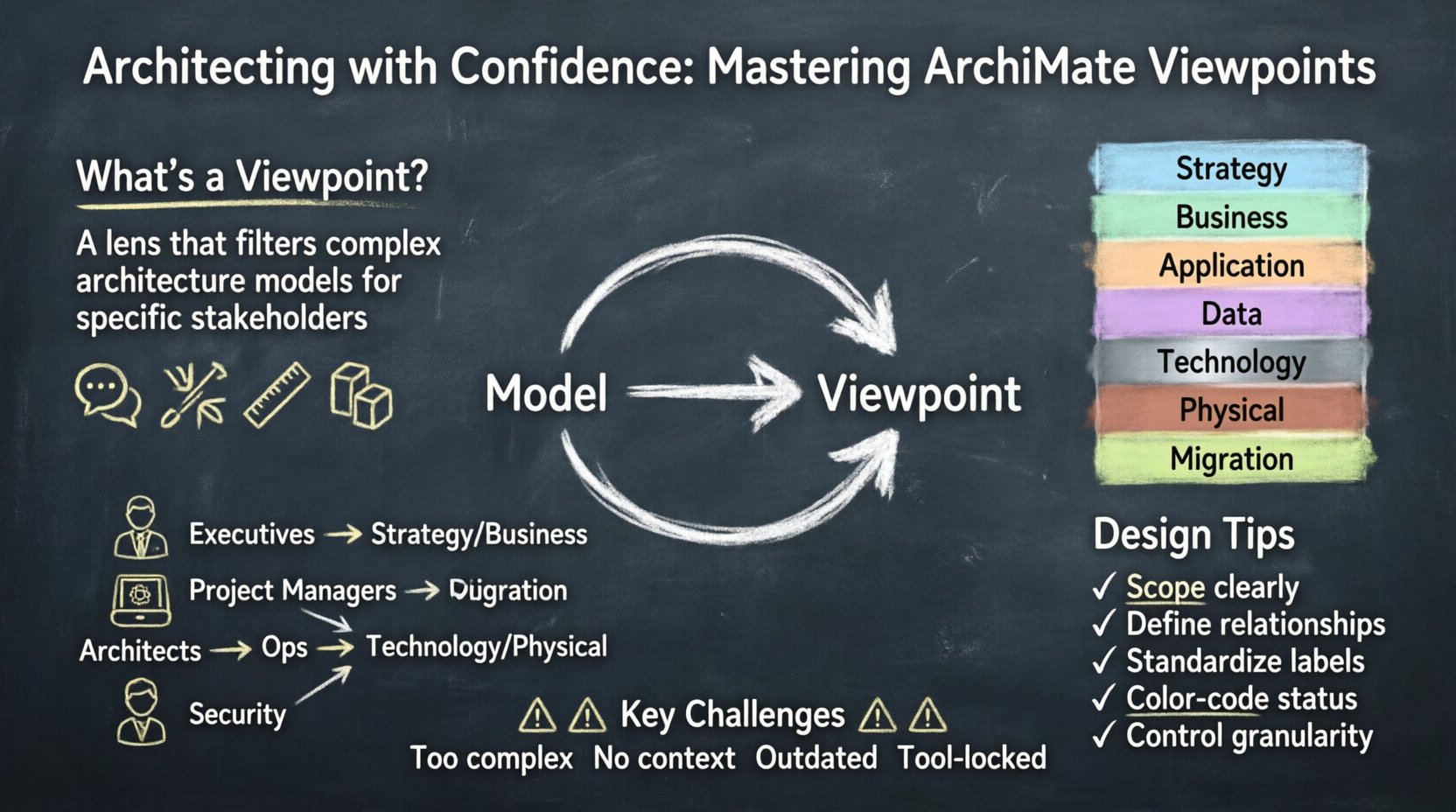
Defining the Viewpoint Concept 🧠
In the context of enterprise architecture, a model is the comprehensive representation of the system. However, a single model is often too dense for any individual stakeholder to digest. A viewpoint acts as a rule set that dictates which parts of the model are relevant to a specific concern. It defines the language, notation, and level of detail required for a particular audience.
Consider a construction project. The city planner needs to see zoning compliance, while the electrician needs to see wiring diagrams. Both are looking at the same building, but from different angles with different requirements. In architecture, this separation is formalized through viewpoints. They filter the model based on:
- Language: The specific ArchiMate notation elements used (e.g., Business Process vs. Application Service).
- Notation: The visual representation style (e.g., layered view, layered view with cross-layer relationships).
- Level of Detail: How granular the information is presented (e.g., high-level capability map vs. detailed data flow).
- Structure: How the information is organized on the page (e.g., swimlanes, clusters).
Without a defined viewpoint, stakeholders might receive information that is either too technical or too vague. A viewpoint ensures consistency. If two architects create a diagram for the same stakeholder, the viewpoint rules ensure both diagrams look and feel the same, even if the underlying data differs.
Relationship Between Model, View, and Viewpoint 🔗
Understanding the distinction between these three terms is fundamental to effective architecture. Confusing them leads to communication breakdowns and redundant work.
- Model: The complete set of information. It contains all the elements, relationships, and constraints of the enterprise. It is the single source of truth.
- Viewpoint: The set of rules and conventions used to create a view. It answers the question: “What are we showing and how?”
- View: The actual graphical representation produced according to a specific viewpoint. It is what the stakeholder sees.
This triad allows for a decoupled architecture. You can update the Model without changing the Viewpoint, and the View is regenerated automatically to reflect those changes. This separation ensures that the underlying data remains consistent while the presentation adapts to different needs.
The ArchiMate Layers and Their Relevance 🧱
ArchiMate organizes architecture into layers to manage complexity. Viewpoints often focus on specific layers or specific relationships between them. Knowing which layers to include in a viewpoint is a key skill.
The core layers include:
- Business Layer: Focuses on strategy, processes, roles, and organizational structure. This is where the business value is defined.
- Application Layer: Deals with software applications and their interfaces. It bridges the business processes with the technical infrastructure.
- Technology Layer: Covers hardware, networks, and system software. This is the physical foundation.
- Data Layer: Represents the information objects used and stored within the organization.
- Physical Layer: Represents the physical locations and devices where applications and systems run.
- Implementation & Migration Layer: Deals with projects and transitions.
- Strategy Layer: Focuses on goals, principles, and drivers.
A well-designed viewpoint usually restricts itself to one or two layers to avoid cognitive overload. For instance, a CIO might prefer a Technology layer view, while a Business Unit Head needs a Business layer view. Mixing too many layers in a single diagram often results in a cluttered picture that satisfies no one.
Structuring Stakeholder Concerns 📋
The primary purpose of a viewpoint is to address a specific concern. Identifying these concerns before creating a diagram is the first step in the process. Different roles have different priorities.
| Stakeholder Role | Primary Concern | Suggested Viewpoint Focus |
|---|---|---|
| Executive Leadership | Strategic alignment and investment | Business & Strategy Layers |
| Project Managers | Implementation feasibility and dependencies | Implementation & Migration Layer |
| System Architects | Integration and interface design | Application Layer |
| Operations Team | Infrastructure stability and monitoring | Technology & Physical Layers |
| Security Officers | Compliance and risk management | Business & Application Layers (Security Focus) |
By mapping stakeholders to these concerns, you can define a matrix of viewpoints. This ensures that no critical perspective is missed and that resources are not wasted creating diagrams for people who do not need them.
Designing a Viewpoint Strategy 🎯
Creating a viewpoint is not just about drawing a box around a set of elements. It involves defining rules that govern the entire lifecycle of the diagram. A robust strategy includes:
- Scope Definition: Clearly state which layers and domains are included. Exclude irrelevant elements to reduce noise.
- Relationship Rules: Define which relationships are allowed. For example, a Business Viewpoint might only show flow relationships between processes, ignoring physical connections.
- Labeling Standards: Ensure consistent naming conventions. A “Process” should always be named the same way across all views to prevent confusion.
- Color Coding: Use specific colors to indicate status (e.g., active, deprecated, planned) or criticality. This should be defined in the viewpoint rules.
- Granularity Control: Specify the depth of the diagram. Should a “Customer Order” process be shown as a single block, or should its sub-processes be visible?
When designing these strategies, it is essential to maintain consistency across the architecture practice. If one team uses a different viewpoint standard than another, the resulting models will be incompatible, making integration impossible.
Common Challenges in Viewpoint Definition ⚠️
Even with a solid plan, pitfalls exist. Recognizing them early can save significant time and effort.
- Over-Complication: Trying to include every possible relationship in a single viewpoint leads to unreadable diagrams. It is better to split concerns into multiple viewpoints.
- Lack of Context: A view without a clear title or legend can be misinterpreted. Always provide context regarding the scope and time frame of the data.
- Stale Viewpoints: Architectures evolve. If a viewpoint is not updated to reflect new business processes, the diagrams become misleading.
- Tool Dependency: While the standard is tool-agnostic, specific modeling platforms often enforce their own default viewpoints. Ensure these defaults align with the organizational standard.
- Inconsistent Detail Levels: Mixing high-level strategic goals with low-level technical configurations in the same view confuses the audience.
Regular reviews of the viewpoint library are necessary. As the organization matures, the needs of stakeholders change. A viewpoint that was useful five years ago might be obsolete today.
Integrating Viewpoints into Governance 🛡️
Viewpoints should not exist in isolation. They are part of the broader governance framework. Governance ensures that the architecture adheres to standards and supports business objectives.
Here is how to integrate viewpoints into the governance process:
- Approval Workflows: Define who is responsible for approving new viewpoints. A standard set of viewpoints should be pre-approved to save time on routine diagrams.
- Quality Assurance: When reviewing a model, check if the resulting views comply with the defined viewpoints. This ensures consistency across the enterprise.
- Documentation: Document the purpose of each viewpoint in a registry. This helps new architects understand why a specific view exists and who uses it.
- Training: Ensure that all architects understand the rules of the viewpoints. Training reduces the likelihood of non-compliant diagrams.
- Feedback Loops: Create a mechanism for stakeholders to request changes to viewpoints. If a stakeholder cannot find the information they need, the viewpoint needs adjustment.
Governance is not about restriction; it is about enabling clarity. By standardizing the way information is presented, governance reduces the cognitive load on stakeholders and accelerates decision-making.
Real-World Scenarios 🌍
Applying these concepts in practice demonstrates their value. Consider a few scenarios where viewpoint management is critical.
Cloud Migration: An organization plans to move from on-premise servers to cloud services. The Business stakeholders need to understand the impact on processes (Business Viewpoint). The IT operations team needs to see the infrastructure changes (Technology Viewpoint). A single view showing both layers would confuse the business team, as they do not need to see server IP addresses. Separate viewpoints allow both groups to focus on their specific migration tasks.
Regulatory Compliance: Financial institutions must adhere to strict data regulations. A Security Viewpoint can highlight where sensitive data flows through the system. It focuses on the Data layer and Application layer, ignoring the physical hardware. This allows auditors to quickly verify compliance without sifting through unrelated infrastructure details.
Legacy Modernization: When replacing a legacy system, the goal is to minimize disruption. A Migration Viewpoint can show the transition path from the old system to the new one. It includes both the old and new states, clearly marking which elements are being retired and which are being introduced.
Future Considerations 🌐
As technology evolves, so do the requirements for architecture. The use of viewpoints is likely to become more dynamic.
- Automation: Future systems may automatically generate views based on natural language queries. Instead of manually creating a diagram, an architect could ask, “Show me the impact of changing this process on the technology layer,” and the system generates the appropriate view.
- Interoperability: As organizations integrate with partners, the need for standardized viewpoints increases. Industry-wide standards for viewpoints could facilitate better data exchange between different companies.
- Real-Time Architecture: Static diagrams are becoming less useful. Viewpoints may need to support live data feeds, showing the current state of the architecture rather than a snapshot in time.
Staying current with these trends ensures that the architecture practice remains relevant. The core principles of viewpoints—abstraction, focus, and consistency—will remain valid, even if the tools change.
Conclusion on Architectural Clarity 📝
Successful enterprise architecture relies on the ability to communicate complex information clearly. Viewpoints provide the mechanism to achieve this clarity. By defining rules for what is shown, how it is shown, and to whom it is shown, architects can manage complexity effectively.
Adopting a disciplined approach to viewpoints reduces confusion, aligns stakeholders, and supports better decision-making. It transforms architecture from a static documentation exercise into a dynamic communication tool. As you implement these practices, focus on consistency and relevance. The goal is not to create more diagrams, but to create the right diagrams for the right people.
Remember that the model is the truth, but the view is the communication. Treat both with care, and the architecture will serve the business effectively.

 English
 Arabic
 Chinese (Simplified)
 Dutch
Dutch French
 German
 Italian
 Japanese
 Korean
 Portuguese
 Russian
 Spanish