


Enterprise architecture involves connecting disparate systems, business processes, and technological infrastructure into a coherent whole. Without structure, this complexity becomes noise. Architects face the challenge of communicating these intricate relationships to diverse audiences who possess different priorities and levels of technical understanding. The solution lies in structured representation. By utilizing specific lenses, known as viewpoints, architects can filter information to match the needs of the audience. This approach ensures that every stakeholder sees exactly what they need to see, reducing confusion and aligning strategic intent with operational reality.
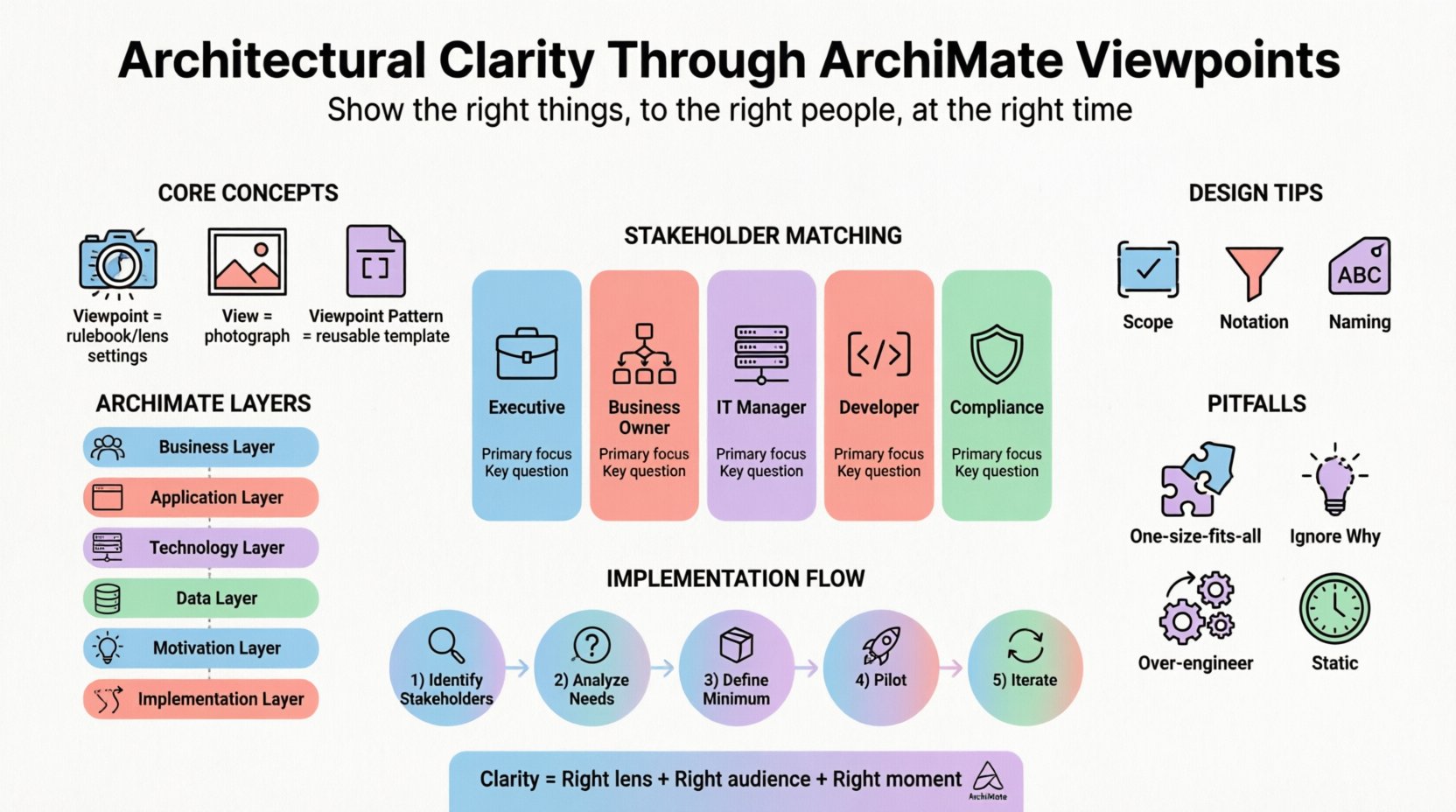
🧩 Understanding the Core Concepts
To achieve clarity, one must first distinguish between the tools used to create the representation and the representation itself. In the ArchiMate modeling language, three fundamental concepts interact to deliver this clarity:
- View: A representation of a set of related viewpoints from the perspective of a specific stakeholder. It is the actual diagram or document produced.
- Viewpoint: A description of the conventions for the creation, use, and interpretation of a view. It defines the notation, concepts, and rules.
- Viewpoint Pattern: A template or starting point that describes a specific viewpoint, often reused across multiple models to maintain consistency.
Think of the Viewpoint as the rulebook for a camera lens. It dictates what focal length to use, what filter to apply, and what time of day to shoot. The View is the photograph itself. Without the Viewpoint, every architect would take a picture of the same building using different lenses, resulting in a collection of images that do not tell a unified story.
📐 The ArchiMate Layers and Their Focus
The ArchiMate standard organizes enterprise architecture into layers. Each layer provides a specific perspective on the organization. While a full model might contain all layers, clarity often requires isolating specific layers for specific discussions. Understanding these layers is the first step in selecting the right viewpoint.
- Business Layer: Focuses on the organizational structure, business processes, and roles. It answers questions about who does what and how value is created.
- Application Layer: Focuses on the software applications that support the business processes. It covers application components, interfaces, and data services.
- Technology Layer: Focuses on the physical infrastructure. This includes hardware, networks, and system software that host the applications.
- Data Layer: (Often integrated) Focuses on the information objects that flow through the business and applications.
Beyond the structural layers, two additional layers provide critical context:
- Motivation Layer: Explains why things are the way they are. It includes actors, goals, principles, and requirements.
- Implementation & Migration Layer: Describes the transition from the current state to the target state. It includes projects, deliverables, and gaps.
👥 Matching Viewpoints to Stakeholders
One of the most common errors in enterprise architecture is presenting a full-stack model to a stakeholder who only cares about the business outcome. This causes cognitive overload. Instead, architects should map specific viewpoints to specific stakeholder groups. The following table outlines common pairings.
| Stakeholder Group | Primary Focus | Recommended Viewpoint Type | Key Questions Answered |
|---|---|---|---|
| Executive Leadership | Strategy & Value | Motivation & Business Process | Does this investment support our strategic goals? |
| Business Process Owners | Efficiency & Flow | Business Process & Collaboration | Where are the bottlenecks in our workflow? |
| IT Management | Infrastructure & Cost | Application & Technology | Are we maintaining the right servers and apps? |
| Developers | Integration & Logic | Application Component & Data | How does this module connect to the database? |
| Compliance Officers | Risk & Governance | Principles & Standards | Are we adhering to regulatory requirements? |
When a business analyst presents a technical infrastructure map to a sales director, communication breaks down. Conversely, when a developer receives a high-level business strategy map without technical details, they cannot implement the solution. The right viewpoint bridges this gap.
🛠️ Designing Effective Viewpoints
While standard viewpoints exist, organizations often require customizations to reflect their specific language, governance structure, or operational reality. Designing a custom viewpoint requires discipline to ensure it does not become an ad-hoc abstraction.
1. Define the Scope Clearly
Before creating a diagram, define the boundaries. What is included? What is excluded? For example, a Customer Onboarding Viewpoint might include the CRM system and the verification process, but exclude the backend payment processing server details. This scope definition prevents the model from becoming too dense.
2. Select the Right Notation
ArchiMate offers various relationship types. A viewpoint should restrict which relationships are allowed. If the goal is to show data flow, allow flow relationships but perhaps hide structural dependencies. This restriction forces clarity by removing noise.
3. Standardize Naming Conventions
Clarity is ruined by ambiguity. A viewpoint should mandate that all business roles use the same naming convention (e.g., “Process” vs “Activity”). All application components should follow a specific naming standard. This ensures that when multiple viewpoints are combined, the terminology remains consistent.
⚠️ Common Pitfalls in Viewpoint Management
Achieving architectural clarity is difficult because it requires constant maintenance and governance. Several common traps can undermine the value of viewpoints.
- The “One Size Fits All” Model: Creating a single massive model and trying to slice it for everyone. This often leads to confusing diagrams where unrelated elements appear together simply because they share a layer.
- Ignoring the Motivation Layer: Many models focus heavily on structure (Business, App, Tech) but ignore the Why. Without linking requirements and goals to the structure, stakeholders cannot understand the value of the architecture.
- Over-Engineering: Using the most detailed notation possible for a high-level presentation. A CIO needs to see the forest, not every tree. Using simplified viewpoints for executive summaries is essential.
- Static Viewpoints: Architecture changes. Viewpoints must be reviewed periodically to ensure they still match the stakeholder’s evolving needs. A viewpoint designed for a legacy system may be irrelevant for a cloud-native strategy.
🔗 Connecting the Layers: The Integration Challenge
One of the unique strengths of ArchiMate is the ability to trace relationships between layers. However, this traceability can introduce complexity. A Service Realization relationship connects a Business Service to an Application Service. A Assignment relationship connects a Business Actor to a Business Role.
To maintain clarity while integrating layers, architects should use specific integration viewpoints:
- Business-Application Mapping: Shows which applications support which business processes. Useful for cost allocation and dependency analysis.
- Application-Technology Mapping: Shows where software is deployed. Useful for capacity planning and infrastructure management.
- End-to-End Process Flow: Combines Business, Data, and Application layers to show a single transaction flow from trigger to completion.
When building these integration viewpoints, the rule of thumb is to limit the depth of the stack. Do not show every layer in every diagram. If the focus is on Business Application mapping, exclude the Technology layer unless a specific deployment issue is being investigated.
🔄 Maintenance and Governance
A viewpoint is not a static artifact. It is a living contract between the architecture team and the organization. To keep architectural clarity over time, governance processes must be established.
Versioning: Every change to a viewpoint definition should be versioned. If a new relationship type is added to the Business Viewpoint, document the change. This allows stakeholders to understand why a diagram looks different in the next release.
Accessibility: Viewpoints must be accessible. If a viewpoint exists but no one knows how to use it or where to find it, it fails its purpose. Documentation for the viewpoint should be as important as the model itself.
Feedback Loops: Establish a mechanism for stakeholders to report confusion. If a CTO says a diagram is unclear, the Viewpoint may need adjustment. The architecture team should treat feedback as a requirement for the Viewpoint itself.
📈 Measuring the Value of Viewpoints
How do you know if your approach to ArchiMate Viewpoints is working? Quantifying architectural clarity can be challenging, but several indicators suggest success.
- Reduced Rework: When requirements are clearly mapped to architecture, developers make fewer mistakes. The rate of rework due to misunderstood requirements drops.
- Faster Decision Making: Stakeholders can access the specific information they need without wading through irrelevant data. Decisions on budget or technology selection happen faster.
- Consistency Across Teams: Different departments produce models that look and feel the same. This consistency indicates that the Viewpoint patterns are being followed effectively.
- Stakeholder Confidence: Stakeholders trust the architecture because they see their specific concerns reflected accurately in the models.
🚀 Implementing a Viewpoint Strategy
Starting a new viewpoint strategy requires a phased approach. Attempting to define every possible viewpoint immediately is overwhelming. Instead, follow this progression:
- Identify Key Stakeholders: List the top 5-10 roles that require architectural information.
- Analyze Information Needs: For each role, ask what questions they need answered. What decisions do they make based on this information?
- Define Minimum Viewpoints: Create a viewpoint that answers the top question for the most critical stakeholder. Keep it simple.
- Pilot the Viewpoint: Use the viewpoint in a real project. Observe how it is used. Note where it fails or where it is ignored.
- Iterate and Expand: Refine the definition based on the pilot. Then, add viewpoints for the next most critical stakeholders.
This iterative process ensures that the architecture function remains relevant and responsive to the organization’s needs. It prevents the creation of a “zoo” of unused diagrams that gather dust.
🎯 Conclusion
Architectural clarity is not about showing everything. It is about showing the right things, at the right time, to the right people. ArchiMate Viewpoints provide the framework to achieve this precision. By separating the definition of the lens (Viewpoint) from the image (View), architects can manage complexity without losing the big picture.
Success depends on discipline. It requires resisting the urge to create a single comprehensive model that satisfies everyone. It demands the humility to listen to stakeholders and adjust the Viewpoint to their needs. When executed well, this approach transforms architecture from a documentation exercise into a strategic communication tool. It aligns business intent with technical execution, ensuring that every investment drives value.
As the enterprise evolves, so must the viewpoints. Regular reviews, clear governance, and a focus on stakeholder value will ensure that the architecture remains a source of clarity rather than confusion. The goal is not perfection, but utility. A useful Viewpoint is one that helps a decision-maker make a better decision.

 English
 Arabic
 Chinese (Simplified)
 Dutch
Dutch French
 German
 Italian
 Japanese
 Korean
 Portuguese
 Russian
 Spanish