


Enterprise architecture involves complex systems, diverse stakeholders, and intricate business processes. When information is presented without structure, confusion arises. Architects often face the challenge of explaining technical decisions to business leaders or translating business needs into technical requirements. This gap in communication can stall projects and create friction across departments. A standardized method for organizing architectural information is essential. This is where the concept of ArchiMate Viewpoints becomes critical. They provide a framework for tailoring models to specific audiences.
Effective communication in enterprise architecture is not about showing every detail of the system. It is about showing the right details to the right people at the right time. Using a generic model for everyone is inefficient and often overwhelming. By utilizing viewpoint-based modeling, architects can create focused representations that address specific concerns. This approach ensures clarity, reduces noise, and aligns stakeholders with strategic goals.
🔍 Understanding Viewpoints and Views
To grasp the value of these structures, one must distinguish between a Viewpoint and a View. While often used interchangeably in casual conversation, they represent different concepts in the modeling framework.
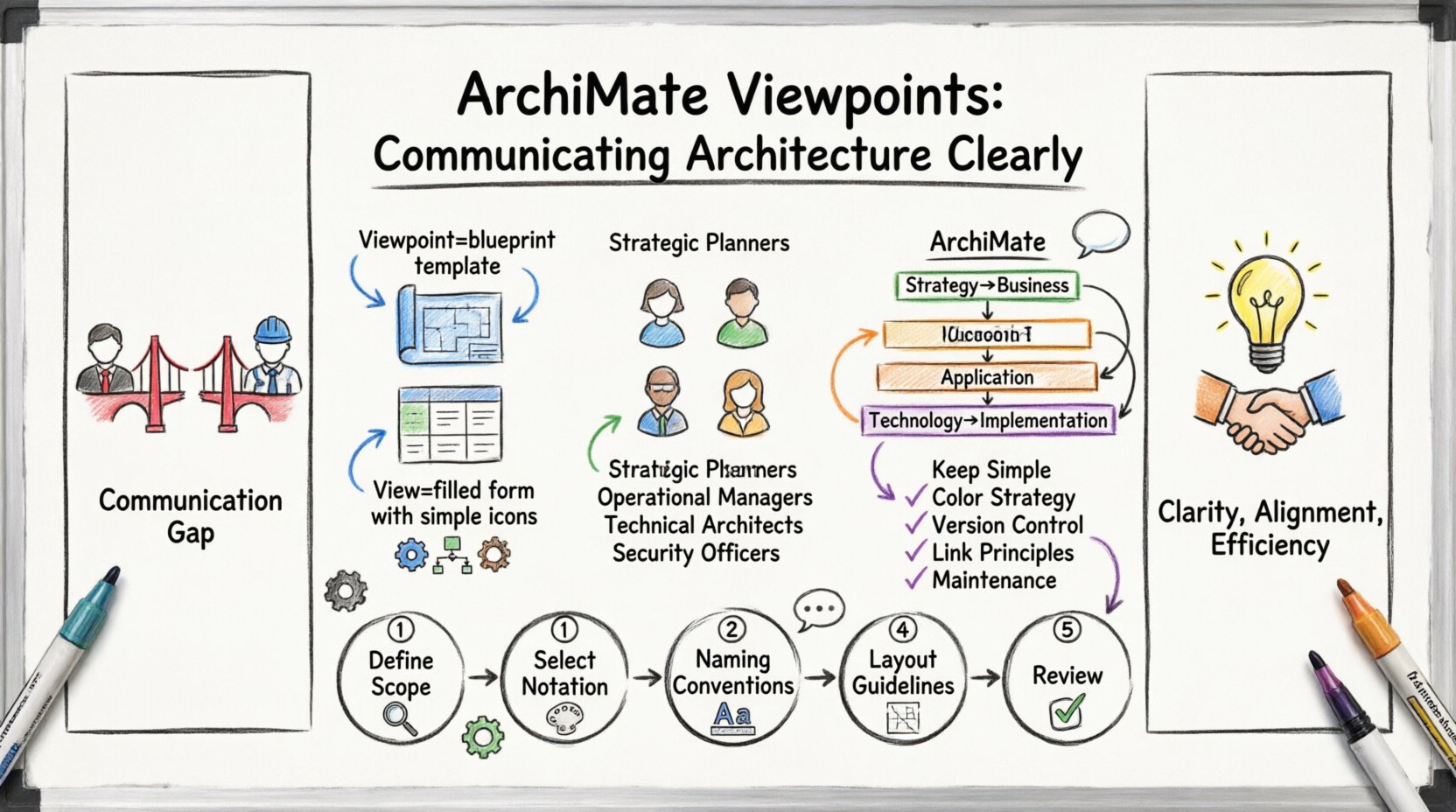
- Viewpoint: A template or specification that defines the conventions for constructing a view. It specifies the notation, the concerns it addresses, the stakeholders it targets, and the required content. Think of it as a blueprint for a specific type of document.
- View: The actual representation or artifact created based on a viewpoint. It is the instance of the model tailored for a specific purpose. If the viewpoint is the template, the view is the filled-out form.
Without a defined viewpoint, views can become inconsistent. One architect might use different symbols for the same business function, while another might omit critical dependencies. Standardizing the viewpoint ensures that every view created follows the same rules, making them easier to interpret and maintain.
👥 Addressing Stakeholder Concerns
The primary driver for creating distinct viewpoints is the diversity of stakeholders. A Chief Financial Officer (CFO) cares about cost, return on investment, and compliance. A Lead Developer cares about system interfaces, scalability, and technology stacks. A Business Manager cares about process flow, customer impact, and operational efficiency.
Attempting to satisfy all these concerns in a single diagram leads to clutter. A diagram dense with technical code references will confuse a business manager. Conversely, a high-level process map will frustrate a developer looking for API details. Viewpoints solve this by filtering information.
Key Stakeholder Groups
- Strategic Planners: Focus on business capabilities, value streams, and strategic objectives. They need to see the “Why” and “What” without the “How”.
- Operational Managers: Focus on business processes, organizational units, and performance metrics. They need clarity on workflows and resource allocation.
- Technical Architects: Focus on application services, interfaces, and technology infrastructure. They need to understand integration points and deployment targets.
- Security Officers: Focus on risk, access controls, and compliance requirements. They need to see data flows and security boundaries.
By mapping these groups to specific viewpoints, architects ensure that every stakeholder receives information relevant to their decision-making process. This targeted approach builds trust and demonstrates professional competence.
🏛️ The ArchiMate Layers and Filtering
The ArchiMate standard organizes enterprise architecture into several layers. These layers provide a logical separation of concerns, allowing architects to drill down from strategy to implementation. Viewpoints utilize these layers to filter content.
| Layer | Focus Area | Typical Viewpoint Audience |
|---|---|---|
| Strategy | Goals, Principles, Drivers, Capabilities | Executive Leadership, Strategic Planners |
| Business | Processes, Actors, Roles, Functions | Business Managers, Process Owners |
| Application | Applications, Application Services, Data Objects | Application Architects, Developers |
| Technology | Nodes, Devices, Networks, System Software | Infrastructure Architects, Ops Teams |
| Implementation | Projects, Migrations, Deliverables | Project Managers, PMO |
A viewpoint might be designed to show only the Business Layer for a specific process. Another might focus on the Application Layer to show dependencies between software systems. A third might span across Business and Application to demonstrate how a business process relies on specific software capabilities. This cross-layering is essential for understanding the impact of changes.
🛠️ Designing Effective Viewpoints
Creating a viewpoint is a deliberate process. It requires analysis of the target audience and the information needed to support their decisions. The following steps outline the methodology for designing these structures without relying on specific software tools.
1. Define the Scope
Identify the boundaries of the model. What is included, and more importantly, what is excluded? A scope definition prevents the model from becoming too large. For example, a viewpoint for a specific department might exclude global infrastructure details that are managed centrally.
2. Select the Notation
Determine which elements and relationships are necessary. The ArchiMate notation offers a wide range of elements. A simple business process view might only require basic process and actor elements. A technical dependency view requires service interfaces and usage relationships. Selecting the right notation keeps the diagram clean.
3. Establish Naming Conventions
Consistency is key for readability. Establish rules for naming elements. For instance, should all processes be named in the gerund form (e.g., “Processing Order”) or the noun form (e.g., “Order Processing”)? Consistent naming reduces cognitive load when reviewing multiple views.
4. Determine Layout Guidelines
Visual arrangement aids understanding. Define rules for layering. Typically, the top layer represents the business context, and the bottom layer represents the technology. Relationships should flow logically, often from left to right or top to bottom. Avoid crossing lines where possible to maintain clarity.
5. Review and Validate
Before finalizing a viewpoint template, test it. Create a sample view and present it to a stakeholder representative. Ask if the information is sufficient and if anything is missing. Gather feedback to refine the template. This iterative process ensures the viewpoint remains practical and useful.
📋 Best Practices for Communication
Once viewpoints are established, the focus shifts to maintaining them and ensuring they serve their purpose. Adhering to best practices helps sustain the quality of the architectural repository over time.
- Keep It Simple: If a diagram is too complex, split it. It is better to have two clear diagrams than one confusing one. Use navigation links or indexes to connect related views.
- Use Color Strategically: Color can highlight status or importance. However, do not rely on color alone for meaning. Use shapes or icons to reinforce the information for those who may not see color distinctions clearly.
- Version Control: Architectural models evolve. Ensure that every view has a version number and a change log. This helps stakeholders understand the history of a decision.
- Link to Principles: Connect architectural decisions to established enterprise principles. This provides context and justification for why a specific design was chosen.
- Regular Maintenance: Schedule reviews of the views. Outdated views can lead to incorrect decisions. A model that does not reflect the current state of the enterprise is worse than no model at all.
🚧 Common Challenges and Solutions
Implementing a viewpoint-based approach is not without hurdles. Organizations often face resistance or confusion during the transition. Understanding these common pitfalls allows architects to navigate them effectively.
Challenge 1: Model Bloat
Issue: Architects tend to create too many views, making the repository difficult to navigate. Stakeholders do not know which view to look at.
Solution: Implement a governance structure. Define a catalog of standard viewpoints. New views should be created only when an existing viewpoint cannot satisfy a new requirement. Limit the number of active viewpoints.
Challenge 2: Lack of Adoption
Issue: Stakeholders find the views too technical or abstract. They do not engage with the architectural documentation.
Solution: Involve stakeholders in the design of the viewpoints. Show them how the view solves their specific problems. Use language and terminology familiar to their domain rather than strict architectural jargon where possible.
Challenge 3: Inconsistency
Issue: Different teams create views that look different, making it hard to compare them.
Solution: Enforce strict adherence to the viewpoint templates. Conduct peer reviews of new views before they are added to the repository. Provide training on the standard notation and layout rules.
🔄 Integrating with Architecture Principles
Viewpoints are not isolated artifacts; they are part of the broader architecture governance framework. They should align with the organization’s architecture principles. These principles define the rules and guidelines that govern the design of the enterprise.
For example, if a principle states “Minimize Data Redundancy,” a data viewpoint should highlight data objects and their relationships across applications. If a principle states “Cloud First,” a technology viewpoint should clearly distinguish between on-premise and cloud resources. By embedding principles into the viewpoint definitions, architects ensure that compliance is visible in the models themselves.
📈 Measuring Success
How does an organization know if the use of ArchiMate Viewpoints is working? Success is not measured by the number of diagrams created, but by the quality of communication and decision-making.
- Reduced Rework: Are projects being built correctly the first time because the requirements were clear?
- Faster Onboarding: Do new architects understand the landscape faster because the views are standardized?
- Stakeholder Feedback: Do business leaders feel they understand the IT landscape better?
- Decision Speed: Is the time from proposal to approval reduced due to clearer architectural impact assessments?
Tracking these metrics helps justify the effort invested in maintaining the architectural framework. It demonstrates that the work is not just documentation for documentation’s sake, but a strategic asset.
🌟 Final Thoughts on Architecture Communication
The complexity of modern enterprise systems requires a disciplined approach to documentation. ArchiMate Viewpoints offer a proven method to manage this complexity. They transform a chaotic mass of data into structured, understandable narratives tailored for specific audiences.
By focusing on the concerns of the stakeholder rather than the capabilities of the tool, architects can build bridges between business and technology. The goal is not to create perfect models, but to create useful models. When every diagram serves a clear purpose and follows a consistent standard, communication flows naturally.
Start by identifying the most critical stakeholder groups in your organization. Define the information they need most urgently. Create a viewpoint to address that need. Validate it with the group. Repeat this process. Over time, this disciplined approach will result in a robust architectural repository that supports the strategic goals of the enterprise. Clarity is the ultimate currency in architecture.

 English
 Arabic
 Chinese (Simplified)
 Dutch
Dutch French
 German
 Italian
 Japanese
 Korean
 Portuguese
 Russian
 Spanish