


Executive Summary
TechServe Innovations, a mid-sized technology service provider specializing in IT consulting and managed services, faced challenges in maintaining high customer satisfaction amid rising operational costs and increasing demands for self-service options. In 2024, the company’s leadership initiated a strategic project to introduce an online personal assistant—an AI-driven chatbot integrated into the client portal—to reduce manual interactions, streamline support processes, and improve overall portfolio management.
This case study uses ArchiMate modeling language to illustrate the motivation aspects of this transformation. Focusing on the Motivation extension, it demonstrates how stakeholders’ drivers led to defined goals, principles, and requirements, ultimately realized through core architectural elements. The project resulted in a 25% reduction in customer support tickets and a 15% improvement in customer satisfaction scores within the first year.
Company Background
TechServe Innovations employs 500 people and serves over 200 enterprise clients across North America and Europe. The company offers services such as cloud migration, cybersecurity, and ongoing IT support. Traditionally reliant on human-led support via phone and email, the organization experienced growing pain points:
- High volume of routine inquiries overwhelming support staff.
- Increasing operational costs due to manual processes.
- Customer feedback indicating a desire for faster, 24/7 self-service options.
In early 2024, the CEO and CFO recognized these issues as threats to long-term competitiveness and profitability.
Stakeholders and Drivers
Key stakeholders drove the initiative:
- CEO: Primary concern was maintaining and improving Customer Satisfaction (internal driver), viewed as essential for client retention and organic growth.
- CFO: Focused on Costs (internal driver), particularly the rising expenses associated with employee workload in customer support.
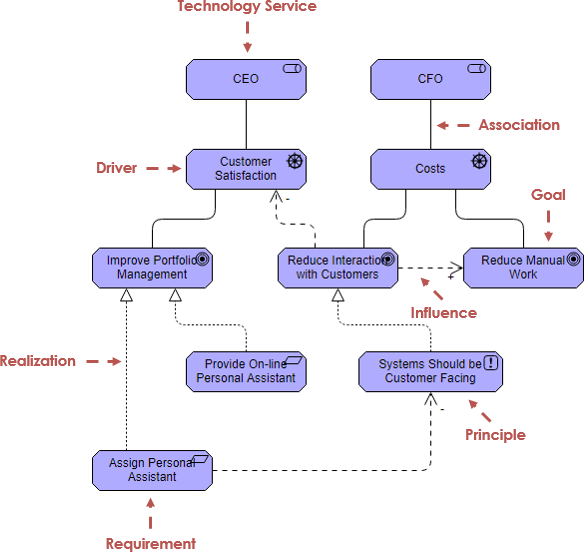
These drivers were associated with the stakeholders through ArchiMate association relationships. Customer Satisfaction influenced the CEO’s strategic vision, while Costs directly impacted financial performance.
No formal assessments (e.g., SWOT analysis) were explicitly modeled in the initial phase, but internal reviews highlighted weaknesses in manual processes and opportunities in AI technologies.
Goals and Influences
The primary Goal was to Reduce Manual Work, addressing both drivers by lowering costs and freeing staff to focus on high-value tasks, indirectly boosting customer satisfaction through faster response times.
Supporting elements included:
- Reduce Interaction with Customers: Modeled as positively influencing the goal (dashed influence arrow), as automating routine queries would decrease direct human involvement while maintaining service quality.
- Improve Portfolio Management: Another supporting element, realized through better tracking and self-service features in the client portal.
These relationships highlight how sub-elements contribute to the overarching goal.
Principles
To guide the architectural design, the company established the Principle: Systems Should be Customer Facing.
This normative guideline ensured that new solutions prioritized user accessibility, self-service capabilities, and intuitive interfaces. It influenced the overall approach, emphasizing digital channels over traditional support methods.
Requirements and Realization
From the goal, a key Requirement emerged: Assign Personal Assistant—the need to provide each client with a dedicated, personalized support mechanism.
This requirement was realized through two main initiatives:
- Provide Online Personal Assistant: The core realization, involving the development and deployment of an AI-powered chatbot.
- Supporting enhancements to Improve Portfolio Management, such as dashboard customizations.
The realization relationship (solid arrow) links the requirement to its implementing elements.
ArchiMate Motivation Diagram
The following diagram captures the motivation aspects of this transformation:
[Image of the provided ArchiMate diagram, depicting Technology Service at the top, with CEO and CFO as stakeholders associated with drivers Customer Satisfaction and Costs, leading to the goal Reduce Manual Work, influenced by Reduce Interaction with Customers, guided by the principle Systems Should be Customer Facing, realizing the requirement Assign Personal Assistant via Provide Online Personal Assistant and Improve Portfolio Management.]
Detailed Explanation of Relationships
- Association — Links stakeholders (CEO, CFO) to their drivers and other undirected connections.
- Influence — Shows how “Reduce Interaction with Customers” positively contributes to the goal.
- Realization — Indicates how lower-level elements (e.g., Provide Online Personal Assistant) fulfill the requirement.
- Other arrows — Represent serving, aggregation, or derived structural relationships as per ArchiMate conventions.
This Motivation viewpoint provides a clear traceability from high-level drivers to actionable requirements, aligning the architecture with strategic intentions.
Implementation and Outcomes
The project extended beyond motivation into the Application and Technology layers (not detailed here), involving integration of a third-party AI platform with the existing client portal. Rollout occurred in Q3 2024, with phased adoption across client segments.
Key outcomes:
- Quantitative: 25% decrease in manual support tickets; 18% reduction in support-related costs.
- Qualitative: Net Promoter Score (NPS) improved from 45 to 62; positive feedback on the “always-available” personal assistant.
- Strategic: Reinforced the principle of customer-facing systems, paving the way for future digital initiatives.
Lessons Learned and ArchiMate Benefits
Using ArchiMate’s Motivation extension provided several advantages:
- Traceability — Clear links from executive concerns to implemented solutions facilitated stakeholder buy-in.
- Alignment — Ensured IT investments directly supported business goals.
- Communication — Visual diagrams helped non-technical leaders understand the “why” behind the project.
- Scalability — The model serves as a foundation for extending the architecture (e.g., adding mobile access or advanced AI features).
Challenges included initial resistance to automation from support staff, mitigated through training and redeployment to complex issues.
Conclusion
This case study exemplifies how ArchiMate can model the motivational drivers behind enterprise transformations. By systematically capturing stakeholders, drivers, goals, principles, and requirements, TechServe Innovations achieved a successful digital shift that enhanced customer experience while controlling costs. For organizations embarking on similar journeys, adopting ArchiMate’s structured approach ensures that architectural changes are purposeful, aligned, and measurable. This foundation supports ongoing evolution in an increasingly digital landscape.
-
Comprehensive Tutorial: Generating ArchiMate Diagrams with AI: In-depth tutorial showing how to use Visual Paradigm’s AI diagram generator to create ArchiMate diagrams and viewpoints efficiently.
-
Introducing AI-Powered ArchiMate Viewpoints Generator in Visual Paradigm: Visual Paradigm’s latest release features an AI-driven ArchiMate viewpoints generator that automates the creation of enterprise architecture views, enhancing modeling efficiency and accuracy.
-
Full ArchiMate Viewpoints Guide (Examples Included): Complete ArchiMate Viewpoint guide, with 23 official ArchiMate example viewpoints, clear ArchiMate diagram examples and explanation, wrote by certified ArchiMate tool vendor.
-
How to Use ArchiMate to Visualize Information Flows with AI: Sep 17, 2025 · Compared to generic AI tools or simple diagram generators, Visual Paradigm ’s AI -powered modeling software stands out because: It understands ArchiMate -specific concepts, including information flows, viewpoints, and business-technology alignment
-
Using Viewpoints to Support Managerial Decision-Making: A comprehensive guide on how selecting appropriate viewpoints enhances strategic decision-making in enterprise architecture.
-
ArchiMate Strategy Viewpoint Guide: The strategy viewpoint allows the business architect to model a high-level, strategic overview of the strategies (courses of action) of the enterprise, the …
-
ArchiMate Motivation Viewpoint Guide: The motivation viewpoint allows the designer or analyst to model the motivation aspect, without focusing on certain elements within this aspect. For example, …
-
ArchiMate Capability Map Viewpoint Guide: The capability map viewpoint allows the business architect to create a structured overview of the capabilities of the enterprise. A capability map typically …
-
Mapping TOGAF ADM Phases to the ArchiMate … – Cybermedian: Visual Paradigm Enterprise Edition is a certified ArchiMate 3.1 enterprise architecture tool that supports all ArchiMate 3 vocabulary, notation, syntax, and semantics. It includes a powerful ArchiMate drawing tool, viewpoint management tool, and TOGAF Guide-through Process.
-
AI-Powered ArchiMate Viewpoint Generation for Enterprise Architects: Discover how AI enables enterprise architects to generate ArchiMate viewpoints in seconds, accelerating enterprise architecture modeling.

 English
 Arabic
 Chinese (Simplified)
 Dutch
Dutch French
 German
 Italian
 Japanese
 Korean
 Portuguese
 Russian
 Spanish